
Having campaigned on latter-day isolationism, U.S. President Donald Trump’s assertive conduct of foreign affairs has surprised those Americans that it has not alarmed.
Wasn’t this the candidate who attacked George W. Bush for involving the U.S. in conflicts whose outcome didn’t directly affect Americans? Who urged that America stay out of other people’s troubles, Syria in particular, because there was nothing in it for the U.S.? Whose campaign manager Steve Bannon sneeringly called his critics “globalists?”
Yes, yes and yes.
So, when Syrian President Bashar al Assad visited another dreadful atrocity upon his luckless people, slaughtering dozens with a long-banned chemical weapon, Trump supporters might still have bet on a none-of-our-business response from the new president.
But they would have lost.
And now some are not happy.
Ann Coulter spoke for many when she wrote “Trump’s Syrian misadventure is immoral, violates every promise he ran on and could sink his presidency.”
It probably won’t, but Laura Ingraham, a reliable Trump-whisperer on Fox News throughout the election campaign, also questioned his commitment to America First: “Voters did not pack his rallies to oust Assad.”
Overseas, populist fellow travelers Nigel Farage and Marine Le Pen also expressed their disappointment: “Where will it end?” tweeted Farage.
Where indeed. On the road to Damascus, perhaps?
Taken together, Trump’s Syria attack and subsequent call for regime change there, the use of a ten-ton “Mother of all Bombs” against Al Qaeda in Afghanistan, and the (eventual) deployment of the USS Carl Vinson battle group to the waters off Korea, it seems a startling repudiation of Trump’s campaign trail foreign-policy tweets, and his inaugural address.
So has Trump been “swamped”?
Not at all.
First, it would be easy to overestimate the right-wing pushback. Any suggestion Trump betrayed his supporters will certainly be over-reported by a hostile media. Take all that with a grain of salt. And Ann Coulter, and those who sail with her, aren’t going over to the Democrats.
Second, the American voter is quick to forgive anything that looks like it went well. The lofty principle of non-interventionism fades in the cruise missiles’ red glare, as long as the missiles hit what they’re pointed at and kill only bad people. So, no surprise: After the Syria attack, Trump’s approval rating jumped six points.
Above all, the facts just don’t support the accusations.
It is a much lower level of military engagement to launch cruise missiles from a warship off the coast of Syria than to put a division on the ground. (And a more determined interventionist would have knocked out all Syria’s airfields, not just the one linked to Assad’s sarin attack.)
Similarly, the MOAB bomb did not represent a fundamental escalation of an existing conflict. Its utility was in portraying Trump’s willingness to use tremendous non-nuclear force – and to warn North Korea that burying nuclear facilities doesn’t necessarily protect them.
Meanwhile, naval power is a famously economical way to project influence.
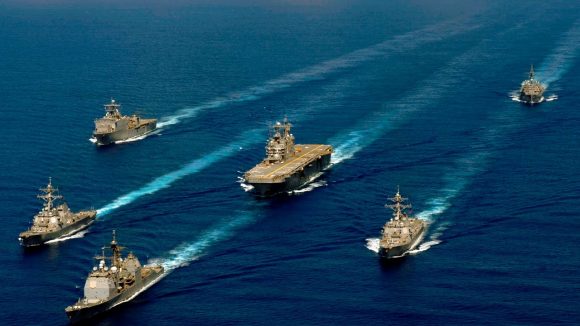
And that – influence – is what this is all about. It is about the psychology of international relations: If you want peace, prepare for war.
Put another way, when the answer to the question ‘what are you going to do about it?’ is clearly known in advance, the bully seldom asks it.
War preparation requires two things – credible military strength, and a clear articulation of purpose.
It would be an intriguing exercise in alternative history to contemplate how things would have gone in Europe if the British and French had sent Hitler an uncompromising ultimatum when he breached the Treaty of Versailles by remilitarizing the Rhineland in 1936.
They had credible military strength: France’s million-man army far outnumbered the 300,000-strong Wehrmacht.
However, neither Great Britain nor France projected clear purpose. Confronted by Nazi aggression, they found excuses to do nothing. Meanwhile American isolationists stood nobly above sordid European affairs.
This projection of weakness encouraged the Axis powers and led directly to the Second World War.
It is also a sad reflection upon human nature perhaps, but the bitter fruit of decency, peaceable intentions and goodwill is a presidency such as Jimmy Carter’s.
During his four years in the White House, the benevolent and pacific Carter oversaw the Russian incursion into Afghanistan, the collapse of America’s crucial middle eastern ally, the Shah of Iran, and the taking of American hostages in their embassy in Tehran.
Likewise, Barack Obama’s ‘humility’ led to the overall weakening of American influence – notably in the Middle East and eastern Europe – the erosion of key alliances and the shame of Benghazi. It was an atrocious record: Even Obama’s friends concede America lost influence on his watch.
Compare these pacifist presidents with Ronald Reagan.
Entering the presidency with a depleted American military reputation, Reagan knew that only strength and the clear perception of it would give him the edge he needed to negotiate with the USSR – hence the massive American military buildup during his presidency, the 600-ship navy, the refreshing of the U.S. nuclear deterrent in Europe, and in particular, the Strategic Defense Initiative.
Thus was born Reagan’s reputation as a super-hawk.
The truth however, is that in eight years, Reagan only deployed America’s massive strength three times: In Grenada, Libya and in Lebanon – and Lebanon was a failure. But somehow, because of the renaissance of the U.S. military, it was still enough. Reagan’s peace-through-strength policy prepared the way for the dissolution of the USSR and America’s brief hegemony as the world’s only superpower.
In this matter, Trump thus far seems to conform to the Reagan template – almost too much for some people. Americans who distrust Trump fear not only that Hillary Clinton was right when she called him temperamentally unsuited to be commander-in-chief: They believe he is beyond happy to prepare for war, and may in fact be eager to pursue it. And they look with dismay on his ostentatious rejection of “Obama’s micromanagement” and his consequent delegation of operational authority to the Joint Chiefs of Staff.
They shouldn’t. If Trump is not a military professional, people like Defence Secretary Jim Mattis and National Security Advisor H.R. McMaster manifestly are.
If you’re a pessimist, Iran, Syria and North Korea could feel like George W. Bush all over again.
But Trump is no neocon on a mission to export freedom and democracy. What he promised was jobs and a strong America. Nothing he has done around the world so far is inconsistent with that. But, neither has anything Trump said excluded any future U.S. intervention.
Success depends upon the world believing America has the strength to counter threats to peace and the will to use it.
Faced as we are with the instability that is the legacy of Obama’s failed soft-power projections of weakness, and the risk that the “crazy fat kid” in Pyongyang will soon develop nuclear-tipped missiles that can fly and is nutty enough to launch them, it’s worth a try.