Everyday Life

Canada’s Other Productivity Crisis: The Daily Irritants That Slow Us Down and Sap Our Spirit

Peter Shawn Taylor
June 2, 2026
Multi-factor verification. Customer surveys. SMS alerts. Endless online check-ins. Technology was supposed to free up our time for better things. Instead, it has created endless obstacles to getting anything done. Plus there’s the constant impact of government regulations and questionable safety measures that further rob us of our valuable time. Peter Shawn Taylor looks at the absurd and annoying ways that 21st-century life ties us up and grinds us down. While some examples seem faintly comical, taken together they comprise what Taylor argues is a micro-productivity crisis of national proportions that is no laughing matter.
Everyday Life

Canada’s Other Productivity Crisis: The Daily Irritants That Slow Us Down and Sap Our Spirit

Peter Shawn Taylor
June 2, 2026
Multi-factor verification. Customer surveys. SMS alerts. Endless online check-ins. Technology was supposed to free up our time for better things. Instead, it has created endless obstacles to getting anything done. Plus there’s the constant impact of government regulations and questionable safety measures that further rob us of our valuable time. Peter Shawn Taylor looks at the absurd and annoying ways that 21st-century life ties us up and grinds us down. While some examples seem faintly comical, taken together they comprise what Taylor argues is a micro-productivity crisis of national proportions that is no laughing matter.
Share on Facebook
Share on Twitter

If you’ve been paying even the barest attention to Canada’s economy over the last several years, you’ll know plenty about the country’s productivity crisis. The Bank of Canada got the ball rolling in early 2024 with a speech by deputy governor Carolyn Rogers in Halifax. “I want to talk about Canada’s long-standing, poor record on productivity and show you just how big the problem is,” Rogers said. “You’ve seen those signs that say, ‘In emergency, break glass.’ Well, it’s time to break the glass.”

Since then, much glass has been broken. Canada’s Big Six banks, including TD and Scotiabank, have released major reports on the country’s poor productivity. The C.D. Howe Institute produced a six-point plan to raise national productivity. The University of Calgary’s School of Public Policy organized a series of conferences titled “Canada’s Productivity Initiative”. And Prime Minister Mark Carney’s 2025 mandate letter to his new Cabinet stressed that, “Our long-standing weak productivity is making life less affordable for Canadian families, straining government finances, and threatening the sustainability of vital social programs.” C2C has covered the issue closely as well.

Perhaps the ultimate indicator of the situation’s seriousness came from the resolutely left-wing and habitually incorrect Canadian Centre for Policy Alternatives, which last year dismissed the “panic” over productivity as mere capitalist hogwash.

A “break the glass” emergency: While economists fret about Canada’s national productivity crisis, a sneakier micro-productivity crisis is quietly getting in the way of Canadians’ ability to get things done, the author argues. At left, the famously congested bridges of New Westminster, B.C. At right, Bank of Canada deputy governor Carolyn Rogers warns about Canada’s fading productivity, Halifax, March 2024.
xA “break the glass” emergency: While economists fret about Canada’s national productivity crisis, a sneakier micro-productivity crisis is quietly getting in the way of Canadians’ ability to get things done, the author argues. At left, the famously congested bridges of New Westminster, B.C. At right, Bank of Canada deputy governor Carolyn Rogers warns about Canada’s fading productivity, Halifax, March 2024. (Sources of photos: (left) AlbertArt/Shutterstock; (right) YouTube/cpac)

With such a flood of insights covering the country’s overall lack of competitive fire, sagging labour efficiency and inability to complete major projects, this story does not try to add to the concerns over macro-productivity. Rather, this story is about Canada’s other productivity crisis: the many small and apparently insignificant ways in which the 21st century is sapping our ability to get things done at a personal rather than national level. These are the obstacles facing Canadians who simply want to pay their bills, get to appointments on time, tend to their lawn and enjoy their fleeting leisure time without endless and unnecessary distractions and irritants.

Canada has a micro-productivity crisis. And it’s as much a “break the glass” emergency as its bigger brother.

Two-step Verification

You want to pay a bill. Or book a flight. Or check your loyalty points. But inputting your username and password is no longer enough. Now you need a six-digit verification code. And like a hapless bystander forced to foil some mad bomber, you have mere seconds to complete the task.

Two-step verification is perhaps the most pervasive example of Canada’s micro-productivity crisis. While online bill payment initially promised to be quicker and easier than its earlier postal version, the process has become ever-slower and more complicated. Since the verification code is generally sent to a different device than the one you’re using, it relentlessly robs you of a minute here, a minute there and turns what ought to be a simple task into a multi-step, multi-device ordeal. If you have your phone on you, great. But what if you left it upstairs? Better take those stairs two at a time!

Tick, tick, tick: Among the most annoying examples of the Canada productivity drag are ubiquitous two-step verification requirements and CAPTCHA tests, digital obstacles that rob users of their most precious resource – time.
xTick, tick, tick: Among the most annoying examples of Canada’s micro-productivity crisis are ubiquitous two-step verification requirements and CAPTCHA tests, digital obstacles that rob users of their most precious resource – time. (Source of left photo: Shutterstock)

Many online services will still remain unconvinced you’re not a bot, requiring a CAPTCHA to prove you’re human. Retyping wavy letters or identifying every square with a bicycle doubles your time wasted. Banks in particular seem to assign zero value to their customers’ time since they waste it so shamelessly – forcing online users to click through a forest of offers for lines of credit, insurance or new types of accounts before they reluctantly let them see their own bank balance. And pray you never lose your phone, which would render the two-step impossible.

The authentication issue is particularly acute when dealing with linked accounts. My wife and I have a joint bank account and credit card, but she’s the primary account-holder. Whenever I want to check our bank balance or look at the credit card bill, I need to verify her identity. If she’s busy, it can’t be done. Access denied. Many other couples have the same problem. A friend tells me she solved this issue by waiting until she and her husband are both in bed and can thus easily verify each other’s identities by phone. Surely there are more productive things couples can be doing between the sheets than paying bills.

Digital inferno: The Canada Revenue Agency now forces taxpayers to complete a Bingo-like matrix of secret three-letter combinations to confirm their identity — an ordeal as tedious as a never-ending customer satisfaction survey.
xDigital inferno: The Canada Revenue Agency now forces taxpayers to complete a Bingo-like matrix of secret three-letter combinations to confirm their identity.

True, there are good reasons to embrace online security. Getting hacked can be terrifying and is no doubt another big waste of time. But there are easier ways to skin this online cat. Authenticator apps or physical keys improve efficiency, but Canada’s banks and other financial institutions refuse to implement them.

And two-step verification may only be the first circle in a long descent into digital Inferno. Once multi-factor authentication takes over, the two-step will go back to being a dance for country hoofers. The Canada Revenue Agency (CRA), for example, recently insisted that I download a “multi-factor authentication passcode grid”. This consists of a matrix of three-letter combinations spread across five columns and rows. Now when the CRA wants to confirm who I am, I must provide the secret letter combos from A3, D4, B2, etc. I almost yell “BINGO!” when my identity’s confirmed. The chart is among my most precious possessions. The CRA tells me I cannot even email it to myself for fear it’ll fall into the wrong hands.

At the risk of carbon-dating myself, I am now convinced that bill-paying was actually quicker and easier in the postal era. You sat down once a month with a chequebook and a roll of stamps and paid every bill in one sitting, without a worry of being hacked. And you already had a hard copy of the bill plus an addressed envelope because the service provider sent them to you for free.

Customer Surveys

Everyone likes to be helpful. And when your favourite store or a particularly efficient restaurant server asks you to fill out a short online survey – It would be so helpful, and I can win a prize at the end of the month! – many of us are inclined to say yes, at least some of the time. Besides, it’ll only take five minutes. Ten minutes later you’re still calculating your annual income and deciding on a suitable gender.

Canada’s macro-productivity crisis has been well-documented by the Bank of Canada, think-tanks and financial institutions. It refers in broad terms to the inability to increase the average output per Canadian worker over the past decade, which has had many negative effects and opened a growing gap in per capita income between Canada and the U.S. But Canada’s productivity problem extends well beyond corporate investment and labour statistics. There’s a parallel, personal-level crisis comprised of the many accumulated losses of time throughout daily life. Among these obstacles to getting things done are mandatory two-step verification procedures, government-mandated alerts and traffic calming measures. Because these micro-losses are individually small and dispersed, they escape serious analysis.

The questions themselves are often pointless or impossible to answer. “Did your experience exceed expectations?” requires knowing your baseline expectations. While it may have been a truly wonderful experience, if you were expecting wonderful, then the correct answer is a seemingly disappointing “No.” As for, “How likely are you to recommend us to a friend?” if you’re not the sort of person who makes recommendations, a truthful “Not likely” is equally accurate and meaningless, though it will be taken as negative.

A survey might be justifiable for a particularly complex or unusual transaction – getting an elephant to Iqaluit, for example. Then, expectations truly matter. But Canadian Tire kicks out a survey request for every banal purchase of furnace filters or gardening gloves. Meanwhile, online retailers like Amazon pester you about the “delivery experience” – that is, opening the front door to find an envelope on your doorstep – sometimes before the package even arrives. And declining the survey means there’s still the wasted time of yet another incoming e-mail or text that needs to be noticed, checked and sent to oblivion. (More on that later.)

Repeat after me, “I am exceeding your expectations”: Lengthy, intrusive and often meaningless customer satisfaction surveys have turned into a time-wasting ritual. To improve their effectiveness, marketing expert Utpal Dholakia (right) urges organizations to limit their surveys to seven questions – and pay customers for sharing their opinions.
xRepeat after me, “I am exceeding your expectations”: Lengthy, intrusive and often meaningless customer satisfaction surveys have turned into a time-wasting ritual. To improve their effectiveness, marketing expert Utpal Dholakia (right) urges organizations to limit their surveys to seven questions – and pay customers for sharing their opinions. (Source of left photo: Shutterstock)

Survey responses are further burdened by the weight many firms – often car dealerships and other service-oriented businesses – place on the results. Even a few low scores can have serious career consequences for sales staff. In an odd twist on grade inflation, many companies now consider anything short of perfection to be a sign of failure. As a result, staff will pressure customers to claim they experienced excellence every single time. Many survey takers comply out of a sense of obligation or sympathy. Mediocre service thus becomes brilliant just to keep everyone happy.

Utpal Dholakia, George R. Brown Chair of Marketing at Rice University in Houston, Texas and an expert on customer satisfaction, observes that the response rates for online surveys have been falling for years. And the results from those who do fill them out are almost always useless for the reasons listed above, especially length. The ideal number of questions for an online survey, Dholakia says, is seven. And he recommends that organizations directly compensate customers for their time. “In most cases, a seven-question survey will merit $5 to $10 in cash or gift cards,” he wrote in the Wall Street Journal. “Offering reasonable compensation to respondents is the single best way to improve the quality of survey data.” Cash sounds good to me.

Online Alerts

Is that a klaxon in your pocket? While they may be useful in some situations, government-mandated warning systems such as Amber Alerts have turned mobile phones into portable screaming devices that interrupt everything from dinner to a customer satisfaction survey, going off at any time and impossible to easily silence.
xIs that a klaxon in your pocket? While they may be useful in some situations, government-mandated warning systems such as Amber Alerts have turned mobile phones into portable screaming devices that can go off at any time and cannot be easily silenced. (Source of photo: The Canadian Press/Lars Hagberg)

“Seat selection is now available.” “Check-in has opened.” “Your bags are ready for loading.” If you’ve got a flight to catch, your airline is intent on having a constant conversation. But like a chatty seatmate, it soon gets too much. The constant barrage of information is distracting from all the other tasks at hand in an airport. And every announcement comes with a shrill demand from your phone to take a look – now! Sure, you can turn off notifications, but sometimes it will be important information like a gate or time change. In reality, you’ve got no option but to pay attention. If only airlines acted this clingy when you need to get in touch over a delayed flight or lost luggage.

The same goes for Amber Alerts and other government-mandated social media warnings. Unlike Americans, Canadians cannot entirely turn off these pocket klaxons. And their scream-level intrusions can appear at any hour of the day, regardless of your location or other priorities you’re attending to. Like the neighbour’s dog, they refuse to be ignored. Similar to two-step verification, there may be a good idea at the core of this concept, but in execution it has become an irritant and great waster of time. Some jurisdictions even require that alerts be sent to the entire province or territory – needlessly interrupting a vast swath of the population within 1,000 km of the alleged incident.

At a conference in Ottawa last month, numerous phones in the crowd, mine included, went off with an Amber Alert in the middle of a presentation, creating a wave of embarrassment and throwing the speakers off their game. But no one could quite muster the nerve to complain about it, since there must have been a child in danger somewhere to justify the intrusion. In fact, it was just a test. A test of how frustrating Amber Alerts can be. The government now has the ability to seize your attention whenever if feels the need and for whatever purpose it decides.

Safety Devices

I recently had to throw out a perfectly good lawn mower. It still cut my grass to the desired height. The only thing wrong was a broken shut-off device that requires the user keep a lever depressed while mowing. These dead-man switches, mandated by federal law in Canada, serve the admittedly useful purpose of ensuring that lawn mowers, power tools and motorized recreational conveyances like jet-skis can’t keep going after the user lets go, causing a potential accident. You might consider it two-step verification for the physical world.

Safety first, Canada productivity never? A federally mandated lawn mower safety or “dead man” switch – useful in theory but cheaply made and impossible to replace when it breaks – forced the author to spend $500 on a new mower after the tiny component broke.
xSafety first, productivity never? A federally mandated lawn mower safety or “dead man” switch – useful in theory but cheaply made and impossible to replace when it breaks – forced the author to spend $500 on a new mower after the tiny component broke. (Source of photo: Shutterstock)

The problem is that no one ever buys a lawn mower because it’s got a great safety switch. Unlike battery capacity or blade width, it’s not a feature of interest. So manufacturers have no motivation to make the switch durable or replaceable. It’s simply another government-mandated cost of doing business, like bilingual packaging and warning labels. This cost stays hidden until it breaks.

I removed the broken switch from my old lawn mower and found that if I squeezed a little internal button with one hand, I could mow the lawn with my other. It was a “depressing” experience in every sense of the word. Given the impracticality of mowing with one hand, I eventually had to buy another lawn mower. Spending $500 to replace a perfectly usable tool is clearly a wasteful diversion of my productivity.

Beyond lawn care, a preponderance of government-imposed safety features of dubious effectiveness threatens the productivity of all Canadians. An argument can always be made that an additional device or procedure might ameliorate some small risk. But at what cost? And to whose benefit? Noisy lobby group Mothers Against Drunk Driving’s current campaign to force car manufacturers to include a Breathalyzer-type mechanism in all new cars is an obvious example, as it would add thousands of dollars to the already-high prices of new cars. And what happens when they break?

According to Utpal Dholakia, George R. Brown Chair of Marketing at Rice University and an expert on customer satisfaction, response rates for online surveys have been falling for years, and the data they collect is mostly useless. The ideal customer satisfaction survey runs to just seven questions, Dholakia says. Yet most companies send out lengthy questionnaires packed with unanswerable or meaningless questions. Meanwhile, organizations demand perfect scores from their staff, which pressures them to cajole customers into giving top marks regardless of the actual experience. Dholakia urges companies to compensate respondents with $5 to $10 in cash or gift cards, increasing the chances they’ll provide useful data.

Phantom Construction Zones

You’re making good time until a flashing sign warns “Construction Zone Ahead”. The zone itself is nowhere in sight, yet still the speed limit drops and your highway lane starts to disappear; you reduce your speed to 80 km per hour, then 60, then 40 or 30, until you’re barely crawling, all before glimpsing the first piece of equipment.

At the end of this slow-moving funnel, you discover there’s no “there” there. Construction is finished. Or hasn’t started. Or it’s an off day for the paving crew. But the signs are there all the same, and with them the resulting inconvenience.

Phantom construction zones not only cause needless congestion, they imperil future road projects by encouraging offsetting behaviour. Once drivers get wise to these fake-outs, some will assume every warning is phony. Or they’ll skeptically wait until the last moment before hitting the brakes, increasing the potential risk if there actually is ongoing construction.
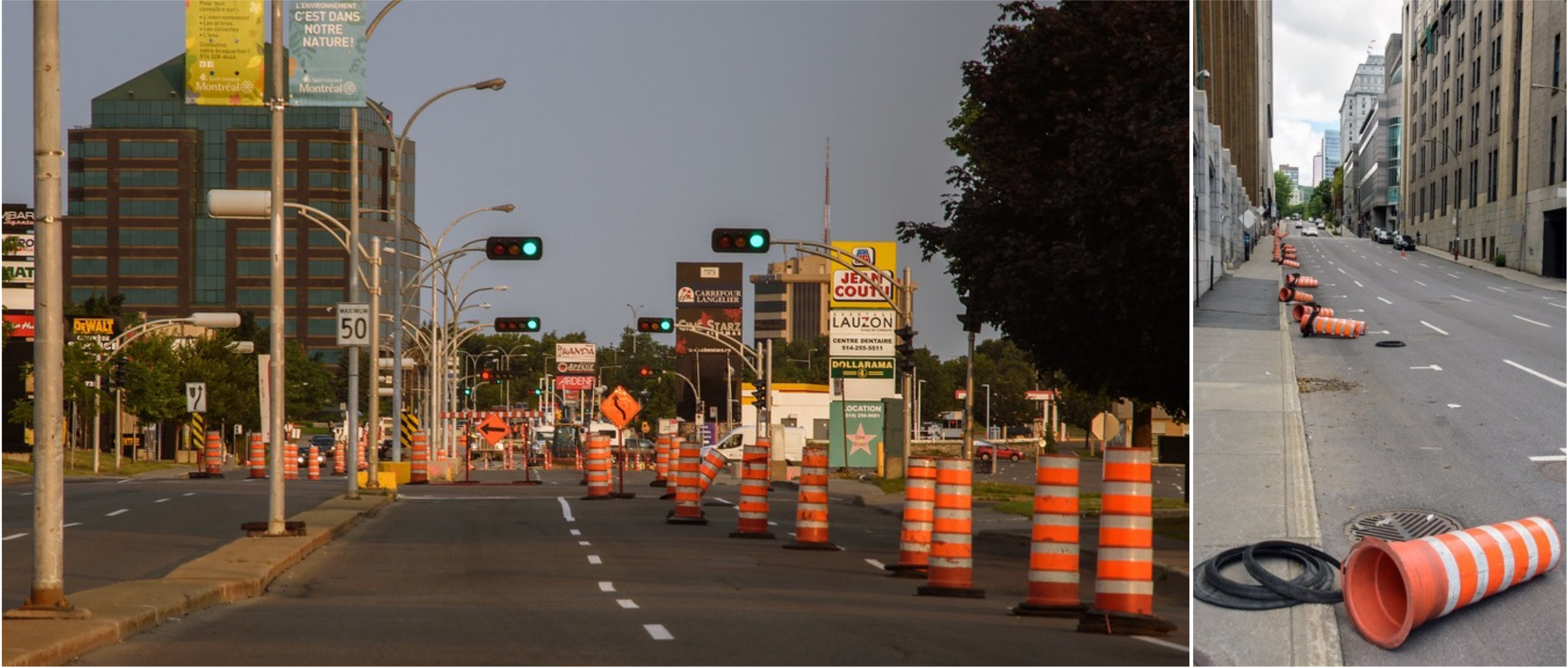
Old enough to drive: Orange traffic markers, ostensibly a traffic calming and safety tool, are meant to alert drivers to temporary disruptions like potholes, water leaks or road works. But they’ve become near-permanent features in many cities, frustrating millions of drivers across Canada. According to La Presse newspaper, one set of cones sat beside a Montreal roadway for 16 years.
xOld enough to drive: Orange traffic markers are meant to alert drivers to temporary disruptions like potholes, water leaks or road works. But they’ve become near-permanent features in many cities, frustrating millions of drivers across Canada. According to La Presse newspaper, one set of cones sat beside a Montreal roadway for 16 years. (Source of photos: caribb, licensed under CC BY-NC-ND 2.0)

This issue is famously acute in Montreal, where orange traffic cones are so plentiful they’re considered an unofficial civic emblem. In 2023 the local chamber of commerce and tourism bureau teamed up to formally estimate the markers’ pervasiveness. In their study of 15 downtown blocks, they discovered over 500 cones, of which nearly one-quarter were serving no purpose other than to needlessly obstruct drivers. That same year, La Presse newspaper reported on a row of orange cones that had been sitting beside a road tunnel since 2007. They were now 16 years old – old enough to drive.

It will come as little surprise that Montreal has the worst traffic in Canada. The latest traffic cone report found that while the city had 40 percent fewer road construction sites than the year previous, the number of traffic cones deployed had actually increased. According to analytics firm INRIX, Montreal drivers each lost an estimated 63 hours sitting in traffic in 2025. If there’s room for optimism, it’s that all the media attention appears to have smartened up local officials in charge of road construction. The share of abandoned and unproductive cones fell from 22 percent in 2023 to a mere five percent in 2025.

Congestion as Policy

In the name of the global Vision Zero project or other efforts to make our streets “safer”, many Canadian cities have adopted policies that seek to make their roads less efficient. Among the most obvious of these efforts are “traffic calming” devices like speed bumps, road constrictions and in-road obstacles. One of the newest of these are flexible bollards, bendy vertical hindrances placed along roadsides or even in the middle of roads meant to discomfort drivers, slow them down or micromanage their traffic decisions.

Beyond impeding traffic, all such measures have unintended consequences. They reduce the number of lanes and parking spots and so narrow roads that cars are sometimes forced to drive on the wrong side to get by. And despite the proliferation of cycling lanes, these measures sometimes reduce space for cyclists. The net effect can be to make roads less safe. And they rob all drivers of time, from the deliveryman to mom rushing a kid to the dentist. It is a micro-productivity crisis organized and implemented by local government.
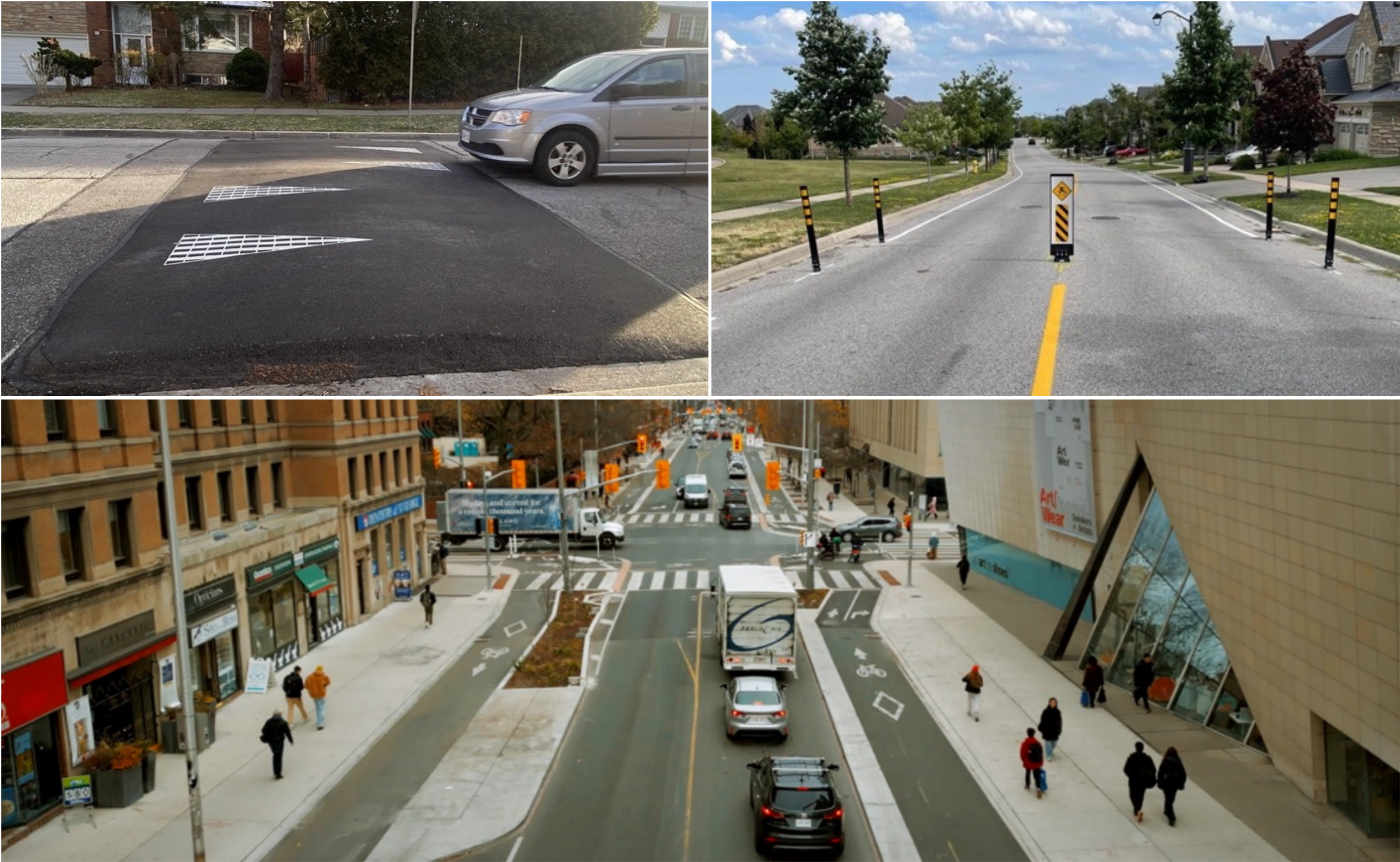
Time bandits: Canadian cities increasingly use “traffic calming” measures such as speed bumps (top left) and flexible bollards (top right) to force drivers to drive slower than originally intended. Toronto’s redesigned Bloor Street (bottom) illustrates the result – longer travel times and 30 percent less traffic capacity.
xTime bandits: Canadian cities increasingly use “traffic calming” measures such as speed bumps (top left) and flexible bollards (top right) to force drivers to drive slower than originally intended. Toronto’s redesigned Bloor Street (bottom) illustrates the result – longer travel times and 30 percent less traffic capacity. (Sources of photos: (top left) toronto.ca; (top right) vaughan.ca; (bottom) toronto.ca)

As part of its “Complete Streets” campaign, for example, Toronto incorporated many traffic-calming and road-obstructing devices in its recent renovation of a 4.7 km stretch of Bloor Street West, a main city artery. This included separated bike lanes, bollards and changes to signals at various intersections, as well as the removal of two car lanes. The goal was to increase cycling and pedestrian traffic by making cars move slower. Mission accomplished.

According to a city review released in 2024, average car speeds on Bloor fell by as much as 30 percent. “When comparing the before-installation period…with interim conditions one year later,” the report states, “average increases in motor vehicle times range from 2.4-4.4 minutes eastbound and 1.5-3.6 minutes westbound.” Daily two-way traffic on the road averaged around 20,000 vehicles before the construction and has “remained relatively consistent” afterwards, according to the report, suggesting that drivers taking this route to work have no better option and are thus absorbing the lost productivity. Cycling advocates have hailed these results as a great victory.

Plot Repetition

When you sit down at the end of the day to watch a show on Netflix or another streaming service, you want that time to be as worthwhile as the rest of your day. Your leisure time deserves productive completion just as much as workaday issues; perhaps more so, since it’s scarcer. So why must we now spend so much time listening to what we already know?

Netflix has come to realize that many of its subscribers watch its shows on their mobile devices while simultaneously doing something else. Emptying the dishwasher or mowing the lawn, perhaps? Hopefully not driving. Since these inattentive half-watchers get frustrated when they can’t follow the plot, Netflix’s solution has been to denude its stories of novelty while endlessly repeating what little is actually taking place. If watching your kid at the playground takes you away from the narrative, the narrative will come to you.

Actor Matt Damon pointed to this phenomenon during a recent appearance on the Joe Rogan Experience podcast. Promoting his latest Netflix action flick The Rip, Damon acknowledged the role played by “second-screen” watchers in the creative process. “The kids are running around. The dogs are running around. Whatever it is. It is just a very different level of attention that you’re willing…to give to it,” Damon observed of movie-watching today. As a result, he said, Netflix now tells its screenwriters, “It wouldn’t be terrible if you reiterated the plot three or four times in the dialogue.”

We heard you the first time: Like being reminded of a plastic bag ban at every checkout, Netflix now – according to actor Matt Damon – instructs screenwriters to repeat a movie’s plot several times to cater to inattentive viewers, forcing real fans to sit through needless repetition. Shown, Damon (at right) and Ben Affleck (at left) in Netflix’s The RipWe heard you the first time: According to actor Matt Damon, Netflix now instructs screenwriters to repeat a movie’s plot several times to cater to inattentive viewers, forcing real fans to sit through needless repetition. Shown, Damon (at right) and Ben Affleck (at left) in Netflix’s The Rip. (Source of still: Claire Folger/Claire Folger/Netflix)

The Rip is a case in point. Featuring Damon and Ben Affleck as two heretofore honest Florida cops tempted by a mountain of newly-seized drug money – aka, the “rip” – Netflix has them experience a prolonged and very repetitive crisis of conscience. “You want to steal this rip?” Affleck asks early on. Later, Demon inquires, “You think I want to steal this rip?” A third time for emphasis, Damon again muses, “It would be so much easier if we just stole this money.” Got it? They’re thinking about stealing the rip.

Stranger Things, a Netflix series that recently concluded its fifth season, is similarly notorious for its repetitive nature. Each episode contains numerous and excruciating scenes in which all the assembled characters stand in a circle and repeat to each other exactly what they intend to do and why. This isn’t entertainment, it’s memory work.

Grocery Store Bags

You pass by the grocery store and remember something you need. Just one thing. A shopping cart is obviously overkill, but as you move through the store, other items call out. You need me too! So you pluck them from the shelves like ripened fruit from a vine. Soon both hands are full and your armpits are doing double-duty as clamps with an item under each. There are still a few more things you could use, but you’re not sure about the grip strength of each individual finger as you add to your perilously perched cache. If you can just make it to the check-out counter…

But the check-out brings no relief, as you’ve forgotten your reusable bags. You certainly aren’t paying for another, given the infestation currently clogging your cupboards, car and garage. Canadian comedienne Julie Nolke has an amusing sketch in which she ponders burning or burying her excess bags like an inconvenient corpse.

So you forgo a bag. The situation is likely to end in one of two ways. Either you juggle and pinch your way from the checkout to your car and drop something breakable on the way. Or you buy less than you really need, requiring yet another impromptu shopping trip tomorrow. Both outcomes are productivity-inhibiting.

Juggling act: With free shopping bags a thing of the past under the plastic bag ban, spontaneous grocery stops have become more awkward.
xJuggling act: With free shopping bags a thing of the past, spontaneous grocery stops have become more awkward.

Grocery stores once begged you to take their free bags. They’d even snuggle your meat in its own separate bag – because they knew that convenience and attention to detail were good for business. Bone-headed federal regulations on plastic products have put an end to all that.

The Rest of the List

This was only a small glimpse at the impediments – government-imposed or otherwise – to Canadians’ personal productivity. Space constraints have prevented a more fulsome discussion of the many other roadblocks to getting things done at work or home. These include:

  • Office meetings in all forms;
  • Social media posts;
  • Online games;
  • Carbon-copy emails;
  • Unsubscribe buttons that don’t;
  • Internet searches that list deceptive hotel booking service websites at the top, rather than the website of the hotel you are actually looking for;
  • Chat-bots that claim to be answering your question but don’t have a clue what you’re really asking;
  • One-size-fits-all products;
  • Anything made of cardboard;
  • Poorly translated instructions;
  • Instructions written in every conceivable language in font so tiny it’s indistinguishable from a solid line;
  • Instructions that dispense with words altogether in favour of incomprehensible pictograms with arrows pointing in all directions;
  • Constantly changing charger formats and the multiplicity of cords they require;
  • Pill-bottle lids;
  • Wooden forks that suck the flavour out of your food like some ghastly pronged sponge;
  • Doctor’s offices that only respond to phone calls but never answer the phone;
  • Impossible-to-open plastic ties used by Costco for bread and bagel bags;
  • Pesticide regulations that leave gardeners with nothing but over-priced vinegar to fight weeds;
  • Bug spray that no longer repels bugs; and
  • On and on and on.
Among the many other time-sucking habits and items plaguing 21<sup>st</sup>-century life: Meetings of all kinds, flimsy wooden cutlery, bread-bag closures, constantly changing charger cords, useless chatbots and the perpetual traffic jams worsened by aggressive traffic calming.
xAmong the many other time-sucking habits and items plaguing 21st-century life: Meetings of all kinds, flimsy wooden cutlery, bread-bag closures, constantly changing charger cords, useless chatbots and perpetual traffic jams. (Sources of photos: (top left) markhillary, licensed under CC BY 2.0; (middle left) Unsplash; (bottom left) Shutterstock)

Micro-Productivity is Real Productivity

“Lost time is never found again,” Benjamin Franklin wrote in Poor Richard’s Almanack. While many of the micro-productivity issues discussed above have been treated in a light-hearted or jocular tone, the problem itself is no laughing matter. Whether through extravagant safety measures, misplaced priorities or contempt for Canadians’ personal time, the 21st century has increasingly come to allocate zero value to individual time costs.


The attention paid to Canada’s macro-productivity crisis arises from the staggering cost of economic inefficiency on a national scale. Yet much the same thing is afflicting the personal level. Time is not valueless. And once lost it can never be regained. But Canadians are treated as passive recipients of whatever poor level of service companies, organizations or governments deign to provide.

Consider again Toronto’s Vision Zero changes to Bloor St. West and those 20,000 drivers who use it going either way daily. The renovations increased the average two-way drive by 5.9 minutes per workday. This adds up to a shocking 24.5 hours per commuter per year. Across the entire cohort, it’s a cumulative 28 years of lost time. For just one small portion of one road.

Even if this informal calculation is an overestimate, the cumulative effect is unambiguously large. Small daily inconveniences spread across large populations quickly rise to mammoth, economy-shaking heights. What would you do with an extra day every year? Presumably something more productive than sitting in your car watching an empty bike lane crawl by.

Traffic calming measures – including flexible bollards, road constrictions and speed bumps – are designed to slow vehicles, and the resulting time costs are measurable. Toronto’s renovation of Bloor Street West in 2024 increased two-way average vehicle travel times by nearly six minutes for the roughly 20,000 daily drivers. This amounts to a loss of 25 hours per year for regular commuters. Meanwhile, Canada’s national plastic bag ban, introduced by Prime Minister Justin Trudeau’s Liberal government in June 2019, eliminated a convenience that grocery stores once provided for free, leaving shoppers either to struggle awkwardly with loose items at checkout or make additional trips. Both policies have the same flaw: governments treat the cost of the individual’s time as zero. Time, in fact, is one of Canadians’ most valuable and scarce resources.

While the costs of traffic congestion are easily recorded and analysed, the micro-productivity losses across many of the other categories detailed above generally escape proper notice and calculation. Two-step verification, for example, might only add 30 seconds to every login. But imagine how many accounts you log into in a year, and those half-minutes quickly add up to hours. Hours you’ll never get back. The same observation holds true for online alerts, the continuing lack of plastic bags and all the other items in our admittedly incomplete compendium of time wasters. Tick by tick by tick, we are losing control of our workdays and our leisure time.

It’s time to break that glass again. Canada’s micro-productivity crisis is out of control.

Peter Shawn Taylor is senior features editor of C2C Journal. He lives in Waterloo, Ontario.

Source of main image: ChatGPT.

Love C2C Journal? Here's how you can help us grow.

More for you

Too Clever by Half: Why Ottawa’s Clarity Act Helps Neither Side in Alberta’s Separation Debate

The House of Commons once had an effective law in front of it that laid out clear steps to assure that any provincial referendum on independence would be democratic and any negotiations after a “Yes” vote would be fair. But it wasn’t the current Clarity Act – it was a bill put forward by the Opposition Reform Party in 1996, and the Liberal government chose to ignore it. Instead, it passed its own legislation designed to crush support for any subsequent secession movement. In Part II of their series on what the Clarity Act means to today’s debate over Alberta’s future, George Koch and Jim Mason delve into the Act’s origin story and explain why it’s so blatantly stacked in favour of Ottawa – and how that could inflame separatist sentiment and undermine the federalist cause.

A Mess and Minefield: Ottawa’s Clarity Act on Provincial Separation is Anything but Clear

Proponents of independence for Alberta seem to believe the federal Clarity Act provides a sure pathway to secession should they win a referendum vote. But as Jim Mason and George Koch explain, the Act is less pathway than political minefield. It demands a clear question with a clear majority vote – but offers no criteria for either. It provides no instructions on how separation negotiations should proceed, but it does allow other provinces, Indigenous groups and others to intervene. And it assigns virtually all decision-making to Ottawa. It is, Mason and Koch find in the first of this two-part series, a formula not for resolution but deadlock, virtually certain to frustrate any constitutional effort to secede. Almost like it was designed that way.

Bubble-Wrapped World: How Safety Culture Has Destroyed Our Sense of Adventure

Why were our forebears more adventurous than we are today? Was it just that they had more empty space to explore, no GPS or instant communications to keep them safe, no social welfare state to protect them? It’s all that and more, writes Murray Lytle. The derring-do of days past, he argues, sprang from a value system that admired courage and saw risk-taking as a social virtue – even a duty – that could expand knowledge and build a better world as well as protect the nation. Lytle urges our society to shake off its smothering safety culture and rediscover a sense of adventure.

More from this author

What’s Yours is Ours: Why Canada’s Charter Ignores Property Rights and What That Means for Everything You Own

“The whole meaning of life,” famed comedian George Carlin once observed, “is trying to find a place for all your stuff. That’s what your house is, it’s a place for your stuff with a cover on it.” If so, then Canadians should be very concerned about their stuff. Unlike nearly every other modern nation, Canada lacks constitutional affirmation of the right to own property and as protection against its unjust seizure. With a recent B.C. Supreme Court ruling putting the very notion of home ownership at risk, Peter Shawn Taylor seeks out legal opinions on Canada’s surprisingly lax attitude towards property rights, how it differs from other countries and what that means for everyone’s possessions. If Canadians really want to protect their homes, belongings and personal finances, Taylor concludes, now’s the time to get loud.

Cash Constrained: Bill C-2 and Ottawa’s Plan to End Paper Money

“Cash is king, credit is a slave,” George N. McLean wrote in his classic 1890 book How to do Business. More than a century later, it’s still good advice – one that active pro-cash movements in many other countries are recognizing. So why does Ottawa seem determined to put its own banknotes out of commission? In the name of fighting international money-launderers, the Mark Carney government is proposing to outlaw all larger cash transactions and interfere with other key aspects of Canada’s cash economy. Through interviews with experts in business, social policy and politics, Peter Shawn Taylor examines the varied benefits cash provides and asks who stands to gain from a truly cashless society.

Restoring Canada Special Series
Part VIII: The Trump Tariffs and Canada’s History as a Trading Nation

Prime Minister Mark Carney recently declared that, “Canada is the most European of non-European countries.” With Chile, Argentina and Australia (among many others) likely to object to such a characterization, Peter Shawn Taylor’s counterclaim that Canada is the “most U.S. of all non-U.S. countries” seems a much safer bet, given the centuries of shared history, geography, culture and trade. In this latest installment of C2C Journal’s Restoring Canada Special Series, Taylor examines the deep economic relationship between the two countries and argues that nothing can ever destroy its significance. Further, any attempt at such a thing – as currently seems popular with the “Elbows Up!” crowd – will ultimately prove disastrous. Canada’s economic future depends on trading with the Americans. Full stop.