My father was a perfect example of the adage “hope springs eternal.” Despite years of heartbreaking disappointments, each spring he would sing happily on our tractor while seeding wheat, barley and oats. Then we hoped for enough sunny days to germinate the seeds. If nature granted us that hope, I would tag along at dad’s side walking through fields of green waving in the Prairie winds. Next, we’d eagerly watch each bank of clouds hoping for rain so the grain seeds would “fill.” Childhood on our family farm taught me that farming – not high-tech, not venture capitalism, not even “wildcat” oil-well drilling – is Canada’s riskiest business.

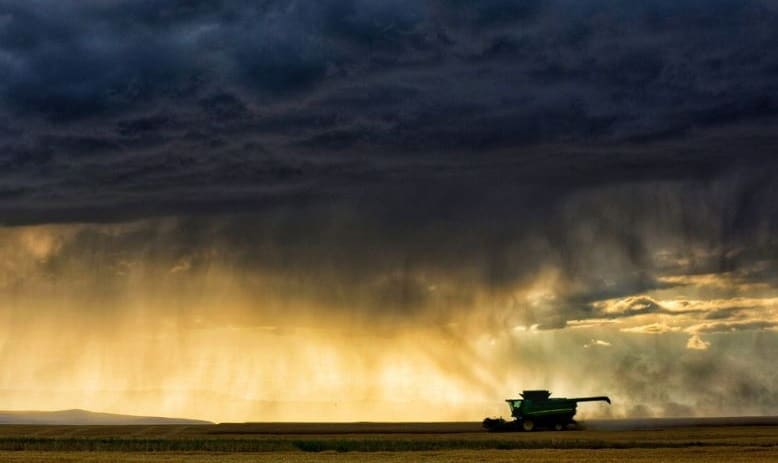
Indeed, our farm was in a “hail-belt.” Every three years or so, those clouds would turn dark and angry, unleashing violent hailstorms that pummelled the plants and transformed that sea of green into blackened waste. Months of work, and our sole source of income for the year gone in mere minutes. One year, huge hailstones and high winds pulverized our barn’s shingles and smashed the windows in our house. Not only did we lose the money spent planting the crop, we now faced the problem of finding the funds to repair the damage. So, as in many other cropless years, dad would get in our old farm truck and head north to haul timber used to support the roofs in coal mines.
A particularly ironic kind of heartbreak came when, after one of our best-ever crops had been cut and was ready to combine, we were hit with an early snowstorm that pushed the swaths into the ground. That winter brought a plague of over-gorged rodents.
The risks didn’t end even when we harvested a bountiful crop. That very success often meant that other farmers had good harvests, too. Back then, the marketing and export of most grain was controlled by the Canadian Wheat Board, and its approach in times of surplus was to impose market rationing. That left farmers like us with bulging grain bins and lower income. Long after I grew up, the Wheat Board was abolished by a Conservative federal government. Overall that’s been very good for grain farmers but has required them to shoulder the new risks of world commodity pricing.

Remarkably, my father managed to keep his sense of humour, quipping that the reason he worked off the farm was so he could afford to lose money farming. But finally, he’d had enough of grain farming. We sold our grain farm and bought one with barns, hay fields and grazing pastures to raise livestock. Over time, we built a large herd of high-quality beef cattle, along with pigs and milk cows. For my sisters and me, this meant hours of daily chores before and after school. But it eliminated most of the risks we faced on our grain farm, and my father didn’t need to leave us to go trucking each winter.
Despite the many joys of growing up on a farm with a close-knit family, however, I decided to study engineering and pursue a career in the energy sector. My sisters also left the farm, to pursue nursing careers.
Today’s farming generation faces a whole new type of risk that my father’s decision to switch from grain to livestock wouldn’t have avoided. That risk was summed up by this Financial Post headline on August 15: “No other sector in our economy is getting slammed as hard as farmers in the global trade war”.

Who could have imagined that Canadian farmers would become the principal victims resulting from the arrest last December of a high-ranking Chinese technology executive? Canadian canola, the nation’s largest generator of grain crop cash receipts, has been banned by China. Now, farmers face the dilemma of leaving their canola trapped in overflowing bins or selling at prices well below production costs. Next came China’s ban on meat imports, eliminating a major portion of the $3.5-billion hog market and depressing prices in all markets.
Adding to that is the impact of U.S. President Donald Trump’s trade war, which saw China ban American soybean imports. That cast a flood of American soybeans onto the global market, collapsing prices for Canada’s third-largest cash crop. Farmers have been urged to expand trade with other, friendlier countries in the Asia-Pacific region, but prying open those markets will require many months if not years of dogged effort.
The financial hardship for Canadian farmers has been traumatic. Statistics Canada reports that net farm income (the return to farm operators for their labor, management and capital, after all production expenses have been paid) fell by more than half in a single year – from $8.1 billion in 2017 to $3.9 billion in 2018. This drove many farmers to the edge of bankruptcy.

Farmers don’t expect Ottawa to come up with that amount of cash to bail them out, but it must be grating for them to watch the Trudeau Liberal government hand dairy farmers $1.75 billion in compensation for granting American farmers access to a minuscule 3.6 percent of the dairy market under the USMCA, the new trade agreement. Is it a coincidence that meat and grain producers are mainly in the West, while dairy farming is centred in Quebec?
These recent events have dealt a serious blow to family farms already in demographic trouble. A Vanier Institute analysis shows that in 2016, more than half of Canada’s farmer-operators were aged 55 or over, while just 9 percent were 35 or under. One thing that hasn’t changed from my father’s time is the need to generate supplementary household income, with 44 percent of farmers today engaged in off-farm work.

The Prairies have been subjected to successive waves of farm consolidation. First came the mechanization of agriculture in the 1920s and 30s – just two generations after settlement. This enabled farmers to handle more land and travel farther for supplies, but also put pressure on the smallest farms. Since the 1950s, some 100,000 family farms have been absorbed into larger operations. Making a living off the old “quarter-section” (160 acres or about 65 hectares) is a very distant memory.
Today, over 50 percent of Canadian farm revenues are generated by just 2 percent of our farms. Now that geopolitics is added to the numerous other risks, consolidation of family farms into more risk-tolerant large-scale corporate operations is likely to accelerate.

I grew up in an era when more than half the population of the Prairie provinces lived in rural communities underpinned by family farms like ours. My hometown of Carstairs, Alberta, was full of thriving, locally owned businesses. Few of us ever travelled to the city to buy groceries, clothing, vehicles or anything else. The same could be said for agricultural towns throughout the West. While my hometown’s proximity to a major city allowed it to escape oblivion by becoming a bedroom community to Calgary, many of the 500 Prairie towns and villages are becoming relics of the past. Formerly bustling main streets are lined with boarded-up businesses, few younger people or kids are in sight, and the decaying towns are inhabited mainly by aging retirees who carry the memories of a bygone era.
Farm consolidation will mean a more efficient and financially resilient agricultural sector. But it also means the demise of the unique Prairie culture that produced generations possessing a sound work ethic and resilience against adversity. And true community values that are becoming increasingly rare.
Gwyn Morgan is the retired founding CEO of Encana Corp.