In 2014 the Supreme Court of Canada issued a stunning decision with profound impacts on the future development of our country. For more than a century, Aboriginal title had been limited to the immediate environs around Indigenous settlements. The court ruling vastly expanded it to “tracts of land that were regularly used for hunting, fishing or otherwise exploiting resources…at the time of assertion of European sovereignty.” In the case of British Columbia, which was not covered by treaties, these “tracts” encompassed nearly the entire province.
The court then defined the rights conveyed: “Aboriginal title means that governments and others seeking to use the land must obtain the consent of the Aboriginal title holders.” The lone exception was when, “After consulting and attempting to accommodate, proceeding without consent is backed by a compelling and substantial objective.” Having established this seemingly helpful (yet undefined) exception, the court then added words that guaranteed endless litigation: “The level of consultation and accommodation required varies with the strength of the Aboriginal group’s claim to the land.” But how could either of those two subjective and inevitably contentious concepts – the strength of the claim, and the appropriateness of the resulting consultation – possibly be decided outside the courts?

Nowhere have those words done more damage than to two major pipeline projects that were to carry Alberta oil through B.C. to tidewater. They were recognized as essential both to accommodate the significant long-term growth in the Prairie provinces’ oil production, primarily from the oil sands, and to diversify our industry’s customer base by accessing growing overseas markets. Until now our sole major export customer, the United States, had regarded the Canadian producing sector as a “captive market”, and over the years the resulting price discount suffered by our industry had totalled tens of billions of dollars.
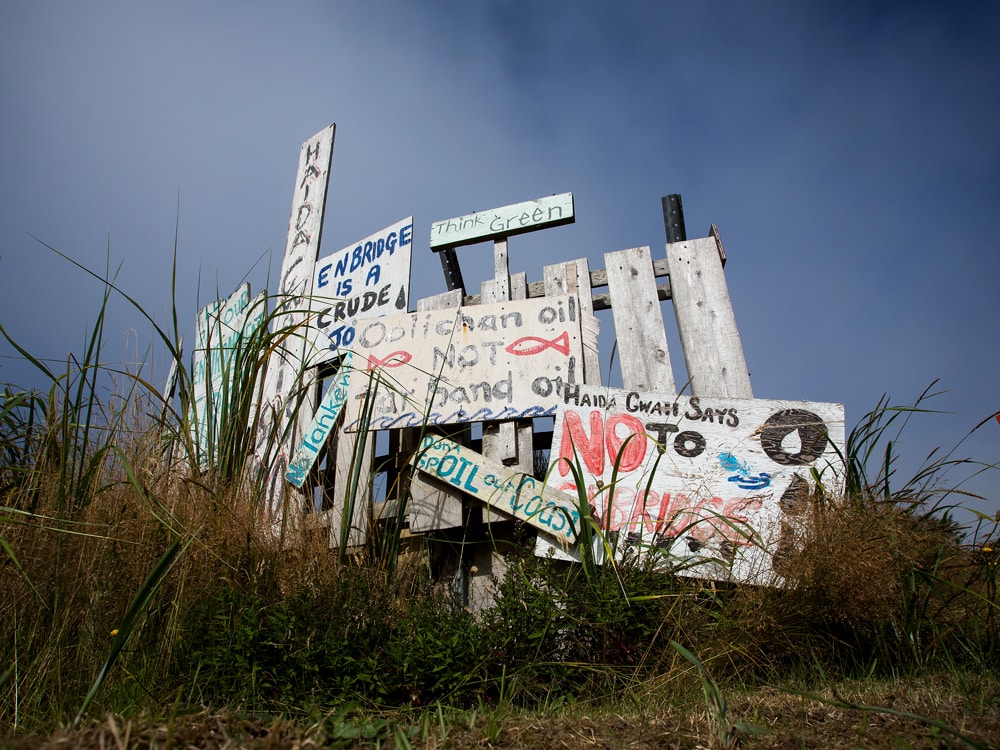
In 2010, Enbridge Inc. filed regulatory application for the Northern Gateway pipeline from Alberta to the port of Kitimat. At a projected cost of $7.9 billion, the 36” diameter, 1,177-km-long pipeline would carry 525,000 barrels per day of diluted bitumen, all of it for export. After four arduous years of hearings, environmental reviews and stakeholder consultation, the Harper Cabinet approved the project.
But in 2016, that approval was struck down after a court appeal by Aboriginal bands claiming insufficient consultation. Enbridge launched a new round of consultation, only to see the B.C. government set back the project by creating the Great Bear Rainforest reserve, which severely limited logging in the 6.4-million-hectare area, signalling that all resource development there was under the gun. The new Prime Minister, Justin Trudeau, reiterated his view that “the Great Bear Rainforest is no place for a crude oil pipeline”, and his Cabinet refused to reconsider the Northern Gateway project.

The bands behind the court appeal were pleased but not the nine living along the route, who lost the anticipated employment and financial benefits. They filed a lawsuit claiming the Great Bear Rainforest prohibition against development on their traditional lands shouldn’t have been implemented without their consent. But it was too late. After six years and multiple rounds of Aboriginal litigation, a pipeline that could have been on-stream today was dead.
Next came the Trans Mountain Pipeline expansion project. With the planned Keystone XL pipeline to the U.S. in continuing difficulty, and the Energy East concept blocked by Quebec, the twinning of the 1,150-km-long Trans Mountain line and tripling of its capacity to 890,000 barrels per day was the lone remaining hope for beleaguered Alberta oil producers. And since every element of Trans Mountain already existed and merely needed augmentation – it had been pumping and loading oil at the port of Burnaby, B.C. for over 65 years without major incident – “TMX” seemed a sure thing.
Kinder Morgan filed regulatory application in 2013 and then consulted with 130 Indigenous communities. The federal Cabinet approved the project in 2016 after conducting its own direct consultation with 117 Indigenous communities. It was Trudeau’s implied trade-off for axing Northern Gateway. But in 2018, the Federal Court of Appeal struck down the approval, citing insufficient environmental review and First Nations consultation. The project was reapproved in mid-2019 after yet another round of consultation. But a few First Nations have filed yet another appeal citing…you guessed it, “insufficient consultation.” And in this instance, the Trudeau government refused even to defend Canada’s legal position, in accordance with a recent internal “practice directive” that is aimed at Indigenous reconciliation.

Six years after that precipitous Supreme Court decision, Alberta oil continues to be sold to gleeful American buyers at huge captive-market discounts. A Fraser Institute study concluded that the discount amounted to $20.6 billion in 2018 alone. A second industry study by Fraser found that annual capital investment in the oilsands alone declined by $21 billion since the pipeline shortage began five years ago. Then there’s the human toll; had those projects moved forward as planned, some 100,000 workers would still have jobs.
The melodrama of endless litigation must not be allowed to continue. But what is the Trudeau government doing to improve the process of gaining Aboriginal consent? Absolutely nothing. In fact, it has compounded the problem by adopting the United Nations Declaration on the Rights of Indigenous People (UNDRIP). UNDRIP requires “free, prior and informed consent” regarding “legislative or administrative measures that may affect Indigenous peoples, including approval of any project affecting their lands or territories and other resources.”

If followed, this amounts to an aboriginal veto over nearly any development, and an at-times-tiny minority-within-a-minority would be able to nix projects that other Indigenous groups favoured. As is almost occurring already. (This C2C Journal article chronicles the court’s creation of the “duty to consult” and the resulting evolution towards an Aboriginal veto.)
Our prime minister seems to think the UN is the home of the wise and right. That fairy tale was demolished last December when the UN Committee on the Elimination of Racial Discrimination released a directive calling for three major Canadian infrastructure projects to be “immediately” shut down, including TMX and the Coastal GasLink pipeline. Coastal GasLink is to supply the Kitimat LNG export facility, the linchpin project to begin getting Canada’s natural gas to growing world markets.

The committee’s directive came as an unwelcome surprise to the 20 First Nations who had signed benefit agreements with Coastal GasLink. The project is supported by every elected Indigenous government along the pipeline, and is considered critical to the economic future of the Haisla Nation around Kitimat. Demonstrating the farcical sloppiness of UN work, the chair of the committee stated he didn’t know most First Nations supported the project because “the role of the committee does not involve investigative work.” This was a slippery dodge; the committee’s staff got the information upon which they based their directive from somewhere. Nothing stopped them from getting accurate information.
Still, I’m sure none of this will deter the prime minister’s ego-driven campaign for a seat on the UN Security Council. It’s even possible there’s a connection between that objective and his government’s reluctance to authorize energy projects. Besides worsening the already fraught Aboriginal consent issue by adopting UNDRIP, Trudeau has courted popularity with the UN’s notoriously anti-Israel membership by voting last December in favour of a motion condemning that country as an “occupying power.” Many observers believe his decision to send our troops on a high-risk and troubled UN mission to Mali was another tactic to gain support for Security Council membership.