Stories

In praise of examined lives

Paul Bunner
March 1, 2015
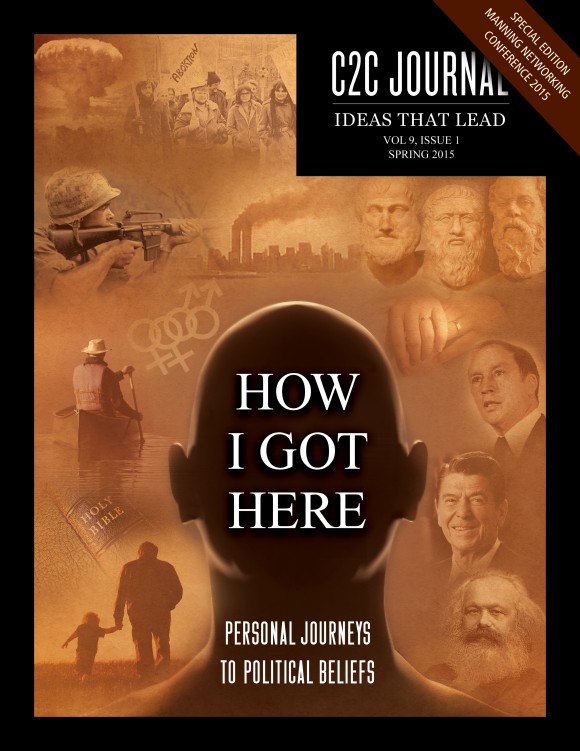
The Spring 2015 Edition of C2C Journal is like nothing else we – or any other magazine that we know of – have ever done. It is a fascinating collection of political biographies by a dozen Canadian writers, young and old, men and women, conservative and liberal, English and French, well-known and unknown. Each piece explores the influences and epiphanies that shaped the writer’s political evolution. By turns poignant and hilarious, touching and courageous, and invariably introspective and insightful, these essays speak to the journeys we all take to political conviction and engagement.
Stories

In praise of examined lives

Paul Bunner
March 1, 2015
The Spring 2015 Edition of C2C Journal is like nothing else we – or any other magazine that we know of – have ever done. It is a fascinating collection of political biographies by a dozen Canadian writers, young and old, men and women, conservative and liberal, English and French, well-known and unknown. Each piece explores the influences and epiphanies that shaped the writer’s political evolution. By turns poignant and hilarious, touching and courageous, and invariably introspective and insightful, these essays speak to the journeys we all take to political conviction and engagement.
Share on Facebook
Share on Twitter

C2C Journal Spring 2015 Cover-Final

The unexamined life is not worth living.”

 – Socrates

Whenever I meet a new or aspiring politician – and I meet a few of them as a journalist and speechwriter – one of the first questions I ask is, “Why are you running?” Many of them, I’m sorry to say, don’t appear to have given it much thought. Usually they get around to saying something about a “desire to serve,” and “to make our [city/province/country] a better place.” These are great – and hopefully sincere – motives, but they don’t really tell me enough to decide whether they’re worth voting or working for.

The ones who really stand out as having thought about their political convictions are the storytellers. They describe momentous events in their lives, books or people who influenced them, and other transformative experiences which shaped their beliefs and inspired them to set their careers and families aside and start knocking on strangers’ doors, begging for money, giving speeches euthanized by party hacks, taking cheap shots from Internet trolls, and suffering all the other indignities that politicians endure.

The elementary idea that democracy is best served by people who believe in something is the inspiration for this edition of C2C Journal. When we put out the call for submissions a couple months ago it prompted a huge response. That should be no surprise, someone sarcastically observed, when you ask writers to write about themselves. What we got, however, was not a riot of narcissism, but a collection of thoughtful, honest, humble and interesting biographies that mirror the journeys we all take to political conviction and engagement.

As well as being posted online at C2CJournal.ca, this special, expanded edition of C2C will be distributed to each of the 1,000-odd delegates attending the annual Manning Networking Conference in Ottawa March 5-7. Several of the writers will be joining me at a session where everyone will be encouraged to tell a story about “How I Got Here.” Since the conference is populated by political activists, journalists and academics from across Canada, it promises to be a lively, stimulating discussion. If you’re a delegate, we hope you’ll stop by our session on Saturday morning and join in.

Included among the contributors is Rainer Knopff, the political scientist and member of the “Calgary School” of conservative academics. His story is a delight to read, a tale of love and Plato, of philosophical evolution from left to right, and of providential happenstances that determined his destiny. Also at the Conference will be former federal Conservative cabinet minister Monte Solberg, whose essay in this edition evinces his gift for humour and reveals how his father, a can of Gold Water beer, and William F. Buckley, rescued him from Saskatchewan socialism at a very young age.

Ottawa journalist Brigitte Pellerin will share her story about her journey from political activism to political ennui, a sad tale of disenchantment with our contemporary democratic choices. More hopeful, at least for conservatives, will be lawyer Paul Beaudry’s countercultural narrative about a lonely right-wing francophone flourishing in a sea of Quebec leftism.

Not on hand, regrettably (but perhaps understandably), will be lawyer and former Prime Minister Jean Chretien advisor Warren Kinsella, whose provocative essay in this edition answers the vexing question about how someone from Calgary can become a Liberal.

Other contributors to this edition include Bernd Schmidt, whose political beliefs were forged in the ruins of post-war Germany and the revolutionary cauldron of the Sixties; Jeremy Cherlet, a Millennial whose political consciousness begins with 9-11 and lies entirely within the Internet age; Elizabeth Nickson, whose political biography is a breathtaking romp through New York, London, South Africa, and 400 years of North American colonial history; and Colby Cosh, the Maclean’s columnist whose story about getting bitten by the libertarian bug at a young age also illuminates why he has become such a uniquely interesting voice in Canadian journalism.

If there’s a constant running through these narratives it is the profound influence of literature on political evolution. With that in mind, as well as the Manning Foundation’s mandate to stimulate more a greater political engagement among Canadians, we invite readers to pass on this edition of C2C to others – especially young people – in hope that some of these stories will ignite their interest and involvement in the political process. With any luck, some of them will go on to become politicians who know why they’re running.

~

Paul Bunner is editor of C2C Journal.  His political journal ranged from writing press releases for peace group at 25 to writing speeches for a Conservative prime minister at 50.


Love C2C Journal? Here's how you can help us grow.

More for you

Sign on the Dotted Line: How B.C.’s Latest Indigenous Outrage Threatens Freedom of Contract Across Canada

As if the mayhem created by the 2025 Cowichan decision regarding property rights wasn’t enough, the B.C. court system has now declared its readiness to undermine legal contracts as well. As Peter Best reveals, a January 2026 decision to allow a contentious Indigenous lawsuit to proceed threatens to upend centuries of contract law. At issue is a small B.C. First Nation’s claim it has an aboriginal title right to export propane on an industrial scale, one that should overrule a signed, legal contract between the port of Prince Rupert and a billion-dollar energy project that itself is providing major aboriginal benefits. Acceding to such an outrageous demand, Best warns, will plunge relations between natives and the rest of Canada further into chaos and mistrust.

The Other Right to Choose: Reversing the Trudeau Immigration Fiasco

Canada’s immigration system was once the envy of the world. Based on the notion that those who get into the country are those who determine its future, the system chose people best able to contribute. Then the Trudeau Liberals blew it up, opening the gates to just about anyone – including literal terrorists – wreaking economic havoc and breaking Canadians’ faith in the value of citizenship. John Weissenberger, who served as chief of staff to the federal immigration minister in Stephen Harper’s Conservative government, has watched it happen with growing dismay, and argues for a return to sanity – centred on the sensible “points” system that served Canada so well for decades.

Suffer the Little Children: The Liberals’ $10-a-Day Childcare Disaster

Waiting lists stretching years. Plummeting quality. Outraged parents. Providers slowly strangled by red tape. The federal Liberals’ vaunted $10-a-day childcare program has proved an expensive disaster. Five years in, Matthew Lau digs into the many problems and inequities this landmark social policy has delivered. Lau finds B.C., which had a three-year head start on the rest of the country and an enthusiastic NDP government leading the way, in the worst straits of all. With an irretrievably flawed system clearly failing Canadian families, Lau argues that Prime Minister Mark Carney should pivot to a fairer, cheaper and more effective alternative.

More from this author

Good News From C2C Journal

C2C Journal is pleased to announce that thanks to the loyal and generous support of our readers, contributors and donors, the Journal is immediately increasing volume and frequency of original stories and essays, expanding staff, unveiling a redesigned website, and launching a sustained social media marketing push on multi-media platforms. Editor Paul Bunner has the details.

One step forward, two steps back for freedom

When he wasn’t kayaking on or swimming in the North Saskatchewan River near his home in Edmonton, C2C Journal editor Paul Bunner spent some of his summer fighting two battles for little freedoms in his local community. He won one and lost one. Although he’s a veteran political activist at the federal and provincial level, Bunner contends that the lifeblood of democracy must be nurtured at the foundations of society if it is to flourish at the top.

The Last Front Page

The rapidly shrinking newspaper business raises all kinds of questions. What will we wrap fish guts in? How will we light backyard fires? And where will we get reasonably accurate and important stories about what’s going on in our community, our country, and the world? The internet? Where global editor-bots decide what’s news? Where politicians can lie with impunity? Where fake news outsells real news? The short answer is yes. The longer and more encouraging answer is in the Spring edition of C2C Journal, which launches today with editor Paul Bunner’s lead editorial and career newspaperman Paul Stanway’s lament for the ink-stained wretches of yesterday’s news.