
Next week, Emmanuel Macron will take office as the tenth President of the Fifth French Republic. For mainstream liberal politics, within and without France, his election comes as a relief, as Macron is a supporter of the European Union, free trade, internationalism, and immigration. His victory over the National Front’s Marine Le Pen exceeded the expectations of pollsters, with Macron taking a full two-thirds of the vote – a landslide by the normal standards of the second, “runoff” round in French elections. On April 23, Macron and Le Pen had won the top two spots over a field of challengers from across the spectrum, earning them the right to contest a final round of voting.
For now, last Sunday’s final result offers a reprieve to the uncertain near-term future of the EU. Had Le Pen managed to win and move forward with a promised referendum on independence, she would have forced an immediate reckoning with the EU’s challenges: poor governance and democratic accountability, a problematic single currency project, dominance by German interests and influence, security failings, clashes between northern and southern Union members, and a leaky border control regime. If France were to secede, the EU could not continue in its present form, as the French are too central to the institutional, economic, and governing dynamic for it to exist without them.
Though damaged in influence, the “Republican Front” of the united mainstream parties, who enthusiastically endorsed Macron, was still able to repel Le Pen. The governing order built by the centre-left and centre-right for decades will continue. In France, the West can still see a familiar liberal and globalist face. And in concert with the Dutch election in March, where populist Geert Wilders failed to take power, some may interpret the French result as a further repudiation of the nationalist tide.
But Macron’s victory was less conclusive than the last time the National Front made it to the second round. In 2002, Le Pen’s father Jean-Marie squeaked by Socialist Lionel Jospin in the first round to finish in second, only to have incumbent Jacques Chirac rout him in the runoff with 82 percent of the vote.
This year Marine Le Pen nearly doubled her father’s percentage. If she or a similar candidate improved the National Front’s support by the same factor in a future election, it would win a majority.
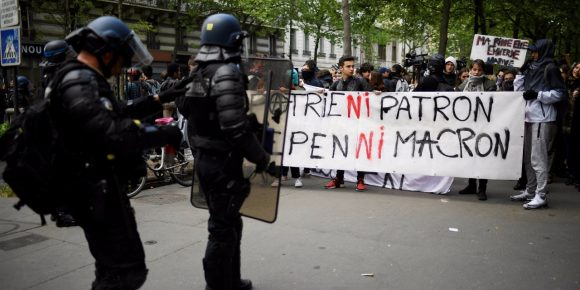
So there is reason to believe that the European liberal consensus is not yet out of the woods. Neither of its established parties, the Republicans and the Socialists, made it past the first round. The victor Macron may seem, in comparison to Le Pen, a staple of the elite. But just weeks ago he was an upstart “insurgent” running as an alternative to the establishment parties. The high rate of protest voting is also notable: over a quarter of registered voters abstained (the highest rate since 1969), while 11.5 percent of those who turned up (over four million people) spoiled their ballots.
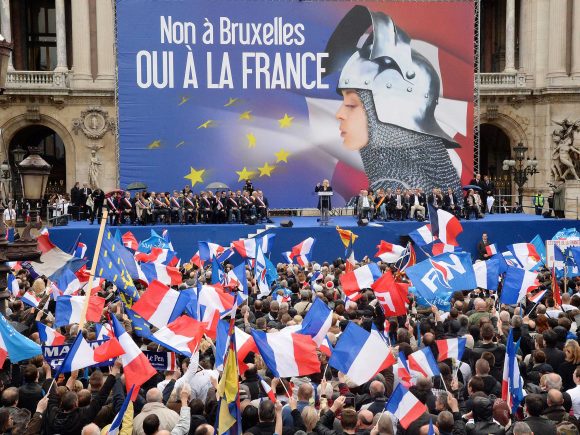
A third of voters endorsed Le Pen, a candidate with no executive governing experience, whose party history is soiled by associations with anti-Semitism. Compared to Macron, she offered little substance in policy proposals, relying instead on unconvincing slogans about her opponent’s employment as an investment banker. That she collected as many votes as she did is remarkable.
To boot, France’s social and economic problems, which gave way to the National Front’s appearance in the runoff, are very real. The country officially remains in a state of emergency following the Bataclan theatre attacks in Paris in the autumn of 2015 and endures regular eruptions from Islamist terrorism. The Nice and Charlie Hebdo attacks, for instance, are very recent memories; a sense of threatened domestic security was a backdrop for this hinge election. The country’s recovery from the 2008 financial crisis has been weak, with 10 percent unemployment and anemic economic growth.
Immigration to France, especially by Muslim North Africans, is politically contentious – perhaps made worse by laws prohibiting census data on religion or race, thereby disallowing official information about the Republic’s religious makeup. No one knows with great certainty how many Muslims live in France, though a French demographer estimated in February of this year that 20.4 percent of the population was either foreign-born or children of the foreign-born: “We therefore had a bit more than one in five inhabitants of foreign origin over two generations in 2015.”
The Pew Research organization cited the Muslim population as 7.5 percent in 2010, projecting a rise to 8.3 percent in 2020 and 9.1 percent by 2030. In contrast, the same Pew dataset shows Canada’s Muslim population as 2.1 percent in 2010, with projections of 2.8 percent in 2020 and 3.6 percent in 2030.
These changing demographics of France play to the hand of the nationalist right. So too do fundamental civic disagreements between native French culture and immigrant culture, exemplified by the perennial debate about the Islamic veil. As Paul Wells has noted, many of Ms. Le Pen’s positions on these cultural questions are consistent with those of Nicolas Sarkozy, the former Gaullist president from 2007 to 2012. What once seemed “extreme” positions have come to resonate beyond the fringes. Even if the National Front never takes power, its influence on the Republic will likely be profound in the medium-term.
France provides an interesting window through which to gauge the source of populist sympathy. In the Anglo-Saxon world, each political faction has its own explanation for populism’s rise in the West. On the left, the story is growing inequality and the political class’s failure to deliver advanced social-democratic goods. On the right, it is a story of political correctness gone mad and a reaction against policies of mass immigration.
The French case rather supports the conservative interpretation. France has a highly-socialized economy with significant government spending on the welfare state, high taxes, and cumbersome business regulations, especially with respect to labour rules. Certainly, there is an harder left in France – represented in the election’s first round by Jean-Luc Mélanchon – that wants to impose an ever-stricter egalitarianism. But that faction has not recently succeeded like the National Front in challenging the consensus view. As in the United States, it has been populists on the right who have channeled public frustrations.
Each of these nationalist movements operates within particular system constraints, the manipulation of which is critical to their success. In Britain, the method was to contest a referendum on independence from Brussels, thereby bypassing the difficulty in establishing a presence in Parliament. In the U.S., the populist right co-opted the mainstream Republicans to win the GOP presidential nomination and ultimately the presidency.
The French nationalists have arguably erred in sticking with the National Front as their vehicle. In France, it is more common for parties to dissolve, merge, or change their names. The Gaullist centre-right has had several iterations over the years. In this election, the broad middle essentially jettisoned the centre-left Socialists and centre-right Republicans for a new party altogether, headed by Macron. Mélanchon’s new party, “La France insoumise,” is effectively a rebranded neo-communist party.
It is to the great advantage of the political centre that that the nationalists have shackled themselves to one eccentric political family, replete with baggage. The articulation of some variety of national conservatism – Eurosceptic and critical of mass migration, without any doubts about the evil of racism, the significance of the Holocaust, or the shame of Vichy France – is coherent and popular enough to form an alternative to the National Front. Without the latter’s historical pedigree, a new party could conceivably perform better in future elections.
No two countries or cultures can be perfectly compared, and global trends are often more complicated than they appear. But the current of fundamental dissent running through Western civilization is unmistakeable. The cast of characters includes Le Pen, Wilders, Donald Trump, Nigel Farage, and the “Alternative for Germany” – plus lesser-known equivalents in almost every Western country. It is difficult to imagine that millions of people have suddenly taken to sympathy for fascism. With so many supporters, the nationalists cannot be written off as a lunatic fringe.
All of this underscores the challenge for France’s President-Elect. Between his inexperience, uncertain support from the legislative branch, deep economic woes, and a commitment to centrism, it is difficult to see how Macron can succeed. And even if he delivers his promise to right the national economy through pragmatic reforms, the major questions of terrorism, demographic change, and cultural nationalism will remain. If Macron fails to fix France, a nationalist alternative will doubtless be ready again in 2022.