If you’ve been paying even the barest attention to Canada’s economy over the last several years, you’ll know plenty about the country’s productivity crisis. The Bank of Canada got the ball rolling in early 2024 with a speech by deputy governor Carolyn Rogers in Halifax. “I want to talk about Canada’s long-standing, poor record on productivity and show you just how big the problem is,” Rogers said. “You’ve seen those signs that say, ‘In emergency, break glass.’ Well, it’s time to break the glass.”
Since then, much glass has been broken. Canada’s Big Six banks, including TD and Scotiabank, have released major reports on the country’s poor productivity. The C.D. Howe Institute produced a six-point plan to raise national productivity. The University of Calgary’s School of Public Policy organized a series of conferences titled “Canada’s Productivity Initiative”. And Prime Minister Mark Carney’s 2025 mandate letter to his new Cabinet stressed that, “Our long-standing weak productivity is making life less affordable for Canadian families, straining government finances, and threatening the sustainability of vital social programs.” C2C has covered the issue closely as well.
Perhaps the ultimate indicator of the situation’s seriousness came from the resolutely left-wing and habitually incorrect Canadian Centre for Policy Alternatives, which last year dismissed the “panic” over productivity as mere capitalist hogwash.

With such a flood of insights covering the country’s overall lack of competitive fire, sagging labour efficiency and inability to complete major projects, this story does not try to add to the concerns over macro-productivity. Rather, this story is about Canada’s other productivity crisis: the many small and apparently insignificant ways in which the 21st century is sapping our ability to get things done at a personal rather than national level. These are the obstacles facing Canadians who simply want to pay their bills, get to appointments on time, tend to their lawn and enjoy their fleeting leisure time without endless and unnecessary distractions and irritants.
Canada has a micro-productivity crisis. And it’s as much a “break the glass” emergency as its bigger brother.
Two-step Verification
You want to pay a bill. Or book a flight. Or check your loyalty points. But inputting your username and password is no longer enough. Now you need a six-digit verification code. And like a hapless bystander forced to foil some mad bomber, you have mere seconds to complete the task.
Two-step verification is perhaps the most pervasive example of Canada’s micro-productivity crisis. While online bill payment initially promised to be quicker and easier than its earlier postal version, the process has become ever-slower and more complicated. Since the verification code is generally sent to a different device than the one you’re using, it relentlessly robs you of a minute here, a minute there and turns what ought to be a simple task into a multi-step, multi-device ordeal. If you have your phone on you, great. But what if you left it upstairs? Better take those stairs two at a time!

Many online services will still remain unconvinced you’re not a bot, requiring a CAPTCHA to prove you’re human. Retyping wavy letters or identifying every square with a bicycle doubles your time wasted. Banks in particular seem to assign zero value to their customers’ time since they waste it so shamelessly – forcing online users to click through a forest of offers for lines of credit, insurance or new types of accounts before they reluctantly let them see their own bank balance. And pray you never lose your phone, which would render the two-step impossible.
The authentication issue is particularly acute when dealing with linked accounts. My wife and I have a joint bank account and credit card, but she’s the primary account-holder. Whenever I want to check our bank balance or look at the credit card bill, I need to verify her identity. If she’s busy, it can’t be done. Access denied. Many other couples have the same problem. A friend tells me she solved this issue by waiting until she and her husband are both in bed and can thus easily verify each other’s identities by phone. Surely there are more productive things couples can be doing between the sheets than paying bills.

True, there are good reasons to embrace online security. Getting hacked can be terrifying and is no doubt another big waste of time. But there are easier ways to skin this online cat. Authenticator apps or physical keys improve efficiency, but Canada’s banks and other financial institutions refuse to implement them.
And two-step verification may only be the first circle in a long descent into digital Inferno. Once multi-factor authentication takes over, the two-step will go back to being a dance for country hoofers. The Canada Revenue Agency (CRA), for example, recently insisted that I download a “multi-factor authentication passcode grid”. This consists of a matrix of three-letter combinations spread across five columns and rows. Now when the CRA wants to confirm who I am, I must provide the secret letter combos from A3, D4, B2, etc. I almost yell “BINGO!” when my identity’s confirmed. The chart is among my most precious possessions. The CRA tells me I cannot even email it to myself for fear it’ll fall into the wrong hands.
The questions themselves are often pointless or impossible to answer. “Did your experience exceed expectations?” requires knowing your baseline expectations. While it may have been a truly wonderful experience, if you were expecting wonderful, then the correct answer is a seemingly disappointing “No.” As for, “How likely are you to recommend us to a friend?” if you’re not the sort of person who makes recommendations, a truthful “Not likely” is equally accurate and meaningless, though it will be taken as negative.
A survey might be justifiable for a particularly complex or unusual transaction – getting an elephant to Iqaluit, for example. Then, expectations truly matter. But Canadian Tire kicks out a survey request for every banal purchase of furnace filters or gardening gloves. Meanwhile, online retailers like Amazon pester you about the “delivery experience” – that is, opening the front door to find an envelope on your doorstep – sometimes before the package even arrives. And declining the survey means there’s still the wasted time of yet another incoming e-mail or text that needs to be noticed, checked and sent to oblivion. (More on that later.)

Survey responses are further burdened by the weight many firms – often car dealerships and other service-oriented businesses – place on the results. Even a few low scores can have serious career consequences for sales staff. In an odd twist on grade inflation, many companies now consider anything short of perfection to be a sign of failure. As a result, staff will pressure customers to claim they experienced excellence every single time. Many survey takers comply out of a sense of obligation or sympathy. Mediocre service thus becomes brilliant just to keep everyone happy.
Utpal Dholakia, George R. Brown Chair of Marketing at Rice University in Houston, Texas and an expert on customer satisfaction, observes that the response rates for online surveys have been falling for years. And the results from those who do fill them out are almost always useless for the reasons listed above, especially length. The ideal number of questions for an online survey, Dholakia says, is seven. And he recommends that organizations directly compensate customers for their time. “In most cases, a seven-question survey will merit $5 to $10 in cash or gift cards,” he wrote in the Wall Street Journal. “Offering reasonable compensation to respondents is the single best way to improve the quality of survey data.” Cash sounds good to me.
Online Alerts

“Seat selection is now available.” “Check-in has opened.” “Your bags are ready for loading.” If you’ve got a flight to catch, your airline is intent on having a constant conversation. But like a chatty seatmate, it soon gets too much. The constant barrage of information is distracting from all the other tasks at hand in an airport. And every announcement comes with a shrill demand from your phone to take a look – now! Sure, you can turn off notifications, but sometimes it will be important information like a gate or time change. In reality, you’ve got no option but to pay attention. If only airlines acted this clingy when you need to get in touch over a delayed flight or lost luggage.
The same goes for Amber Alerts and other government-mandated social media warnings. Unlike Americans, Canadians cannot entirely turn off these pocket klaxons. And their scream-level intrusions can appear at any hour of the day, regardless of your location or other priorities you’re attending to. Like the neighbour’s dog, they refuse to be ignored. Similar to two-step verification, there may be a good idea at the core of this concept, but in execution it has become an irritant and great waster of time. Some jurisdictions even require that alerts be sent to the entire province or territory – needlessly interrupting a vast swath of the population within 1,000 km of the alleged incident.
At a conference in Ottawa last month, numerous phones in the crowd, mine included, went off with an Amber Alert in the middle of a presentation, creating a wave of embarrassment and throwing the speakers off their game. But no one could quite muster the nerve to complain about it, since there must have been a child in danger somewhere to justify the intrusion. In fact, it was just a test. A test of how frustrating Amber Alerts can be. The government now has the ability to seize your attention whenever if feels the need and for whatever purpose it decides.
Safety Devices
I recently had to throw out a perfectly good lawn mower. It still cut my grass to the desired height. The only thing wrong was a broken shut-off device that requires the user keep a lever depressed while mowing. These dead-man switches, mandated by federal law in Canada, serve the admittedly useful purpose of ensuring that lawn mowers, power tools and motorized recreational conveyances like jet-skis can’t keep going after the user lets go, causing a potential accident. You might consider it two-step verification for the physical world.

The problem is that no one ever buys a lawn mower because it’s got a great safety switch. Unlike battery capacity or blade width, it’s not a feature of interest. So manufacturers have no motivation to make the switch durable or replaceable. It’s simply another government-mandated cost of doing business, like bilingual packaging and warning labels. This cost stays hidden until it breaks.
I removed the broken switch from my old lawn mower and found that if I squeezed a little internal button with one hand, I could mow the lawn with my other. It was a “depressing” experience in every sense of the word. Given the impracticality of mowing with one hand, I eventually had to buy another lawn mower. Spending $500 to replace a perfectly usable tool is clearly a wasteful diversion of my productivity.
Beyond lawn care, a preponderance of government-imposed safety features of dubious effectiveness threatens the productivity of all Canadians. An argument can always be made that an additional device or procedure might ameliorate some small risk. But at what cost? And to whose benefit? Noisy lobby group Mothers Against Drunk Driving’s current campaign to force car manufacturers to include a Breathalyzer-type mechanism in all new cars is an obvious example, as it would add thousands of dollars to the already-high prices of new cars. And what happens when they break?
Phantom Construction Zones
You’re making good time until a flashing sign warns “Construction Zone Ahead”. The zone itself is nowhere in sight, yet still the speed limit drops and your highway lane starts to disappear; you reduce your speed to 80 km per hour, then 60, then 40 or 30, until you’re barely crawling, all before glimpsing the first piece of equipment.
At the end of this slow-moving funnel, you discover there’s no “there” there. Construction is finished. Or hasn’t started. Or it’s an off day for the paving crew. But the signs are there all the same, and with them the resulting inconvenience.
Phantom construction zones not only cause needless congestion, they imperil future road projects by encouraging offsetting behaviour. Once drivers get wise to these fake-outs, some will assume every warning is phony. Or they’ll skeptically wait until the last moment before hitting the brakes, increasing the potential risk if there actually is ongoing construction.
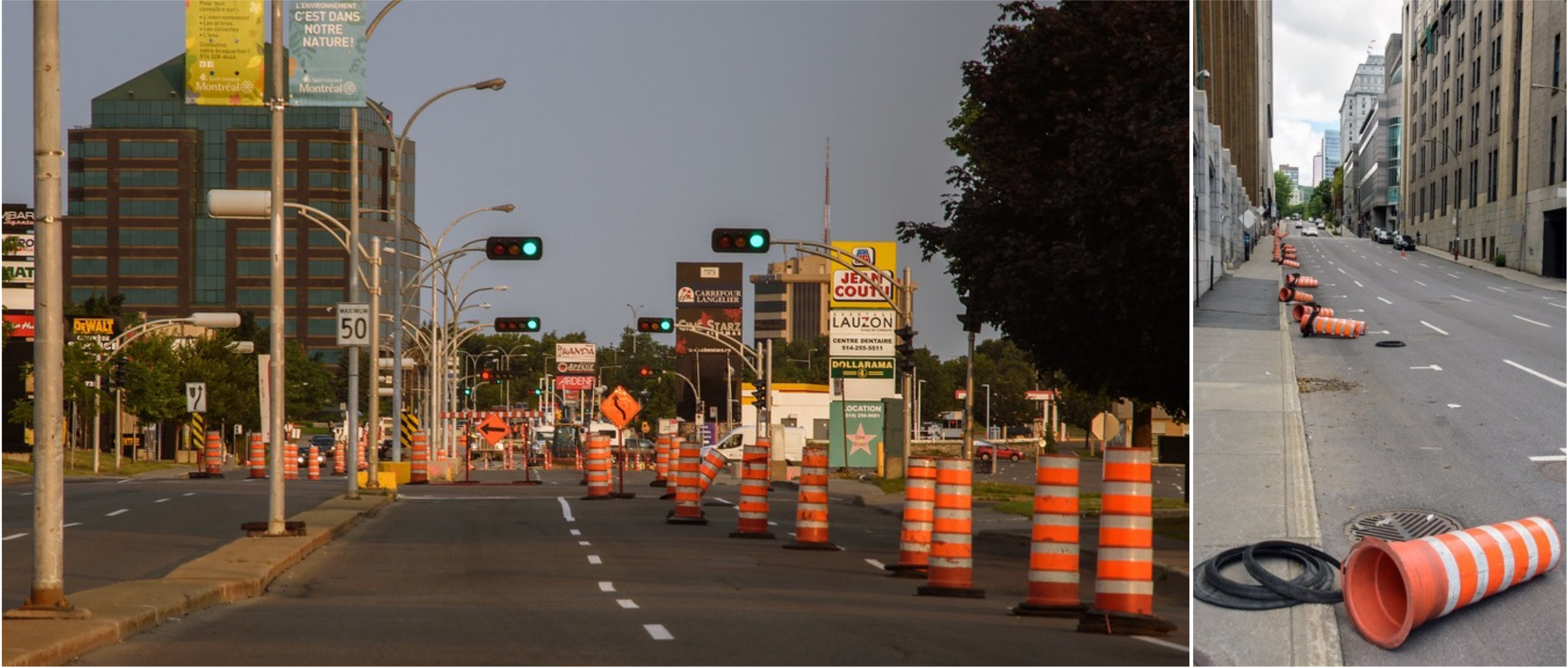
This issue is famously acute in Montreal, where orange traffic cones are so plentiful they’re considered an unofficial civic emblem. In 2023 the local chamber of commerce and tourism bureau teamed up to formally estimate the markers’ pervasiveness. In their study of 15 downtown blocks, they discovered over 500 cones, of which nearly one-quarter were serving no purpose other than to needlessly obstruct drivers. That same year, La Presse newspaper reported on a row of orange cones that had been sitting beside a road tunnel since 2007. They were now 16 years old – old enough to drive.
It will come as little surprise that Montreal has the worst traffic in Canada. The latest traffic cone report found that while the city had 40 percent fewer road construction sites than the year previous, the number of traffic cones deployed had actually increased. According to analytics firm INRIX, Montreal drivers each lost an estimated 63 hours sitting in traffic in 2025. If there’s room for optimism, it’s that all the media attention appears to have smartened up local officials in charge of road construction. The share of abandoned and unproductive cones fell from 22 percent in 2023 to a mere five percent in 2025.
Congestion as Policy
In the name of the global Vision Zero project or other efforts to make our streets “safer”, many Canadian cities have adopted policies that seek to make their roads less efficient. Among the most obvious of these efforts are “traffic calming” devices like speed bumps, road constrictions and in-road obstacles. One of the newest of these are flexible bollards, bendy vertical hindrances placed along roadsides or even in the middle of roads meant to discomfort drivers, slow them down or micromanage their traffic decisions.
Beyond impeding traffic, all such measures have unintended consequences. They reduce the number of lanes and parking spots and so narrow roads that cars are sometimes forced to drive on the wrong side to get by. And despite the proliferation of cycling lanes, these measures sometimes reduce space for cyclists. The net effect can be to make roads less safe. And they rob all drivers of time, from the deliveryman to mom rushing a kid to the dentist. It is a micro-productivity crisis organized and implemented by local government.
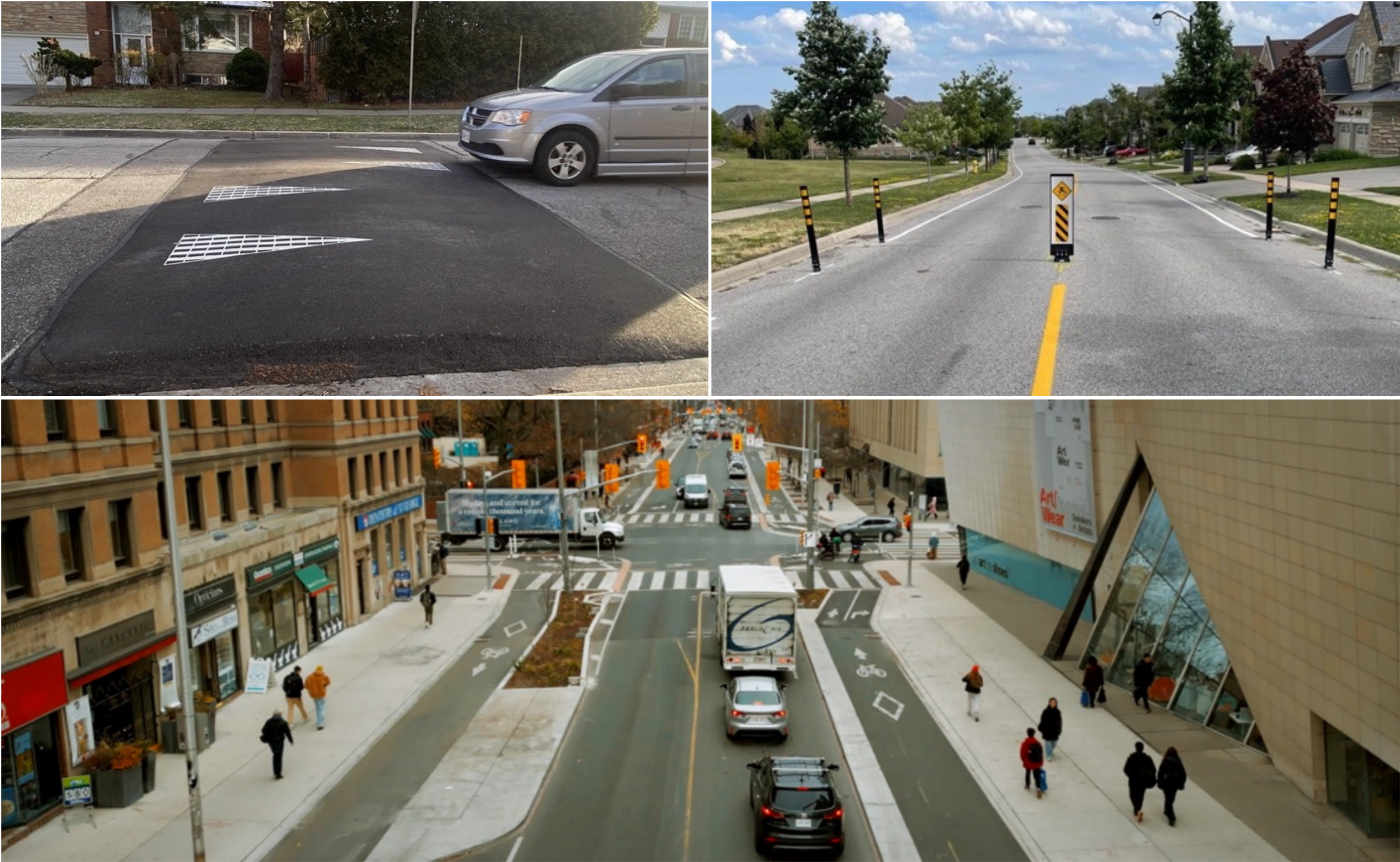
As part of its “Complete Streets” campaign, for example, Toronto incorporated many traffic-calming and road-obstructing devices in its recent renovation of a 4.7 km stretch of Bloor Street West, a main city artery. This included separated bike lanes, bollards and changes to signals at various intersections, as well as the removal of two car lanes. The goal was to increase cycling and pedestrian traffic by making cars move slower. Mission accomplished.
According to a city review released in 2024, average car speeds on Bloor fell by as much as 30 percent. “When comparing the before-installation period…with interim conditions one year later,” the report states, “average increases in motor vehicle times range from 2.4-4.4 minutes eastbound and 1.5-3.6 minutes westbound.” Daily two-way traffic on the road averaged around 20,000 vehicles before the construction and has “remained relatively consistent” afterwards, according to the report, suggesting that drivers taking this route to work have no better option and are thus absorbing the lost productivity. Cycling advocates have hailed these results as a great victory.
Plot Repetition
When you sit down at the end of the day to watch a show on Netflix or another streaming service, you want that time to be as worthwhile as the rest of your day. Your leisure time deserves productive completion just as much as workaday issues; perhaps more so, since it’s scarcer. So why must we now spend so much time listening to what we already know?
Netflix has come to realize that many of its subscribers watch its shows on their mobile devices while simultaneously doing something else. Emptying the dishwasher or mowing the lawn, perhaps? Hopefully not driving. Since these inattentive half-watchers get frustrated when they can’t follow the plot, Netflix’s solution has been to denude its stories of novelty while endlessly repeating what little is actually taking place. If watching your kid at the playground takes you away from the narrative, the narrative will come to you.
 We heard you the first time: According to actor Matt Damon, Netflix now instructs screenwriters to repeat a movie’s plot several times to cater to inattentive viewers, forcing real fans to sit through needless repetition. Shown, Damon (at right) and Ben Affleck (at left) in Netflix’s The Rip. (Source of still: Claire Folger/Claire Folger/Netflix)
But the check-out brings no relief, as you’ve forgotten your reusable bags. You certainly aren’t paying for another, given the infestation currently clogging your cupboards, car and garage. Canadian comedienne Julie Nolke has an amusing sketch in which she ponders burning or burying her excess bags like an inconvenient corpse.
So you forgo a bag. The situation is likely to end in one of two ways. Either you juggle and pinch your way from the checkout to your car and drop something breakable on the way. Or you buy less than you really need, requiring yet another impromptu shopping trip tomorrow. Both outcomes are productivity-inhibiting.

Grocery stores once begged you to take their free bags. They’d even snuggle your meat in its own separate bag – because they knew that convenience and attention to detail were good for business. Bone-headed federal regulations on plastic products have put an end to all that.
The Rest of the List
This was only a small glimpse at the impediments – government-imposed or otherwise – to Canadians’ personal productivity. Space constraints have prevented a more fulsome discussion of the many other roadblocks to getting things done at work or home. These include:

Micro-Productivity is Real Productivity
“Lost time is never found again,” Benjamin Franklin wrote in Poor Richard’s Almanack. While many of the micro-productivity issues discussed above have been treated in a light-hearted or jocular tone, the problem itself is no laughing matter. Whether through extravagant safety measures, misplaced priorities or contempt for Canadians’ personal time, the 21st century has increasingly come to allocate zero value to individual time costs.