File this under: Times when it would have been better to keep your mouth shut.
On June 13, 2021, Toronto condo developer Corey Hawtin boasted to The Globe and Mail that his company planned to shake-up the Canadian real estate market in a big, big way. Hawtin, CEO of Core Development Group Ltd., said he was planning to spend $1 billion over the next five years to buy 4,000 single-family homes, renovate them and rent them to families frozen out of home ownership by skyrocketing real-estate costs.
“Buying a house or condo has become less and less attainable,” Hawtin told the Globe. “That is really compounding the rental demand in all of our marketplaces.” Renting out single-family homes at scale, he noted, was already a proven winner in the U.S. “We were trying to answer the question: Why is nobody doing this in Canada?” Hawtin’s executive vice-president Faran Latafat asked in the same interview. “We could not come up with an objective answer to that.” It didn’t take long for the answer to appear.
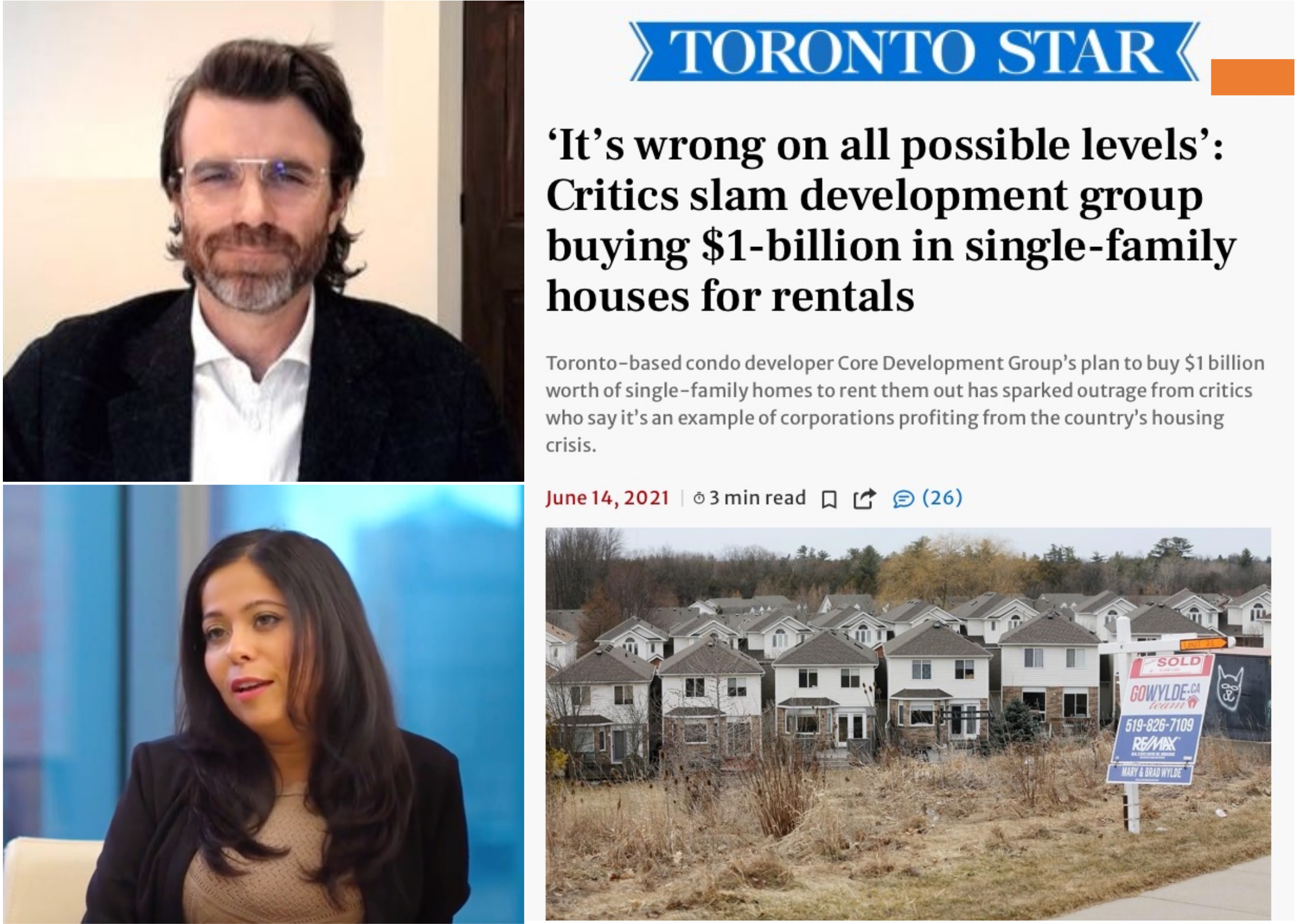
It turns out lots of people really hate the idea of corporations renting houses. “It’s wrong on all possible levels,” screamed a Toronto Star headline the very next day. Housing commentators and tenancy groups lit up social media denouncing the idea. John Pasalis, president of a Toronto brokerage firm, said the proposal was “a betrayal of this country’s young people.” Left-wing tenant activist group ACORN called it “very frightening” and warned the CBC that Canada could be heading down the path of “Ireland in the 18th Century,” presumably with distant landlords and poverty-struck tenants on the verge of civil war.
Then the politicians weighed in. “Why is this government allowing billionaires to buy up homes at a time when families are struggling to find a home they want to live in?” demanded Ontario NDP MPP Jessica Bell in an open letter to Premier Doug Ford within days of Hawtin’s initial announcement. The political reverberations have never really stopped. Three years later, federal Finance Minister Chrystia Freeland declared that her Liberal government would be “cracking down on large, corporate investors who buy up single-family homes.” She then launched an investigation into the phenomenon, encouraging critics to suggest ways Ottawa could stop it.

Amid all the passionate denunciations and pearl-clutching, however, this legion of Canadian critics would likely be surprised to find out they’re making common cause with someone widely regarded to be this country’s number-one enemy – U.S. president Donald Trump.
Appearing at the World Economic Forum meeting in Switzerland this past January, Trump unwittingly allied himself with the Toronto Star, CBC and all those other angry voices who condemned Core Development back in 2021. “Homes are built for people, not for corporations,” Trump stated at Davos. “And America will not become a nation of renters.” He then pointed an accusing finger at the “Wall Street giants and institutional investment firms [that]…have driven up housing prices by purchasing hundreds of thousands of single-family homes”.
A day earlier Trump had signed an executive order declaring war on those large investors. Congress responded by introducing the 21st Century ROAD to Housing Act, which later passed both houses with large bipartisan majorities and is now law. In addition to measures meant to make first-time homeownership more affordable and to encourage faster new home construction, the act includes provisions meant to crack down on corporate rental ownership, including a 350-house limit on any corporation. As in Canada, the message from Washington seems crystal clear: corporate landlords are a very bad thing that must be stopped.
But if that’s so, why has the concept already proved so successful in the U.S.? Because renting homes at scale meets an important need. Over the past decade-and-a-half, renting has become an important option for American families shut out of homeownership by high prices. Anyone prepared to look beyond the populist bluster will discover the same thing holds in Canada as well. Corporate rental homes could solve some of this country’s most intractable housing problems without any direct government interference or intervention. But first you have to get past the rage.
Birth of a New Market
The institutional rental market for single-family houses was born out of calamity. The 2007-2008 global financial crisis pushed the American housing market into its greatest-ever crisis. “There was an average price correction of 25 percent,” recalls Edward Pinto, co-director of the Washington-based American Enterprise Institute Housing Center, in an interview. “Some markets saw prices fall by as much as 60 or 70 percent.” The collapse of subprime mortgage bonds and rapidly rising interest rates caused a sharp spike in foreclosures as millions of American homeowners found themselves unable to make their mortgage payments. Amid this flood of abandoned houses, “nobody knew where the bottom of the market might be,” Pinto says.
 Hollywood’s take on the housing crisis: The catastrophic collapse of the American real estate market in 2007-2008 was memorably portrayed in the 2015 movie The Big Short as a teetering Jenga tower. At bottom, actor Christian Bale plays Michael Burry, the unconventional investor who first spotted the looming disaster in subprime mortgage bonds. In 2008, Burry made US$100 million betting against the housing market.
 Once the concept became a proven winner, a buying spree ensued. Institutional money poured into high-growth Sunbelt states such as Arizona, Florida, Georgia, North Carolina, Texas and California. Government policy further encouraged these efforts as a way to stabilize the real estate market. The housing rush only ended when the supply of cheap homes dried up towards the end of the decade. In 2019 Blackstone sold its stake in Invitation Homes for US$7 billion, nearly doubling its money in seven years. But profit-taking didn’t mean an end to the rental bonanza.
In rescuing the housing market, Wall Street had stumbled upon the fact that many families liked the idea of renting from a landlord with a national reputation. For some, it was because they couldn’t qualify for a mortgage; others were simply keen to avoid the hassles of home ownership. A key demographic proved to be low-to-medium-income working households who were stuck in cramped one- or two-bedroom high-rise apartments but wanted to live somewhere with more room. “If you have children, a three-bedroom house offers a lot more space,” Pinto observes. “It’s likely got a basement, a yard and a garage.” Offering single-family houses for rent thus provides “a service to the market for people who cannot afford to buy or renovate these homes on their own.”
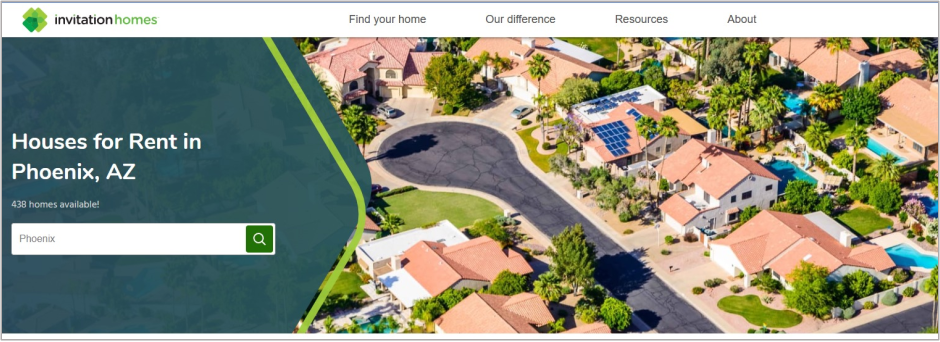
To keep growing this newly-discovered market, institutional investors pivoted to building new houses to rent out. According to the National Association of Home Builders, the “build-to-rent” segment now constitutes seven percent of new home construction in the U.S. Of the 800,000 corporately-owned rental houses in America today, Pinto figures approximately 340,000 are purpose-built. “And this is a segment that didn’t even exist five or six years ago,” he marvels. Invitation Homes’ 97.2 percent occupancy rate testifies to the robust underlying demand for the concept.
How Big? How Bad?
While the corporate rental model has been both popular and profitable, Pinto cautions that its overall national footprint remains quite modest. “Large institutional investors own less than one percent of total single-family housing stock” in the U.S., he explains in a recent research report. Even in Sunbelt cities where corporations have been most active, their portion seems disarmingly slim. In Atlanta, corporations own just 4.2 percent of all houses; in Houston, it’s 2.2 percent. The only city where corporate rental properties constitute a sizeable share is Jacksonville, Florida, at 22 percent.
Regardless of the actual figures, many politicians and observers have come to believe that corporate money is to blame for every complaint made by families struggling to buy their first home. “You’ve driven up housing prices by purchasing hundreds of thousands of single-family homes,” Trump told Wall Street investors at Davos. “It’s just not fair to the public.” But are institutional investors really ruining the housing market for everyone else?
Joshua Coven is a professor of real estate at the Zicklin School of Business at the City University of New York’s Baruch College. Coven recently studied the implications of corporate home ownership across the housing sector, including its impact on local rents and house prices. The full measure of corporate involvement, he explains in an interview, is far less dramatic than most politicians and activists make it out to be. Coven found that corporate house purchases for rental purposes explain only one-fifth of observed price increases. This is largely because corporations replace Mom and Pop investors in the local rental business. Plus, the U.S. real estate market is so large that even with Wall Street owning 800,000 houses, the overall impact is marginal.

More significantly, Coven’s research revealed a substantial decline in rental costs in areas where corporations are most active. “Renters should like large institutional investors,” the real estate professor explains, “because they increase the supply of rental properties and lower rents.” He also bolsters Pinto’s contention that corporate rental homes provide a tangible benefit to young working-class families priced out of home ownership. In particular, Coven notes that rental houses allow these families access to a greater range of neighbourhoods than would be possible if they were forced to own. This can be a big deal in the U.S., given that schools in areas with a high concentration of single-family homes tend to be much better than those where apartment complexes dominate.
In toting up the costs and benefits, Coven admits that corporate rentals do have “an impact on homebuyers, but [the price increase] is smaller than you would think”. At the same time, he finds the effect on the rental market to be “unambiguously positive.” It’s a trade-off that tends to benefit struggling, lower- to middle-income working families, which seems entirely fair. As Pinto observes, following through on Trump’s attempt to shut down the entire corporate rental sector threatens great damage to this vulnerable demographic.
“Removing large institutional investors will not convert renters into homeowners,” Pinto says. “Instead, it will likely reduce the supply of rental housing, particularly family-sized units, leading to higher rents and reduced housing stability.” Denied a house to rent, many of these families would be forced to move back into smaller apartments.
Given the modest impact on home prices and the ample rental benefits associated with corporate ownership, what explains the great animosity shown to the rental home sector by Trump and others? “The issue polls well,” Pinto snaps. “Main Street hates Wall Street. It’s as simple as that.” That said, the final version of the federal housing bill quietly softened or removed many of Trump’s extreme demands on the corporate rental sector. It will survive, despite the widespread hostility.

Canada’s Miniscule Market
While the U.S. government wants Americans to think it is cracking down on corporate ownership of rental housing, in Canada the issue is even more fraught. The goal here is to stamp it out before it can even get started, and without any care for the benefits it could provide.
In 2022, the Toronto Star, arguably Canada’s loudest voice in the panic over corporate rental homes, launched an investigation into Hawtin’s scheme by searching provincial property records to uncover his firm’s rental footprint. It could find just 81 homes owned by Core Development, mostly in mid-sized Ontario cities such as Peterborough and Kingston. And when the Star talked to the company’s actual tenants, they discovered folks like Robert Justin.
The Peterborough resident told the paper he was paying $2,400 a month for the main floor of a three-bedroom bungalow he shared with his wife, daughter and granddaughter. Describing his family as “low-income,” Justin explained to the Star that, “We wouldn’t be able to afford to buy a house like this in this neighbourhood.” In other words, Core Development’s rental houses were filling the same niche in Canada as corporate landlords have in the U.S. – providing modest-income families who lack access to a hefty downpayment the many benefits of living in a detached home in a nice neighbourhood.
The ongoing hue and cry obscures the scantiness of hard data on the actual scale of the issue. Statistics Canada only began tracking corporate ownership of rental homes when the topic first flared in the early 2020s, with figures now available for seven provinces. Of Ontario’s approximately 4 million houses (detached, semi-detached and townhomes) in 2023, Statcan found just 84,000 owned by an incorporated “for-profit business or government entity.” The overwhelming majority – over 3.3 million – are owned by their occupants, while another 538,000 are available for rent through the Mom and Pop sector.
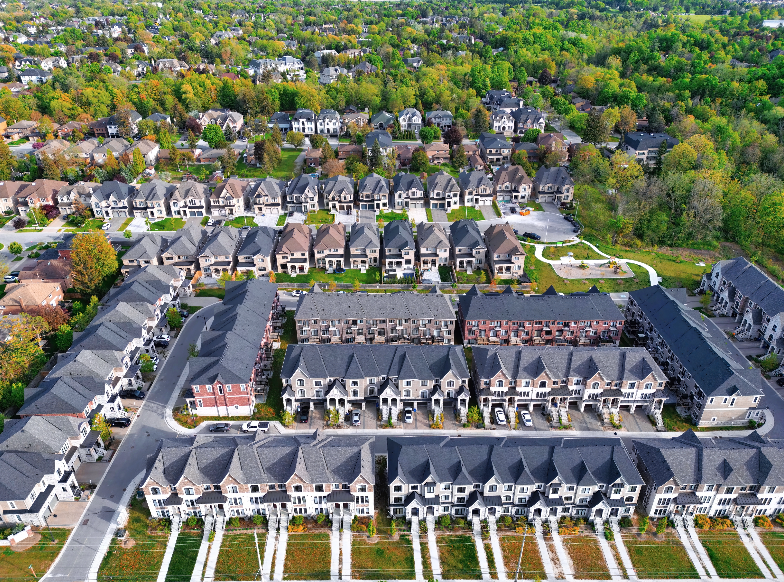
“The figures are quite low when it comes to for-profit corporations owning single-family homes,” admits Jean-Phillipe Deschamps-Laporte, manager of Statcan’s Canada Housing Statistics Program, in an interview. And he notes that nearly one-quarter of those 84,000 homes are in rural areas, suggesting they’re actually cottage rentals of little relevance to Canada’s urban housing crisis. Corporate ownership of single-family homes in Canada is very small potatoes.
As if to prove this point, in 2023 Hawtin announced his firm had a portfolio of just 550 rental homes – a far cry from the promised 4,000. A year later he said he was pivoting away from buying and renovating houses and would instead build 10,000 new single-family homes to rent. “The angry critics that we had last time were mostly those that were frustrated that they couldn’t buy a home. I get it,” he told the Globe. “We need more rentals.” Real estate observers at the time noted that Core Development appeared to be selling off some of its original rental properties at bargain prices. To date, there’s been no sign of the 10,000 new homes. Whether these delays are because of execution issues or the vast, negative public backlash is unclear. Core Developments did not respond to repeated request from C2C Journal for comment.

Despite the slow and hesitant rollout of Core Development’s promised housing revolution, the animosity shows no sign of abating. In 2022, the Justin Trudeau government appointed Canada’s first Federal Housing Advocate, which has since led a crusade against “financialization” – that is, the presence of profit-making entrepreneurs – in the entire housing market. And as mentioned, in 2024 Freeland launched her own anti-financialization effort that sought suggestions for “ways to restrict the purchase and acquisition of existing single-family homes by very large corporate investors”. Its results have not yet been released by the Mark Carney government. Through threats and other measures, Canada may end up killing the idea of corporate-owned rental houses before it even gets started.
If so, life will not be getting any easier for young Canadian families.
A Revised Canadian Dream
Like the American Dream, the Canadian Dream has long included homeownership among its capstone achievements. This is as it should be, given the many personal, financial and societal advantages to living in a house you own. Surveys repeatedly show Canadians of all ages aspire to homeownership as a life goal. And they overwhelmingly want to own a detached or semi-detached ground-level house. But at some point, reality forces its way into all dreams.
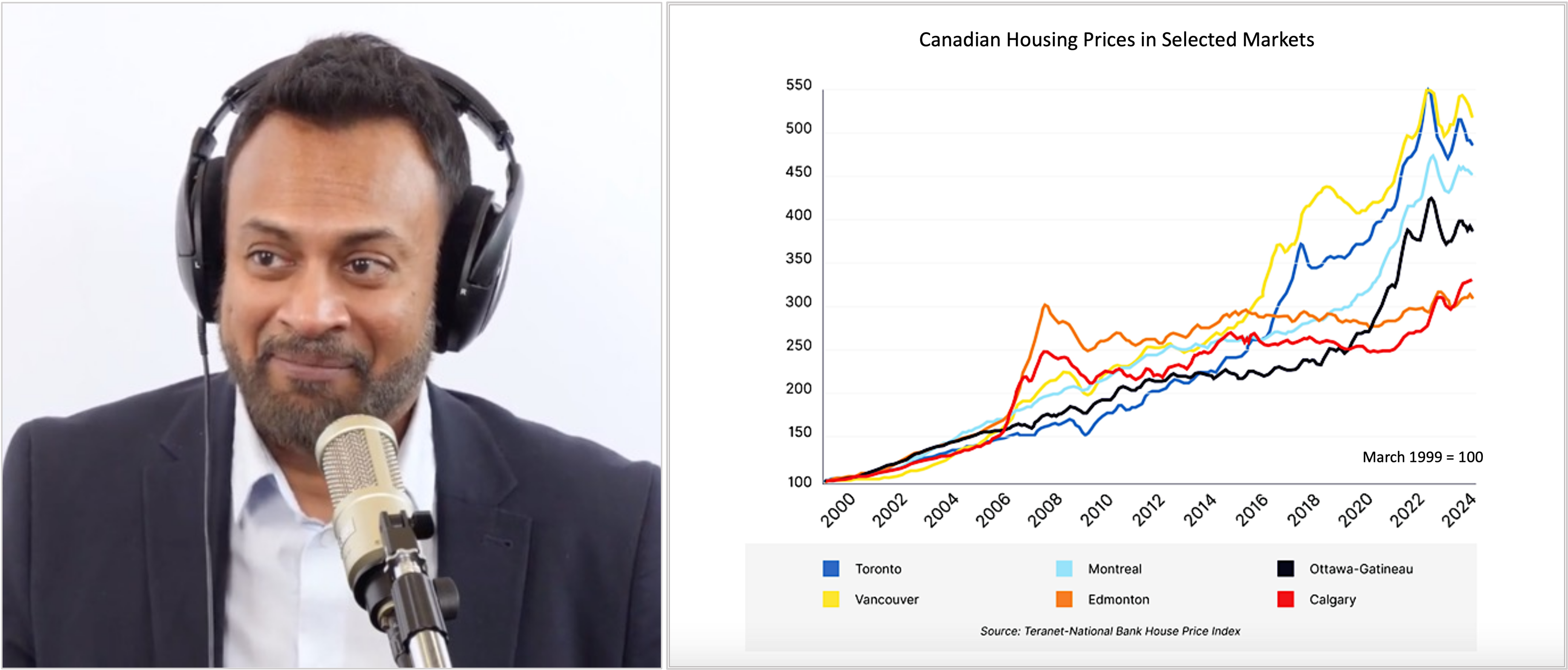
Canadian home prices have risen a shocking 300 percent since 1996. This far outpaces growth in incomes and has made owning a house nearly impossible for large swaths of the population, particularly young Millennials and Gen Zs. According to Carl Gomez, chief economist at Toronto-based Centurion Asset Management and a longtime real estate observer, the rising cost of homeownership is changing how Canadians dream. “For 20- and 30-year-olds who are just embarking on having a family, renting a house now makes a lot of sense,” he says in an interview. Such couples haven’t given up on the idea of living in a house, Gomez adds, just owning one. “They want space to have children, but the cost of ownership is too high. And this latent pool of demand is only going to grow larger.”
Mike Moffatt is another economist with a big interest in where young families live. As the founding director of the Missing Middle Initiative and a former economic policy advisor to the federal Liberals, Moffatt worries that many Canadians are putting off plans to have children because they don’t have enough bedrooms to accommodate a growing family. Or if they do choose to have kids, they are forced to make sacrifices that diminish their quality of life in other ways. “Young couples are either staying in high-rise condos and not having kids, or they’re leaving the big cities and moving somewhere far from work,” Moffatt says in an interview, warning that these smaller centres often require daily hour-long commutes.
Moffatt wants to resurrect the possibility of homeownership for younger generations. But only a massive increase in the supply of new single-family homes can make this happen: either through zoning changes that allow for more infill housing in urban areas or by unlocking additional suburban land by relaxing Greenbelt and other land restrictions meant to limit sprawl. Both solutions will require the unwinding of decades of government policies that pushed developers to concentrate on high-density solutions rather than single-family homes. Until this land crunch is resolved, Moffatt admits renting could fill the void by making single-family homes available to more families.
Gomez agrees that creating a U.S.-style corporate rental market in Canada “makes 100 percent sense” on paper, given the frustrations felt by younger families. But he and Moffatt point to major obstacles standing in the way of bringing the concept north. First, there’s been no price correction sufficient to lure institutional investors into the rental market. While Canadian real estate prices have fallen from their 2022 highs by about 25 percent, most of the decline has come in the over-heated condo market. Detached house prices are only down about 10 percent, Gomez observes. It’s not enough to cause a rash of foreclosures or create a buying opportunity on Bay Street.
Second, the many obstacles that have contributed to Canada’s inability to meet the demand for new homes for purchase – high land and labour costs, onerous taxes, Greenbelts, zoning restrictions, lengthy approval delays, federal immigration policies, growing restrictions on contractors and trades, expensive mandatory “Green” features in new houses, etc. – also stand in the way of building new rentals. “The bottlenecks are still there,” laments Moffatt.

Added to these structural problems is the overarching – and entirely illogical – political resistance to corporate rentals. If renting houses is so bad, Moffat observes, then the Mom and Pop sector should have been villainized long ago. These entrepreneurs also bid up home prices and rent out houses to make a profit – and their sector is six times the size of the corporate one. So why do small investors get a free pass?
“It’s easier to go after a faceless corporation than it is to criticize your neighbour who owns a couple of rental homes down the street,” Moffat suggests. Yet institutional investors are probably a better option for most renters given their preference for high-tech solutions, round-the-clock access and strict adherence to policies and procedures. “A corporate landlord is never going to kick you out because they want their cousin to move in,” Moffatt quips.
While institutional money has always been a part of Canada’s real estate market, to date it has mostly focused on building condos and, more recently, rental apartment buildings. With the condo market deep in the doldrums and the rental apartment concept now looking like it is running out of steam as well, Moffatt says, “It’s an open question where the [big investors] go next. Do they start to look at some of these U.S. models?” Renting homes at scale, he agrees, could be the next big thing. So how do we get there?
Options Aplenty
In 2022, when the buzz over Core Development’s rental home plan was still at a fever pitch, commercial real estate brokerage Cushman & Wakefield released a lengthy research report aimed at tickling the fancy of international investors. The Case for Single-Family Rental Investment in Ontario, Canada claimed to have identified “a generational opportunity to invest in Canadian single-family homes at historically high expected returns.” While sky-high Canadian real estate prices in the province’s major metropolitan areas argued against investing in rental homes there, the report pointed to high-growth secondary markets such as London and Kitchener/Waterloo, as well as farther-flung northern locales like Timmins and Sault Ste. Marie, as attractive opportunities.
In an interview, report co-author Samantha Sannella, senior managing director of Cushman & Wakefield, argues that the basic strategy she outlined in 2022 remains sound. The corporate housing rental concept, she says, offers “a lot of advantages.” But events in the U.S. and Canada have tempered her enthusiasm. To stave off the inevitable political attacks and avoid driving up home prices, Sannella now recommends building new homes to rent rather than buying and renovating existing houses.

To further dampen criticism, Sannella also recommends that providers add a “rent-to-own” pathway for tenants. This could turn rental housing into an additional rung on the homeownership ladder, offering renters the chance to become owners over time – and without the bother of moving. Invitation Homes is currently promoting this concept on a trial basis at some of its U.S. locations. Significantly, the aforementioned 21st Century ROAD to Housing Act includes a provision allowing large corporate house owners like Invitation to expand their portfolio of homes if newly added rental units include such a tenant-purchase pathway.
To get the ball rolling in Canada, Sannella is looking to the country’s largest institutional investors for help. “Our pension funds are flush with money,” she says. “They just need to find a good [investment] model.” Big public pension funds such as the Canada Pension Plan, Ontario Teachers’ Pension Plan and Ontario Municipal Employees Retirement System have long been drawn to infrastructure-style investments that offer steady long-term cashflow. Corporate rentals fit that bill. Once the federal ban on foreign investment in Canadian real estate expires in 2027, Sannella figures there could be plenty of competition from overseas as well.
“In markets where the cost of land is not too high, the economics do work,” says Gomez, who used to work as an economist at Parkbridge’s corporate parent. “There is lots of demand for renting single-family homes. And it is serving the same demographic that tapped into rental communities in the U.S.” The underlying issue in the success of this concept, as with the entirety of the Canadian housing crisis, remains access to affordable, developable land. Plus a wider political appreciation for the benefits of renting.

Looking Past the Anger
Fifteen years ago, American investors figured out how to turn the subprime disaster into a new and profitable market by providing an important service to a large slice of a long-overlooked demographic. Young working-class families eager to enjoy the benefits of a single-family house can now do so without having to accumulate a massive downpayment.
For their effort, these institutional entrepreneurs have been unfairly cast as the Gordon Gekkos of the real estate world. The facts make clear the injustice of this vilification. On balance, corporate money and management has provided a clear benefit to the broader housing sector by pushing down rents without unduly raising house prices. It seems a very equitable saw-off. What political push-back has occurred in the U.S. is mainly performative politics. In Canada, the concept has been viciously attacked even before it has launched. As a result, families have been denied the opportunity to see the evidence for themselves.

Homeownership deserves to remain at the apex of the Canadian Dream. Owning one’s own house offers a suite of benefits that shouldn’t be ignored and cannot be replicated elsewhere. But recent events have made scaling this peak in the traditional manner all but impossible for many Canadian families. Rather than simply deny them access, corporate rental homes offer an intermediate step on the way to the summit. Or the option of settling for a closer and more accessible plateau that offers many of the same advantages. Canadian families want options. Rental houses owned by financial institutions can provide those options. Why should anyone stand in the way of that?
Peter Shawn Taylor is senior features editor at C2C Journal. He lives in Waterloo, Ontario.
Source of main image: ChatGPT.