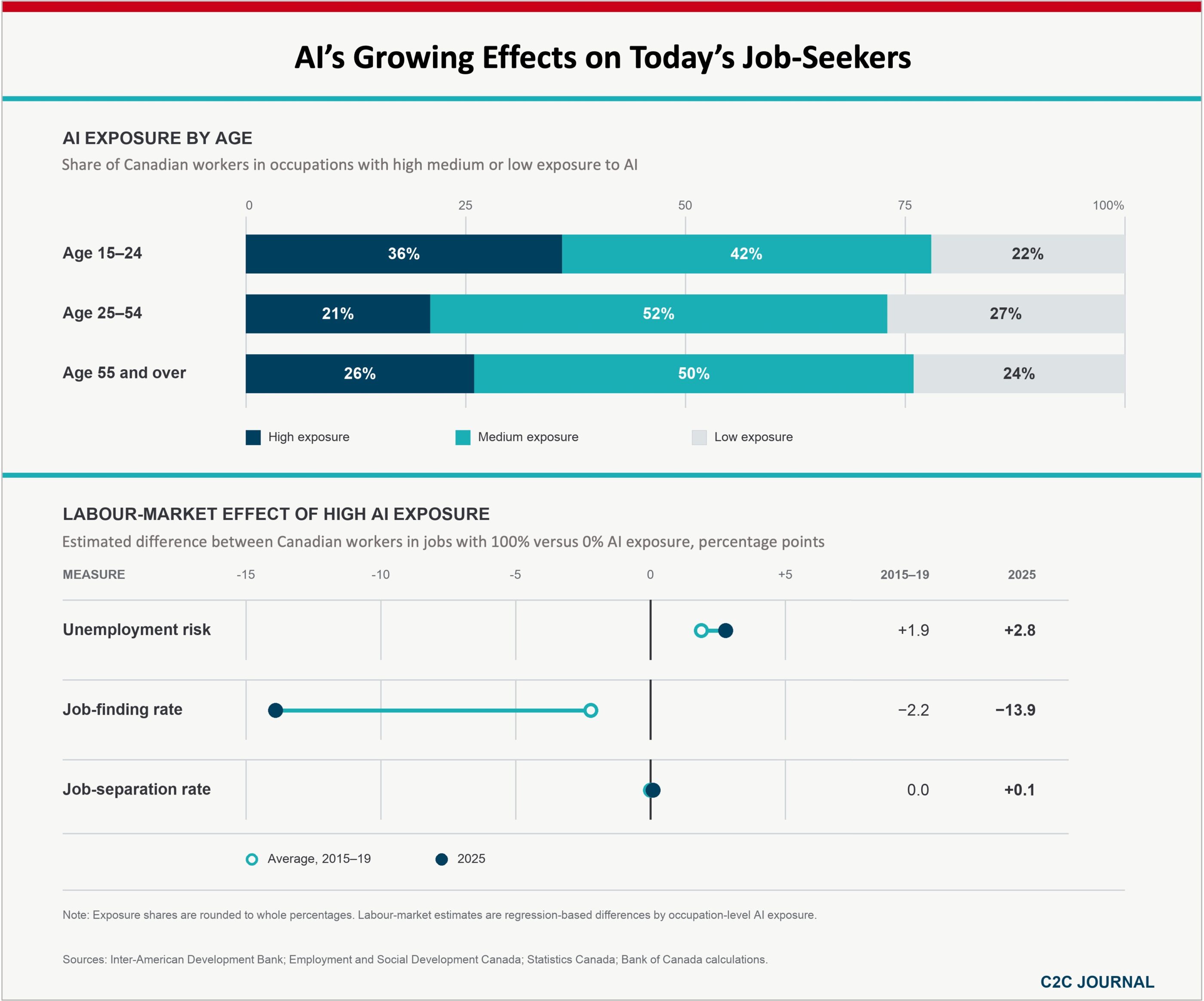
The U.S. evidence points in the same direction, with important caveats. Stanford’s Digital Economy Lab reports that employment among 22- to 25-year-olds in highly exposed occupations – which include software developers, customer-service representatives, accountants and auditors, and administrative assistants – stands 19 percent below where it would be had it kept pace with less-exposed peers.
Less-exposed roles include maintenance and repair workers, home-health aides, freight handlers and housekeepers/cleaners. Such roles overlap with the physical work Morgan described, although AI exposure measures specific tasks rather than simply dividing blue-collar from white-collar jobs. The Stanford researchers explicitly describe the result as an early, descriptive signal rather than proof that AI caused the gap.
Canadian evidence is more mixed. A Statistics Canada study through December 2025 found no statistically significant employment-growth difference across its AI-exposure groups, although employment in coding-intensive occupations stagnated for workers younger than 30 while growing among those aged 30 to 49.

A newer Stanford study helps explain why firms can become more productive while the junior share of employment falls. Using 1.25 billion job postings and 154 million employment records across 41 countries, the researchers found that foreign affiliates of AI-adopting companies reduced the junior share of their workforce relative to comparable firms. The decline mainly reflected stronger senior employment rather than a collapse in junior headcount. That is a more subtle shift than the familiar robot-takes-your-job story. But it’s a shift.
It also creates a long-term question: where will the next generation of senior workers come from if fewer people enter the workforce and accumulate experience? It echoes the age-old lament of young people trying to find their first decent job: the company says I need work experience before they’ll consider hiring me, but how am I supposed to gain experience if nobody will hire me? But in this case, the dilemma applies to the company as much as to the worker.
The Apprenticeship Hidden Inside Office Work
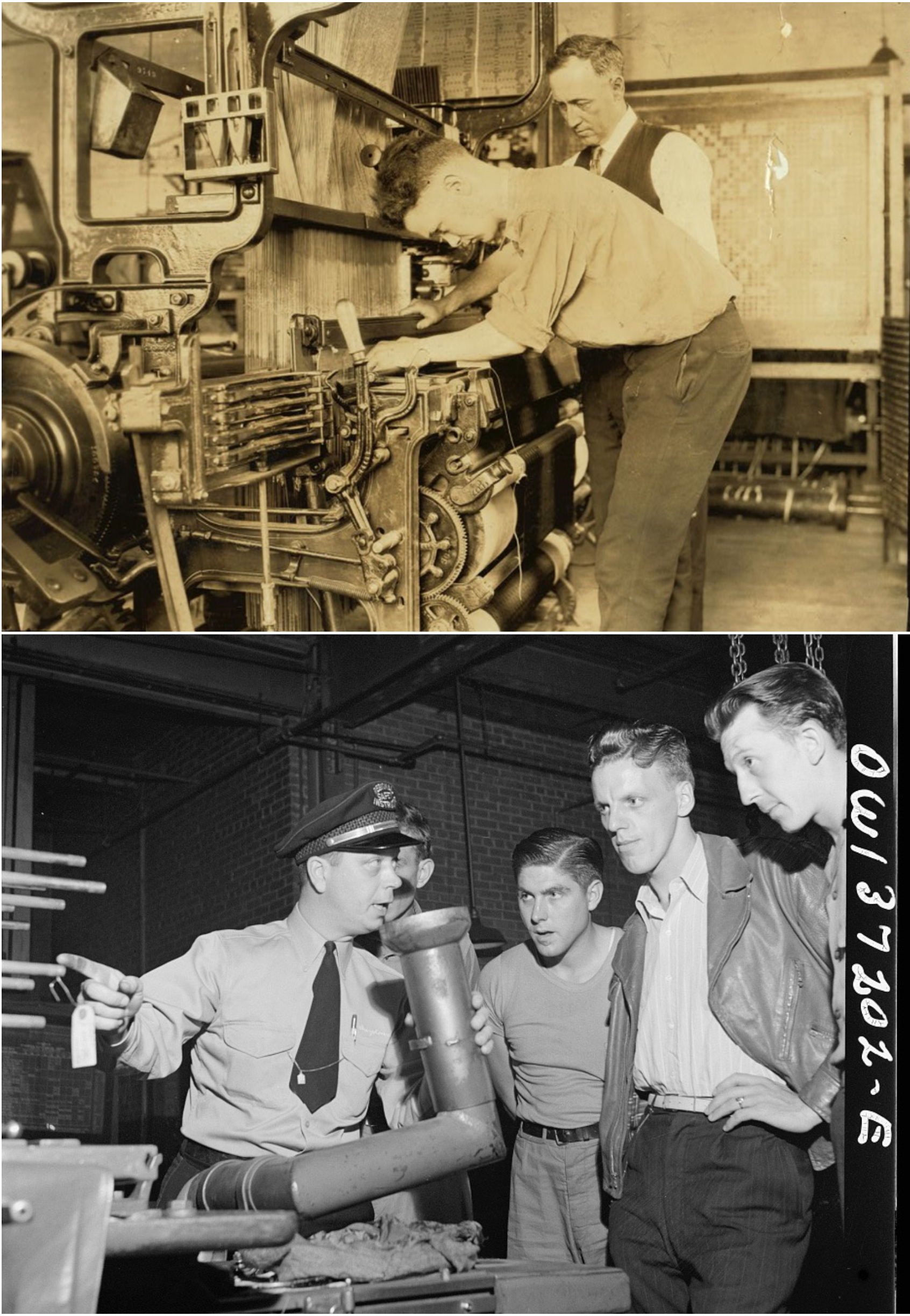
For probably the last two centuries, many white-collar job categories have contained an informal apprenticeship built through supervisors and co-workers that nobody called an apprenticeship. A new insurance employee reviews ordinary files before seeing ambiguous ones. A junior analyst cleans data, reconciles conflicting numbers, drafts a first memo and gets corrections. A young marketer writes routine copy, studies edits and eventually learns when a standard formula will backfire.

All of this work is overseen by seasoned older hands whose responsibilities – even if not their job titles – include mentoring the incoming generation. And remember, nearly all “blue collar” companies have always had a white-collar component. Think of the front-office sales team at the small Ontario auto-parts manufacturer or the Alberta oilfield fabrication shop. So the fresh-faced sales assistant goes into the warehouse and flags the parts for the big new order – and then their supervisor goes over every selection, piece-by-piece, fills in what the recruit missed, and explains what went wrong. The mentoring sometimes even takes longer than if the veteran did the work to begin with. Much of this work thus looks inefficient when measured task by task. But it is also how new employees acquire pattern recognition, judgment, customer context and a feel for exceptions.
Today’s generative AI is increasingly reshaping tasks inside exposed jobs, including parts of that training substrate. It can produce the first draft, summarize the file, classify the request, write the routine code and propose the obvious answer. Firms have a rational incentive to automate those tasks because the productivity benefit arrives immediately. Canada has good reason to care about those gains. The Bank of Canada has repeatedly warned that weak productivity leaves the nation’s economy more vulnerable to shocks, and Statistics Canada reported that job vacancies requiring a bachelor’s degree or higher were down by 6.9 percent year-over-year in the first quarter of 2026.
Yet eliminating a task and eliminating a learning opportunity are different decisions, even if they’re not always seen as such. A thoughtful management team could remove repetitive drafting tasks while deliberately preserving the parts of the workflow that teach their employees how to detect errors, handle exceptions and defend a decision. The danger comes when leaders measure only immediate output per worker. A process can look leaner this quarter while quietly producing fewer people capable of handling novel cases next year.
AI Can Accelerate Learning, Too
The strongest counterargument is that AI itself can teach novices, and there is real evidence for it. In a study in the Quarterly Journal of Economics, Erik Brynjolfsson, Danielle Li and Lindsey Raymond analyzed data from 5,172 customer-support agents. AI assistance increased their productivity by 15 percent on average. Less experienced and lower-skilled workers gained more, while the most experienced workers saw smaller benefits. The researchers also found evidence that AI assistance helped people learn and shared useful practices across a workforce.
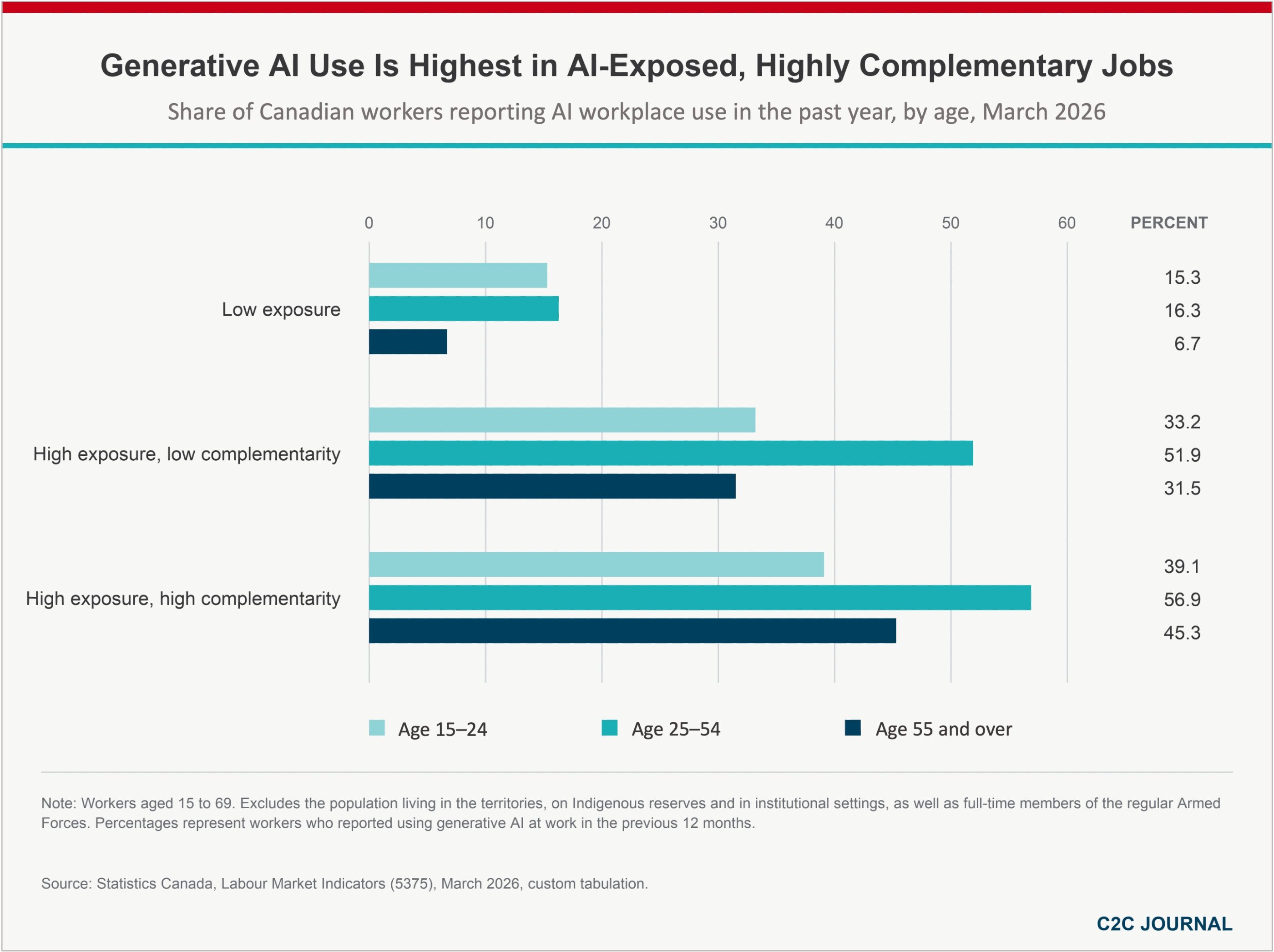
That distinction between automation and complementarity, where AI helps people perform tasks more effectively instead of replacing their role, could become decisive. Statistics Canada reports that Canadian workers already use generative AI at very different rates depending on the nature of their work. In March 2026, 53.8 percent of workers in high-exposure, high-complementarity occupations used generative AI at work, compared with 45.9 percent in high-exposure, low-complementarity occupations and 14.2 percent in low-exposure jobs. The question for employers is therefore less whether workers will use AI than what role AI will play in the learning process.
Governments have started treating AI literacy and work experience as related problems. Ottawa’s new National AI Literacy Initiative offers practical AI learning for students, educators, workers and communities. A separate federal spending measure announced in September will support 10,000 AI-related work placements for post-secondary students, recent graduates and postdoctoral fellows. Earlier in the summer, the fifth phase of CanCode set out to provide AI and coding learning opportunities to more than 1 million students and teachers.
Those initiatives are intended to address access to skills, although, as with all federal government measures these days, it’s uncertain what will come out of them. Either way, employers still control the daily architecture of competence. A three-hour AI course cannot substitute for months of navigating difficult customer interactions, ambiguous evidence and decisions that carry consequences. Canada’s own labour-market work done for the 2025 G7 meeting, the Compendium of Best Practices, emphasizes that workers in AI-exposed occupations need problem-solving, digital, social and management skills alongside AI capability. Those skills don’t develop merely by becoming familiar with new digital tools, but through repeated practice and feedback.

The practical response does not require preserving obsolete busywork. Employers can automate a routine first draft while requiring junior staff to verify sources and factual accuracy, identify what the model missed and explain the final judgment. Courts have already encountered legal briefs containing invented AI-generated case citations. That experience gives firms another reason to demand source checks and defensible human judgment.
Managers in turn can use AI to generate practice cases, then use their own experience and judgment to assess employees on the underlying concepts. They can rotate newer workers through the handling of exceptions under supervision, instead of shielding them from every difficult case. Managers can also track whether an employee is becoming better at catching errors, operating under escalating uncertainty and making decisions independently, rather than counting only how many tasks AI helped them complete.
The incentive problem is easy for companies to miss because the costs of such training and mentoring and the benefits arrive on different clocks. If a junior employee spends an hour reconciling a messy file, the firm pays for that hour today. If the same employee learns enough from the exercise to make a sound independent decision two years from now, the payoff arrives later and may benefit another employer. In the past, this was simply accepted; we might lose a promising young employee whom we trained and mentored, but we’ll probably gain another who has decided to move on from a different organization. That is how much of the economy – and society – has functioned since the Industrial Revolution.
Today, automation makes it tempting to remove developmental work even when the organization still needs experienced judgment in the future. That temptation is stronger when managers are rewarded for quarterly throughput, headcount efficiency or short-term cost reduction.
Consider an insurance team. A new employee once learned by processing a large volume of ordinary cases, seeing which details mattered and gradually recognizing the unusual ones. An AI system can now classify many routine files, summarize the evidence and recommend a disposition. Simply accepting those recommendations makes the junior worker faster but probably teaches them little or nothing. A redesigned workflow could sample routine files for independent review, require the employee to identify disagreements with the model, route unusual cases to supervised discussion and periodically test whether the employee can reason through a case without assistance. The same technology then removes clerical repetition while increasing exposure to judgment.
Such an approach demands better than lowest-common-denominator companies, organizations with vision, dedication and more-than-quarterly thinking. It matters greatly, because expertise is partly a stock accumulated through thousands of small encounters. Organizations rarely know which particular routine case will teach the lesson that later prevents an expensive mistake.
The sensible goal is therefore selective automation. Remove repetition that adds no learning value. Preserve enough direct contact with the work for novices to build mental models, and deliberately redirect some of the time saved by AI into harder cases, feedback and supervised decisions. That approach makes the productivity gain visible today without treating future competence as a free resource.
Productivity and workforce development can reinforce each other. The evidence suggests that AI can raise the productivity of novice workers when it transfers useful knowledge, while hiring patterns can still shift against younger workers when firms use the same technology primarily to substitute for junior tasks. The design of work determines which effect dominates inside an organization.
A Better Measure of AI Success
For years, Canadian productivity debates have focused on capital investment, competition, regulation and technology adoption. More recently, tariffs and questions about Canada’s response have joined the debate. Those issues all remain important. AI adds another asset that is harder to see on a balance sheet: the stock of human judgment inside a firm. Every organization depends on experienced people who can recognize when the normal process has stopped being normal, and who can take corrective action. Such capability has always taken time to build.
The central test for workplace AI adoption should therefore include two numbers. The first is straightforward: how much more useful output does the organization produce with the same resources? The second takes longer to observe: are junior employees becoming capable of doing harder work with less supervision? A company that improves the first number while degrading the second may have borrowed productivity from its own future.
Canada’s AI opportunity is real. So is the possibility that organizations obsessed with immediate efficiency could automate away part of the process by which an entire economy’s expertise renews itself. The most durable productivity gains will come from using AI to remove low-value repetition while preserving, and sometimes accelerating, the experiences through which people learn to exercise judgment. For Canada, the relevant measure is whether both sides of that ledger improve together.
Gleb Tsipursky, PhD, is a behavioural scientist, CEO of Disaster Avoidance Experts, and author of The Psychology of AI Adoption at Work: From Resistance to Results (Georgetown University Press, 2026).
Source of main image: ChatGPT.