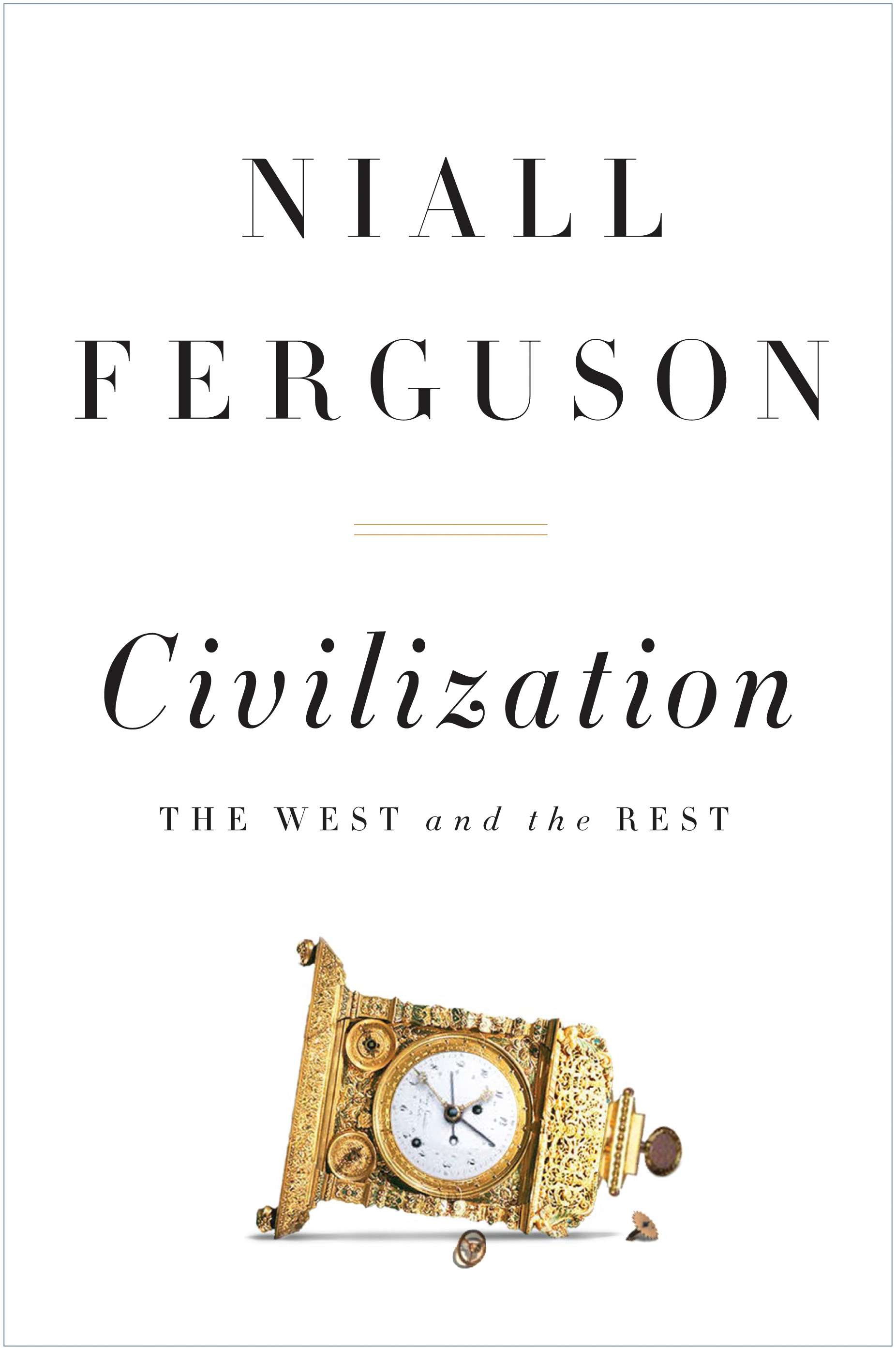
Civilization: The West and The Rest. Niall Ferguson. New York: The Penguin Press, 2011, pp. 402, $40.50.
Reviewed by Patrick Keeney
In this lucid and engaging account, Niall Ferguson, the prolific Harvard historian, sets out to analyze the reasons for Western supremacy from 1500 to the present, and, in light of this analysis, to ask if the decline of Western civilization is inevitable. Ferguson’s aim is ambitious, covering approximately 500 years of world history. This is narrative history on a grand scale.
The decline of Occidental civilization has been a recurring theme among historians since at least 1918 when Oswald Spengler published his Decline of the West. Yet, as Ferguson makes clear, there is nothing inevitable about the degeneration of any civilization. The belief in inescapable decline arises from mistakenly thinking about civilization in metaphors borrowed from nature. We see the cycle of birth, growth and decay throughout nature, including our own lives, and so are seduced into falsely thinking that civilizations are similarly ordered.
But civilizations are the opposite of natural constructions. They are the products of human thought and ingenuity, and so rise and fall – not according to a necessary natural order – but rather by patterns of thoughts, ideas and beliefs and the practical consequences that flow from these. In other words, civilizations are, in their essence, the outcome of a particular cultural mindset.
What then constitutes Western civilization? This is a famously contested question, and Ferguson’s answer is one that places the emphasis on ideas and values rather than on blood or territory: “The ‘West’ … is much more than just a geographical expression. It is a set of norms, behaviours and institutions with borders that are blurred in the extreme.” It is a logical entailment of this definition that “Western peoples” are not defined by race or ethnicity, but rather by a particular cultural mindset. As the author notes, “… some of the most ardent and eloquent defenders of Western values today [have] ethnic origins … very different from my own.” In this context, it is worth noting that the book is dedicated to Ayaan Hirsi Ali, the Somali-born writer whose defense of the West and unyielding critique of Islam has generated much controversy.
Ferguson, while far from a triumphalist, self-satisfied apologist for all things Western, is nevertheless an unabashed admirer of the Western achievement. His unrepentant celebration of the West’s accomplishments strikes a breath of fresh air in an age that has been raised on multicultural platitudes, not to mention the guilt-inducing pieties of the school of history known as “post-colonialism.” He writes:
… [T]his Western package still seems to offer human societies the best available set of economic, social and political institutions – the ones most likely to unleash the individual human creativity capable of solving the problems the twenty-first century world faces. …. The big question is whether or not we are still able to recognize the superiority of that package.
In the author’s view, these institutions and cultural attainments are daily threatened by atavistic and barbaric forces, in particular by the all-pervading culture of relativism, which asserts that any idea, any theory, and any viewpoint -no matter how outlandish – is just as good as any other. In recent years, we in the West have lost faith in our institutions and have lost sight of our core values. Hence, “… the biggest threat to Western civilization is posed not by other civilizations, but by our own pusillanimity – and the historical ignorance that feeds it.”
An overarching question guides Ferguson’s enquiry: What allowed a small handful of countries on the western edge of the Eurasia land mass to so completely dominate the rest of the world and “trump the outwardly superior empires of the Orient?” The dominance and superiority of the West is not mere chauvinism or Eurocentrism: Western superiority is a historical fact. And while Ferguson has no illusions that the reign of Western civilization is unblemished or without its share of tragic events, he dismisses the multicultural fad that would have us believe that “cultures are in some sense all equal” as “demonstrably absurd.” Nor does he buy into the romanticism and nostalgia that attaches to history’s losers. Rather, the rise of the West is the “single most important historical phenomenon of the second half of the second millennium after Christ.”
And the world is increasingly taking on the norms of Western culture, including the demand for political freedom. As Arthur Schlesinger once noted: “When Chinese students cried and died for democracy in Tiananmen Square, they brought with them not a representations of Confucius or Buddha, but a model of the Statue of Liberty.” And the broader demotic culture of the West, from blue jeans to American music and Hollywood blockbusters, is increasingly the template for the rest of the world: “A growing number of Resterners are sleeping, showering, dressing, working, playing, eating, drinking and traveling like Westerners.” With each passing year, the world becomes increasingly Westernized.
What then explains the Western ascendancy and its conquest and colonization of so much of the world? Ferguson is quick to acknowledge that the fortuitous weakness of its rivals played a vital role in Western domination. The various internal crises in competing civilizations – whether the fiscal and monetary crisis of the Ming dynasty, or the “unlimited sovereignty of religion in the Muslim world”, or the military decline and retreat of the Ottoman Empire – had nothing to do with the West, yet they opened opportunities that the West was quick to exploit.
But as fortuitous for the West as these internal struggles were, the real power of Western domination lay elsewhere. In Ferguson’s view, the mainsprings of Western power rest on “six identifiably novel complexes of institutions and associated ideas and behaviours.” Borrowing a metaphor from computer science, Ferguson speaks of six “killer applications.” These six “killer apps” account for the differences between the West and the Rest. They are 1) competition; 2) science; 3) property rights; 4) medicine; 5) the consumer society; and 6) the work ethic. When taken together, they account for what distinguishes the West from the Rest and makes it superior. Ultimately, then, Western civilization rests on these six ideas. The author devotes a chapter to each of them, elaborating on how, exactly, a particular idea has manifested itself in the West, while at the same time failing (or only partially succeeding) in rival civilizations.
Ferguson’s list is, of course, open to discussion and debate. For my part, I think Ferguson has underplayed what lies at the basis of all Western institutions: namely, a long tradition of self-criticism and a capacity to submit even our most cherished beliefs and traditions to critical scrutiny. This daring and unfettered quest for knowledge, this boundless intellectual curiosity was first exemplified by the radical questioning of Socrates at the very dawn of the Western project. It is this tradition of what Bertrand Russell called “liberating doubt” that is a touchstone of the Western tradition, and one that has no real equivalency outside of the West. However, this is a quibble. As Ferguson writes, quoting the jazz pianist Thelonious Monk, “Don’t play everything, or every time; let some things go by… .”
Throughout the book, certain salient points emerge. First is the critical point that the differential between the West and rest was institutional. The West’s signal achievement lay in the development of cultural attitudes and their institutional codification. Foremost among these was the natural philosophy that led to the rise of science, and the application of scientific knowledge to the world. Especially important was the application of scientific knowledge to the realm of military power.
Scientific literacy, with an emphasis on the empirical and the experimental, is a crucial element of the Western mind. And here we encounter an important fault line between the West and its Muslim rivals. While it is true that Islamic scholars were in part responsible for transmitting to the West the learning and scholarship of the ancient world, Islam critically failed to reconcile faith with reason. What the author calls the “unlimited sovereignty of religion in the Muslim world” ultimately meant that Islam was unable to reconcile itself with scientific knowledge, a failure that proved (and continues to prove) disastrous to the nations of the Near East.
One of the deep divergences between the West and Islam revolves around their respective attitude toward science and the recent attempts by Muslim nations to catch up. So while Iran, for example, tries to successfully close the scientific gap by developing nuclear weapons, and other Islamic nations attempt to modernize by sending their children to Western universities, we can still meaningfully ask: “Can a non-Western power really hope to benefit from downloading Western scientific knowledge, if it continues to reject that other key part of the West’s winning formula: the… institutional innovation of private property rights, the rule of law and truly representative government?”
In addition to the material prosperity brought about by science, the West has also developed distinctive institutions in education, the judiciary and in government. Politically, the West has evolved means of providing democratic, secular and stable government, one that crucially turns on the division between Church and State. Unlike Islam, which recognizes only the law of Allah as codified in sharia, the West early on developed secular institutions. An independent judiciary predicated on the inherent dignity of the individual guarantees a wide variety of individual freedoms, most crucially, freedom of speech and freedom of conscience. Western universities, understood as autonomous corporate entities free from government control, continue to provide the standard against which all others are measured.
Ferguson’s celebration of Western culture is tinged by a certain trepidation about the future. His anxieties include the spiritual vacuum that is exemplified by the empty churches of Europe, and which makes the West vulnerable to various brands of Islamic extremism; the failure of capitalist competition as evidenced by the recent financial crisis; the fact that so few students study science; the violation of property rights by various levels of government; the insatiable appetite for taxation; and an enervating culture of relativism, one which is little more than a form of intellectual disarmament.
This is a learned book, but one which is written for the general public. The author makes his case in language that is vivid and direct. It contains an extensive bibliography and complete footnotes.
Through centuries of struggle, the West has managed to produce a unique and superior civilization. In the author’s view, the peoples of the West need to become mindful of what is at stake. We need to take heed, and stop taking for granted the very real achievements of the West, in particular our hard-won political freedoms. Western civilization is one that should be celebrated and defended without hesitation or apology. In Ferguson’s cogent account, the reader is led to a new appreciation of Western achievement and what we stand to lose if we fail to preserve and defend our values.