Stories

Nothing corrupts like power: What Margaret Thatcher taught the world

Mark Milke
April 9, 2013
Stories

Nothing corrupts like power: What Margaret Thatcher taught the world

Mark Milke
April 9, 2013
Share on Facebook
Share on Twitter

Throughout human history, men and women have struggled to tear themselves free from concentrated power and its ill effects. While many people in developed, democratic and capitalist countries often take their freedoms for granted, history is filled with tyrants and bullies who stand between citizens, their freedom and their prosperity.

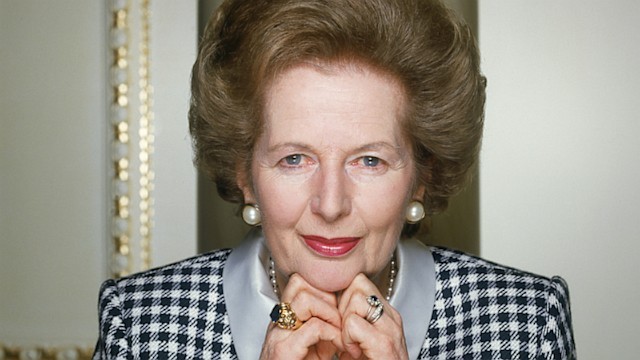
Margaret Thatcher, Great Britain’s Prime Minister between 1979 and 1990, and who recently died, understood—perhaps better than any other leader in the modern world, why governments ought not to have day-to-day control over the economic aspects of citizen’s lives.

The reason for that limited approach to government is simple: governments already have 100 per cent of the political power.  By necessity, a national government also has 100 per cent of a nation’s military power. Thus, it is a grand mistake to also allow government involvement in the economic lives of citizens. Such involvement has often meant that citizens have nothing left—not only figuratively, but often literally.

In Thatcher’s lifetime, the most extreme example of the concentration of political, military and economic power was the Soviet Union.  There, poverty was rampant and freedoms were non-existent.

In the West, less extreme forms of concentrated power existed, but they nevertheless also produced disastrous consequences.

For example, pre-Thatcher, the United Kingdom’s Labour party had long advocated state ownership of “the commanding heights of the economy.”  That was a 1918 phrase and program of action from Vladimir Lenin; in Canada, it was adopted by the Waffle wing of the New Democratic Party in the 1970s.

In practice in the United Kingdom, this meant government ownership of major sectors and industries: those in the production of coal, iron and steel and which ran the railroads, utilities, and international telecommunications.

In the 1970s, much of the British economy was tied to government and thus to the decisions of politicians. That, and laws that gave labour leaders extreme leverage over state companies, meant regular and sometimes lengthy strikes. Strikers included miners, train staff, hospital workers, garbage collectors, truck drivers and even grave-diggers who refused to bury the dead.

The result was economic paralysis, stagnation and weakened prosperity. In 1976, the economy was so poor that Britain, once a world-spanning power, borrowed money from the International Monetary Fund to support the British pound.

Margaret Thatcher changed all that. After her 1979 election win, she set about freeing Britain’s economy. That included an attack on inflation (reduced to 2.4 per cent by 1986 from 22 per cent six years before); getting public finances under control; and cuts to high marginal tax rates (down to 25 per cent from a pre-Thatcher high of 83 per cent).

The Iron Lady also promoted private enterprise. That meant privatizing state ownership of companies in the aerospace and shipbuilding sectors. It later included returning British Telecom, British Airways, Rolls-Royce, parts of British Steel, Leyland, the airports, and later, gas, water and electricity utilities to the private sector where they belonged.

Thatcher attacked over-regulation and labour agreements that dampened the creation of new businesses, more jobs and a wider prosperity. Trade union members were given more power over union leaders (thanks to the introduction of the secret ballot, among other reforms). The British Prime Minister also cut off taxpayer subsidies to failing industries such as money-losing coal mines; she sold government housing to the (often poor) inhabitants so they could finally have property of their own and a real stake in Britain’s future.

All of it worked to restore Britain to prosperity. While Britain is currently in recession (as is much of Europe) it is better off relative to many European countries. This is so despite past attempts by the previous Labour government to undo some Thatcher policies on deficits and taxes.

Thatcher’s influence was profound. It resulted from her clear understanding about what works in the real world. That understanding had its genesis in youthful observances of how her father ran his small grocery store.

As Lady Thatcher wrote in her 1993 book, The Downing Street Years, “I knew from my father’s accounts that the free market system was like a vast sensitive nervous system.” That system, wrote Thatcher, was able to respond to events and signals all over the world. Thus, the system could “meet the ever-changing needs of peoples in different countries, different classes, of different religions, with a kind of benign indifference to their status.”

That open system, Thatcher rightly asserted, was much preferable to top-down attempts where “governments acted on a much smaller store of conscious information and, by contrast, were themselves ‘blind forces’ blundering about in the dark, and obstructing the operations of markets rather than improving them.”

As Thatcher concluded, “the [negative] economic history of Britain for the next forty years confirmed and amplified almost every item of my father’s practical economics.” Indeed—until Margaret Thatcher redirected and transformed Great Britain.

~

Mark Milke is a Senior Fellow with the Fraser Institute, the editorial board chair of C2C Journal, and author of Why Margaret Thatcher Mattered: The Iron Lady for a New Generation

Love C2C Journal? Here's how you can help us grow.

More for you

The Ultimate Green-Washing: how LEED certification raises construction costs and worsens housing affordability while sidelining genuinely sustainable architecture.

The Ultimate Green-Washing: The False Promise of LEED Certification

Builders, developers and politicians have all avidly pursued LEED certification of major buildings and housing over the past several decades. Meant to be the pinnacle of “green” construction standards, LEED demands not just energy efficiency but the pursuit of many nakedly ideological goals like public transit use and even social equity. And its effects go far beyond virtue signalling and woke positioning. As this investigation by engineer Greg Wilson reveals, not only does LEED certification drive up construction costs and make housing affordability even more problematic, but buildings constructed to display its contradictory desires often consume more energy than traditional ones. Wilson calls for a return to sanity and a true form of sustainability: buildings that work well and will last for centuries.

B’nai Brith Canada and other Jewish groups back Canada’s “anti-hate” laws, including the Combatting Hate Act and Online Harms Act – a bet on state power that Ezra Levant and John Carpay warn will backfire.

Misplaced Faith: Why B’nai Brith Canada and Other Jewish Groups Should Oppose “Anti-hate” Laws

That free speech has been fundamental to Judaism for over 3,000 years is especially admirable considering the innumerable anti-Semitic attacks that uncontrolled public discourse has emboldened over the centuries. The courage it takes to defend that principle in present-day Canada is beginning to fray, however, as prominent Jewish organizations like B’nai Brith Canada are backing Ottawa’s recurring expansion of “anti-hate” laws – most recently with the Combatting Hate Act and Online Harms Act. But such legislative cudgels never work, writes Lynne Cohen in this originally reported essay – and often end up being used to batter their original proponents. Seeking safety behind the power of the state, Cohen argues, is exactly the wrong approach. Free speech can be messy, unpleasant – and very hard to extend to one’s enemies – but the alternative is far worse.

“First One to Shine”: Reflections on My Indian Residential School Experience

If you want to learn the truth about a time and place, it would make sense to ask some of those who were there. In this heartfelt memoir, Elaine Ayoungman Clifton, who was born into the Siksika First Nation near Calgary, tells a story today’s activists don’t want you to hear. Far from an instrument of repression and evil, the Indian Residential School she attended for a decade was warm and welcoming, the teachers caring and conscientious. They instilled in her a love of reading, did not try to crush her language and culture, and did not try to separate her from her large family. “I am grateful for what they taught me and the care, friendship and love they gave to me over many years,” Ayoungman Clifton writes. If Canadians really want to respect the lived experience of all Indigenous people, hers is an authentic voice we should listen to.

More from this author

Not So Beautiful Minds: Conspiracy Theories from JFK to Oliver Stone and Donald Trump

Shocking events that plunge a country into chaos or destroy a beloved leader are hard for anyone to process. The evil done is so towering it bends the human psyche to accept that the evildoer is utterly banal, a loner walking in ordinary shoes. The cause simply must befit the outcome; thus can a conspiracy theory be hatched. At other times, the cold hope of political or financial gain or simple mischief might be the source. There certainly is no shortage of conspiracy theories. Mark Milke revisits one of history’s most famous political assassinations and the conspiracy theories it spawned to illuminate the ongoing danger this toxic tendency poses to us all.

Picture of Thomas Hobbes frontispiece of Leviathan. A renowned pieceof political work on liberty

Future of Conservatism Series, Part VII: Memo to Politicians: We’re Not Your Pet Projects

Canadian conservatives have most of the summer to ruminate on what they want their federal party to become – as embodied by their soon-to-be elected leader, anyway. Acceptability, likability and winnability will be key criteria. Above all, however, should be crafting and advancing a compelling policy alternative to today’s managerial liberalism, which has been inflated by the pandemic almost beyond recognition. Mark Milke offers a forceful rebuttal against the Conservative “alternative” comprising little more than a massaged form of top-down management.

Leaders_debate_2019_canada_diversity_bias_free_speech_liberal_conservative

So Much for Diversity: The Monochromatic Moderators of Monday’s Debate

Canada is a big, diverse country by virtually any measure, from our no-longer-so-sparse population to our epic geography to the ethnic makeup of our people. Diverse in every way, it seems, except in our elites’ aggressively progressive official-think. Consistent with this is the otherwise bizarre decision to have Monday’s federal leaders’ debate hosted by five decidedly similar female journalists. Mark Milke briefly profiles the five and, more important, advances a positive alternative: five distinguished women diverse in background, hometown and, above all, thought.