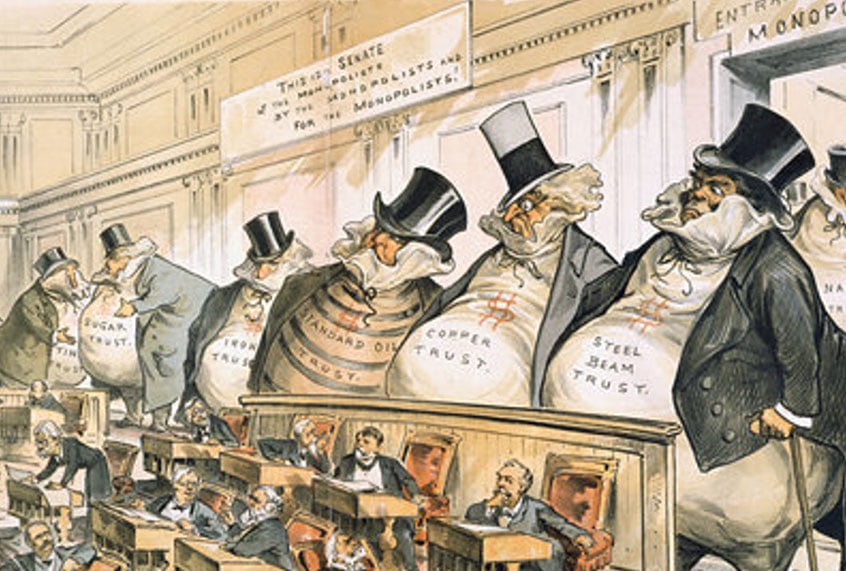
In response to the possible resurgence of wealth taxes, “at least in the dreams of left-wing politicians,” Andrew Coyne asked in a column earlier this summer: “What is the problem to which this is a solution?” The ostensible answer came in an article by Erika Beauchesne of Canadians for Tax Fairness: “Growing inequality is the problem. The richest families in Canada are now more than 4,400 times wealthier than the average family, according to a study by the Canadian Centre for Policy Alternatives (CCPA).”
There it is: the purpose of the tax is to take a whack at rich people. It would be easy to let the “4,400 times wealthier” claim skate by unchecked and dive into the alleged problem of some rich people having too much money, for which this tax is a solution. The statistic bears close examination, however.

First, the CCPA report examined only 87 families, or Canada’s top 0.001 percent. The fact that people in the top 0.001 percent are much richer than average is not of particular interest or concern. It’s almost necessarily true in virtually any society. Second, looking solely at the inequality of wealth – that is to say, the accumulated assets of various categories of people – vastly overstates the differences in how various Canadians actually live. As the CCPA report itself notes, inequality of income is much less extreme than that of wealth. Other research shows that the inequality of people’s consumption is, in turn, much less extreme than that of income. What that means is that the average Canadian by no means consumes a mere 1/4400th as much as members of those remote, super-wealthy 87 families. Finally, inequality in the standards of living of Canadians is much less than that of consumption, income or wealth.
Exaggerated claims of inequality aside, the main weakness in the case for the wealth tax is that it lacks a convincing explanation as to why it’s problematic that Canada has 87 very rich families. Would the ordinary person be better off if the wealthiest families had less money? Surely not, unless the money was accumulated through nefarious means.
Indeed, to the extent that economic transactions are voluntary and governed by the rule of law, the better off are the wealthiest members of society, the better it is for everyone else, too. (We’re not talking about corrupt or lawless societies, especially those retaining the primitive tribal view of wealth hoarding rather than creation; in such societies economics is a zero-sum game and inequality often indicates unjust relationships.) The single greatest factor that has driven the growth of prosperity is trade. The average person is better off having very rich people to deal with, as opposed to having only the poor available as customers. The richer a person’s trading partners, the more that person can hope to get in return.
Simple examples illustrate this point. Is somebody better off working for a rich employer or a poor one? Is a struggling farmer likely to pay higher wages than a profitable manufacturing company? And is a restaurant owner – as well as their employees – better off if his most frequent diners are rich or poor? Who wants the nicer cut of beef, the fancier bottle of wine? Who tips more? Surely sellers of labour, food, and everything else do best if their customers are rich. So then who, exactly, would benefit if the rich had less money?

Columnist Peter Foster provided a useful thought experiment regarding wealth inequality. “Nobody on earth has done more to widen the gap [between rich and poor] than Bill Gates, the founder of Microsoft,” Foster wrote in his book Why We Bite the Invisible Hand. “So would the world be a better place if Bill Gates – and all the other billionaire entrepreneurs – had never been born? In fact, what the wealthy in a capitalist society are ‘guilty’ of is not taking too much, but creating too much.”
In creating and selling things that made millions or billions of the rest of us better off, Gates and others like him have pulled further away from the pack. More generally, most of our own country’s great companies since the very beginning were created by people pursuing wealth. In so doing, they generated productive jobs for millions, retirement incomes for ordinary Canadians, and made staggering philanthropic contributions, many of which continue today. Without them Canada would be immeasurably worse off, and Canadians much poorer. Some of today’s “87” are their descendants. Punishing them for their forebears’ successes seems churlish, to say the least.

Indeed, if we want to argue that the wealthiest families are “taking” too much, Foster contends, we might also want to castigate the Beatles for grabbing an “unfair” share of pop music income and accuse bestselling authors of taking “too much” of the book market. But just as the Beatles are celebrated for enriching society, so too should be wealthy CEOs and investors. As Foster concluded, even “if Bill Gates never had a philanthropic bone in his body, he would still rank as one of the greatest benefactors of mankind.”
Besides nowhere explaining why it is problematic for rich people to have lots of money, Canadians for Tax Fairness’s case for wealth taxes is weak in other ways. Their article argues, for example, that research from the OECD has “suggested that countries increase taxes on wealth.” Problematically for them, the OECD’s news release on the cited study says that its report “assesses the case for and against the use of net wealth taxes…but does not call for their introduction.”
Its argument from authority razor-thin, Canadians for Tax Fairness turns quickly to public opinion, citing apparent popular support for a wealth tax. The argument, however, that increased government redistribution of people’s net assets is good economic policy because the majority of the public judges it to be so is not one that should be accepted even in a high school economics class.

The organization goes on to say that polls find “support among the very group the tax would target.” Fabulously wealthy people claiming to support higher taxes on their own kind is a recurring phenomenon in both Canada and the U.S. But if that’s so then, in the meantime, until their desired policy is passed into law, such people will no doubt write annual cheques to their government equal to whatever percentage of their wealth they feel is appropriate. Come to think of it, there’s no need for a tax at all. That this never happens indicates the sincerity underlying these claims.
Naked pragmatism is still another argument for a wealth tax. Bluntly put, governments just need more money. In the United States, Senator Elizabeth Warren, a leading candidate for the Democratic presidential nomination, has proposed a wealth tax that she claims would raise over US$200 billion annually. But if there is new spending to be funded, surely cutting existing government fat would be the best way to do so, and even if taxes need to rise, a wealth tax is an inordinately inefficient way to increase government revenue.

Significant economic harm would be caused by discouraging the most enterprising members of society from creating more wealth and from investing capital in its most productive uses. A wealth tax would instead encourage them to dissipate more of their existing wealth through consumption before it could be taxed, or to hide it in asset classes that are harder to tax. These perverse incentives and unintended – though easily foreseeable – consequences ensure that the roaring torrent of promised government revenue would be a disappointing trickle (probably leading to calls for even higher taxes).
The wealth tax, in sum, purports to solve a problem that does not exist, while creating a myriad of new problems. Aside from its fundamental injustice, its greatest tragedy would be reducing the incentive for future wealth-seeking inventors and innovators to create the life-improving, prosperity-lifting things nobody has even thought of yet.
Matthew Lau is a Toronto writer.