

Climate and Economy

Averting “Climate Poverty” for Canada’s Middle Class

Matthew Lau
March 14, 2020
Pursuing grandiose visions tends to cloud judgment, and when the vision is saving our very planet from an apprehended climate crisis, it’s little surprise that numbers are fudged, logic is twisted, the hardest-hit are ignored and entire social classes are cast into the trash. Matthew Lau, however, refuses to be dazzled by dreams. In this article, Lau remains rooted in reality and fixed on crunching the numbers to come up with some arresting conclusions about the huge costs of government climate policies to working people here and now, set against marginal if not ephemeral benefits to come over the next 80 years.
Climate and Economy

Averting “Climate Poverty” for Canada’s Middle Class

Matthew Lau
March 14, 2020
Pursuing grandiose visions tends to cloud judgment, and when the vision is saving our very planet from an apprehended climate crisis, it’s little surprise that numbers are fudged, logic is twisted, the hardest-hit are ignored and entire social classes are cast into the trash. Matthew Lau, however, refuses to be dazzled by dreams. In this article, Lau remains rooted in reality and fixed on crunching the numbers to come up with some arresting conclusions about the huge costs of government climate policies to working people here and now, set against marginal if not ephemeral benefits to come over the next 80 years.
Share on Facebook
Share on Twitter

By today’s standards, the quality of life 80 years ago was comparatively awful. In 1940, for instance, only about half of American households had indoor plumbing. Most still did not have central heating, a telephone, or a washing machine, none of which even were recent inventions at the time. Medical care was far worse than today, and the life expectancy was only 63 years, about the same as in Canada.

Given the vast improvements from 1940 to 2020, we might reasonably expect that 80 years from now the quality of living will again be far better than it is today. And just as the average person, at least in developed countries, in 2020 has access to better goods and services than even the wealthiest members of society in 1940, it’s entirely possible that the average person in 2100 will be materially more comfortable than even the “top 1 per cent” in 2020.

Lau - Inset 1 (above)
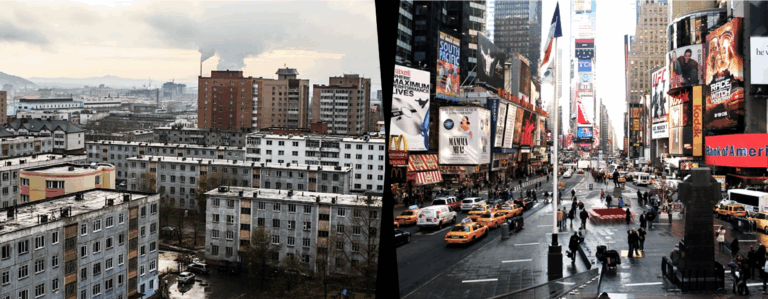
80 years of progress: Compared to the harsh living conditions in the 1940s, developed countries are far better off.

This is an expectation that should not be altered by predictions of catastrophic global warming. Indeed, as economics professor Steve Ambler at Université du Québec à Montréal wrote last fall in the Financial Post, “If we fail to meet the goals set out in the Paris Agreement – if in fact we do nothing to reduce greenhouse gas emissions,” then the best estimate from the Intergovernmental Panel on Climate Change, the UN body dedicated to synthesizing worldwide climate change research, “is a rise in average temperature in 2100 of 3.66 [degrees] C and a reduction of 2.6 per cent in world GDP.”

To be sure, 2.6 per cent of world GDP (estimated to be US$87.3 trillion in 2019) is nothing to sneeze at. But assuming conservatively that real GDP per capita increases by 1 per cent annually, Ambler noted, people living in 2100 will be more than twice as productive as we are today. In that context, 2.6 per cent is a rather modest reduction. And it is, after all, not a 2.6 percent drop from today’s level, but simply 2.6 percent gradually shaved off the cumulative growth expected over the next 80 years. Similarly, if our incomes today were cut by 2.6 per cent, surely we would still consider ourselves vastly better off than people living in 1940.

What is curious is that the economic effects of global warming – an expected 2.6 per cent reduction in income to people living in 2100 – is a cause of such professed shock and horror to left-wing politicians and activists. They, after all, constantly clamour for ever-increasing taxes on the top 1 per cent of income earners today (as well as on lower income categories). This is purportedly to help the lower and middle income groups. So why are they also the loudest advocates for expensive climate policies that make lower and middle income people poorer today, in order to benefit the much richer people living in 2100?

Lau - Inset 3 (above)
Is a 2.6 per cent reduction in GDP caused by climate change over 80 years really a cause for shock and horror?

It is not even likely that today’s climate policy agenda – everything from carbon taxes and energy efficiency regulations and subsidies, to an ever-increasing regulatory burden on industry, to more radical schemes such as the “green new deals” proposed by the federal and some provincial NDP and Green parties in Canada in emulation of the most radical Democrats in the U.S. – will help the relatively richer people in 2100. They will certainly, however, cause the relatively poorer people in 2020 to be worse off.

Over a period of 80 years, 2.6 percent of GDP in the final year works out to an annual GDP growth rate of just over 0.03 per cent starting now. Put another way, assuming that the IPCC’s estimate is right, trying to prevent the 3.66° C temperature increase by 2100 only makes sense if we can do so at an average cost of less than 0.03 percentage points of GDP growth per year. 

In the Canadian context, note that the assumptions used in the Parliamentary Budget Officer’s April 2018 economic outlook suggested that the federal government’s $50-per-tonne carbon tax, when fully implemented, would cut real GDP by 0.45 per cent in 2021-22. That’s 15 times the break-even rate. And that’s just the federal carbon tax, and doesn’t include the costs of the vast array of other climate policies enacted by the federal, provincial, and municipal governments.

And if the economic effects of $50 per tonne sound bad, consider that according to the Ecofiscal Commission, the least costly way for Canada to achieve its Paris targets is through a $210-per-tonne carbon tax by 2030. Meeting the Paris targets would clearly be an expensive endeavour, especially since governments have a tendency to find the most economically expensive, rather than the most efficient, ways to do things.

xOpening up trade and cutting regulations could help to increase the well-being of Canadians.

Moreover, even if all countries met their Paris targets, there would be almost no compensating benefits in the way of mitigating the projected temperature increases. A peer-reviewed journal paper by Bjørn Lomborg of the Copenhagen Consensus Center in Denmark estimated that even if all Paris promises were fulfilled by 2030, the total temperature reduction relative to the “do nothing” scenario would be a mere 0.05° C by 2100.

Given the IPCC’s estimate of a 3.66° C temperature increase corresponding to a cut of 2.6 per cent in global GDP by 2100, the 0.05° C temperature reduction resulting from having every country meet its Paris targets – even assuming that doing so would not reduce GDP growth – would deliver almost no economic benefit to people in 2100. Even the projected environmental “benefit” would hardly be detectable against the background noise of our ever-shifting climate.

If we really wanted to help people in 2100, we should focus on increasing their wellbeing, starting with making up the IPCC’s “lost” 2.6 per cent in economic growth over the next 80 years (which, again, works out to just over 0.03 percentage points of GDP growth per year). This could easily be achieved by reducing taxes, tearing down barriers to free trade, eliminating counterproductive government programs, and cutting regulations on businesses and labour. Examples abound of governments implementing such policies in the past, with astounding positive effects on GDP.

x“Don’t underestimate the value of Doing Nothing.”

There is no need for the Paris Agreement or other grandiose government policies to reduce greenhouse gas emissions. Such policies will likely deliver no benefits to future generations while certainly doing significant harm to people today.

A government “do nothing” approach, by comparison, seems a good one. As it says in one Winnie-the-Pooh book: “Don’t underestimate the value of Doing Nothing.” Indeed, when it comes to government, nothing is usually the best thing to do.

Matthew Lau is a Toronto writer.
Love C2C Journal? Here's how you can help us grow.

More for you

From the Strait of Hormuz to Cuba, Net Zero is Dying – Mark Carney Needs to Let Go

After decades spent pursuing net-zero dreams at great cost to their economies and social fabric, most of the world’s industrialized nations are waking back up. War with Iran and the threat of tanker blockades have everyone worried about oil and natural gas supplies and clamouring for energy security. Or nearly everyone. Not Mark Carney, though. Canada’s prime minister keeps pushing industrial carbon taxes higher and insists on wasting taxpayers’ money on windmills that make no difference. Gwyn Morgan recalls his own observation of the global warming movement’s original rise, its morphing into the radical “net zero” cult – and its spectacular global disintegration. It is high time, Morgan writes, that Canadians demand Carney also drop his delusions.

Busted Flush: Why Your Next Mayor Should Be an Engineer

You drag yourself out of bed for your morning coffee, but the faucet’s dry. And the toilet won’t flush. It’s going to be a really bad day. Beneath our cities lie massive webs of pipes delivering water and removing sewage. They are crucial to our daily lives. But as Greg Wilson reveals, they have been scandalously overlooked and underfunded across Canada. The City of Calgary, C2C Journal found out, has even skimmed more than $1 billion from its ratepayer-funded water utility to spend on other programs. With a spate of recent failures bringing attention to the condition of our local water services, Wilson argues for a dramatic change in priorities at city hall: drop the social engineering and put real engineers in charge.

We Have Ways of Making You Talk: The Tyranny of Land Acknowledgements and Other Compelled Speech

Indigenous land acknowledgements have become so common that many Canadians no longer give them a second thought – simply accepting a kind of tuneless new national anthem before events of all sorts. And that’s why they’re so dangerous. The enforced conformity and compelled speech they depend on are not just threats to individual freedom, writes George Ramsay, they also create a divisive moral hierarchy based on race. In this originally reported story, Ramsay delves into the dangers posed by Canada’s broader shift to enforced verbal compliance, reveals the inspiring stories of a few brave souls who have dared to challenge this social tyranny and offers practical tips on how the rest of us can fight back too.

More from this author

Suffer the Little Children: The Liberals’ $10-a-Day Childcare Disaster

Waiting lists stretching years. Plummeting quality. Outraged parents. Providers slowly strangled by red tape. The federal Liberals’ vaunted $10-a-day childcare program has proved an expensive disaster. Five years in, Matthew Lau digs into the many problems and inequities this landmark social policy has delivered. Lau finds B.C., which had a three-year head start on the rest of the country and an enthusiastic NDP government leading the way, in the worst straits of all. With an irretrievably flawed system clearly failing Canadian families, Lau argues that Prime Minister Mark Carney should pivot to a fairer, cheaper and more effective alternative.

Let Free Markets Reign: How Capitalism Protects Workers, Consumers and the Environment

It has become widely accepted that capitalism has failed – that free markets exploit workers, hammer consumers and can’t be trusted as the bedrock of a liberal democracy. It’s why an unrepentant “democratic” socialist, Zohran Mamdani, can be elected mayor of New York and why Mark Carney can produce a budget with massive spending and increased government meddling yet still be hailed as a prudent manager. Matthew Lau isn’t having it. In this incisive critique, Lau demolishes four myths driving the modern attack on capitalism and explains how it is only free markets that make people richer, happier and more equal.

Something to Cry About: The Disastrous Rollout of Canada’s $10-a-Day Childcare

Low prices and high volumes can be a successful business model in the right hands. Just think Costco or Walmart. But should anyone trust government to pull off such a strategy? As the early returns on the Trudeau Liberals’ $10-a-day childcare program reveal, Ottawa is utterly incapable of delivering on such a promise. While offering childcare at a fraction of its true cost has led to a massive increase in demand, the country is now beset by disastrous childcare shortages and ever-lengthening waiting lists. In fact, more parents are looking after their own kids at home now than was the case in 2019. As Matthew Lau reports, there’s a solution to Canada’s childcare supply woes, but the Liberals refuse to consider it.