The Economy

Restoring Canada Special Series
Part II: Carney’s Energy Policy and the Fragile Canadian Economy

Gwyn Morgan
May 23, 2025
“Meet the new boss/Same as the old boss,” The Who’s Pete Townshend wrote back in 1971. Words that today might well apply to Mark Carney. Canada’s new Liberal Prime Minister says he wants to make Canada a “conventional and clean energy superpower”, and suddenly seems to support new oil and natural gas pipelines. But Gwyn Morgan, who devoted years as a CEO to defending Canada’s oil and natural gas industry, doesn’t buy it. Carney, he notes, spent years abroad on an ever-more-strident net-zero quest, and recently said he’s keeping his predecessor’s oil and gas emissions cap in place. In this incisive critique, Morgan takes the measure of the new PM and finds that the prospects of restoring the Canadian economy have dimmed further.
The Economy

Restoring Canada Special Series
Part II: Carney’s Energy Policy and the Fragile Canadian Economy

Gwyn Morgan
May 23, 2025
“Meet the new boss/Same as the old boss,” The Who’s Pete Townshend wrote back in 1971. Words that today might well apply to Mark Carney. Canada’s new Liberal Prime Minister says he wants to make Canada a “conventional and clean energy superpower”, and suddenly seems to support new oil and natural gas pipelines. But Gwyn Morgan, who devoted years as a CEO to defending Canada’s oil and natural gas industry, doesn’t buy it. Carney, he notes, spent years abroad on an ever-more-strident net-zero quest, and recently said he’s keeping his predecessor’s oil and gas emissions cap in place. In this incisive critique, Morgan takes the measure of the new PM and finds that the prospects of restoring the Canadian economy have dimmed further.
Share on Facebook
Share on Twitter

Former Prime Minister Justin Trudeau’s carbon taxes, electric vehicle subsidies and net-zero mandates became a key factor in Canada’s anemic GDP growth over its “lost decade” and contributed materially to the doubling of our national debt. Restoring Canada’s economy following the dismal Trudeau era would have been challenge enough for a Conservative successor. But now we have a new Liberal prime minister who is also ardently pro-net-zero, but more cunning and even better-connected to the global eco-zealotry establishment than his predecessor. The April 28 election outcome thus severely complicates the job of reviving economic growth in our country – the genuine kind, where productivity grows on a per capita basis and not just due to increasing population – and, from there, restoring the Canadian economy.

Mark Carney has served as co-chair of the Glasgow Financial Alliance for Net Zero (GFANZ), an organization he co-founded in 2021. GFANZ was dedicated in part to pressuring financial institutions to stop supporting carbon-intensive industries – foremost among them oil and natural gas projects. He was also the UN’s Special Envoy for Climate Action and Finance, an assignment which had similar goals. Carney’s ostentatious removal in March of Trudeau’s despised consumer carbon taxes markedly reduced gasoline prices and helped get him elected. But Canadians shouldn’t be fooled; I don’t believe for a moment that Carney’s worship at the net zero altar has changed.
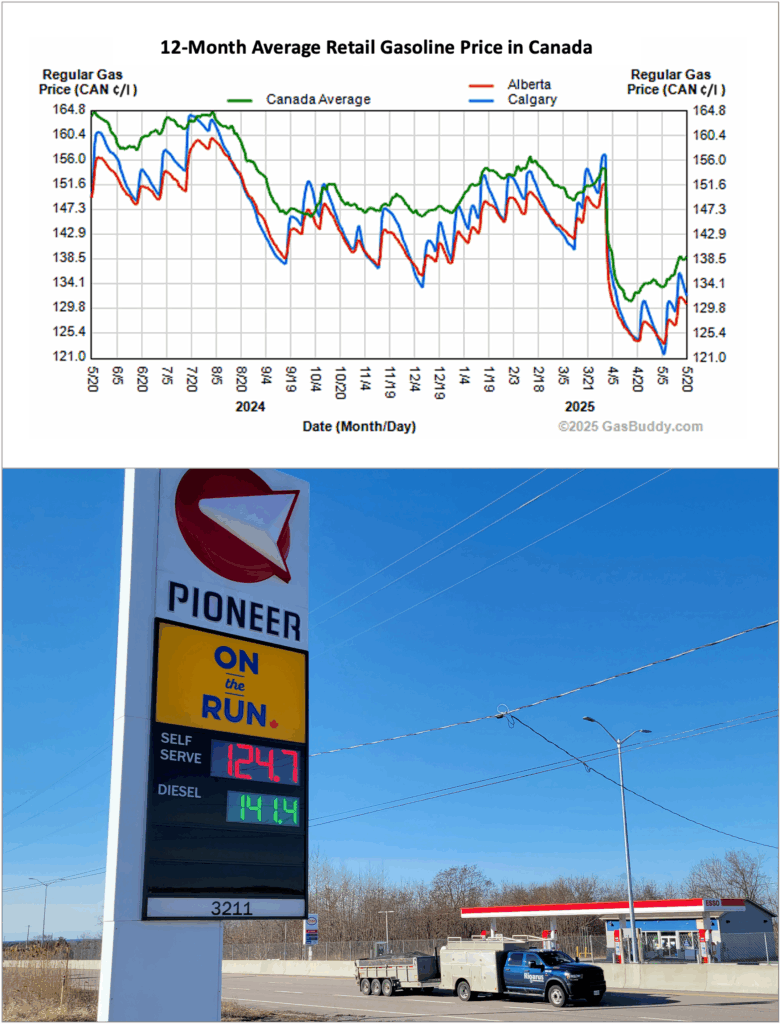
Hidden in plain sight: Prime Minister Mark Carney’s ostentatious removal of predecessor Justin Trudeau’s consumer carbon tax markedly lowered gasoline prices; yet his energy policy includes further increasing carbon taxes on industries, raising the price of nearly all goods throughout the Canadian economy. Shown, gasoline and diesel fuel prices on April 1, 2025 at a gas station in Newcastle, Ontario.
xHidden in plain sight: Prime Minister Mark Carney’s elimination of predecessor Justin Trudeau’s consumer carbon tax lowered gasoline prices; yet his energy policy includes further increasing carbon taxes on industries, raising the price of nearly all goods throughout the Canadian economy. Shown, gasoline and diesel fuel prices on April 1, 2025 at a gas station in Newcastle, Ontario. (Sources: (graph) CBC; (photo) The Canadian Press/Doug Ives)

Instead, Carney simply moved Canada’s carbon taxes “upstream”, i.e., entirely onto manufacturers and producers, where they can’t be seen by voters. Those taxes will, of course, be largely passed back onto consumers in the form of higher prices for virtually everything. Many consumers will blame “greedy” businesses rather than the real villain, even as more and more Canadian companies and projects are rendered uncompetitive, leading to further reductions in capital investment, closing of beleaguered factories and facilities, and lost jobs.

For all Carney’s efforts to portray himself as a regular, salt-of-the-earth Canadian Joe, he is irredeemably elitist, having lived abroad for decades, acquiring citizenship in no fewer than three countries, marrying a non-Canadian student at Oxford who would go on to become a prominent “eco warrior”, and amassing one well-paid foreign job after another. He took to his career among the global elite with evident gusto, making it difficult now to believe he can genuinely relate to regular Canadians. Such as parents who bear the hidden costs of all those green policies while struggling to house and feed their family. Or someone working 14-hour days trying to build a business and meet a payroll. I suspect that to Carney, these people are just indistinguishable drones among the masses – whose carbon emissions are destroying the world’s environment. A problem to be managed rather than a people to be served and enabled to thrive.

Prime Minister Carney’s continuation of net-zero policies – including EV mandates, an oil and gas emissions cap and upstream carbon taxes hidden in production costs – threatens to deepen the economic damage inflicted under his predecessor Justin Trudeau’s government. These policies have already contributed to Canada’s per capita GDP falling to just 55 percent of the U.S. level, while national debt doubled. If Carney maintains this course, Canada could slip below all 37 other OECD members in key economic indicators.

Carney’s elitism and green beliefs will make restoring Canada’s economy all the more difficult, and his election victory comes at a particularly bad time for Canada. That’s because the U.S. – for better or worse our nation’s number-one trading partner and energy customer – is moving in the opposite direction on climate policies of all kinds, as well as pulling out of the Paris Accord and even crippling Carney’s GFANZ through an aggressive Congressional investigation that sent most of its U.S. member banks fleeing.

Carney now says he wants to raise Canada into a “conventional and clean energy superpower”. But before Trudeau came along, Canada already was well on its way to becoming a conventional energy superpower. Our crude oil reserves of 171 billion barrels are fourth-largest in the world, and our current production of 5.1 million barrels per day is also fourth-highest. Our natural gas production ranks fifth in the world, with an enormous untapped reserve base that could support decades of liquefied natural gas (LNG) exports – an opportunity that the U.S. has been exploiting aggressively while Canada essentially stands by.
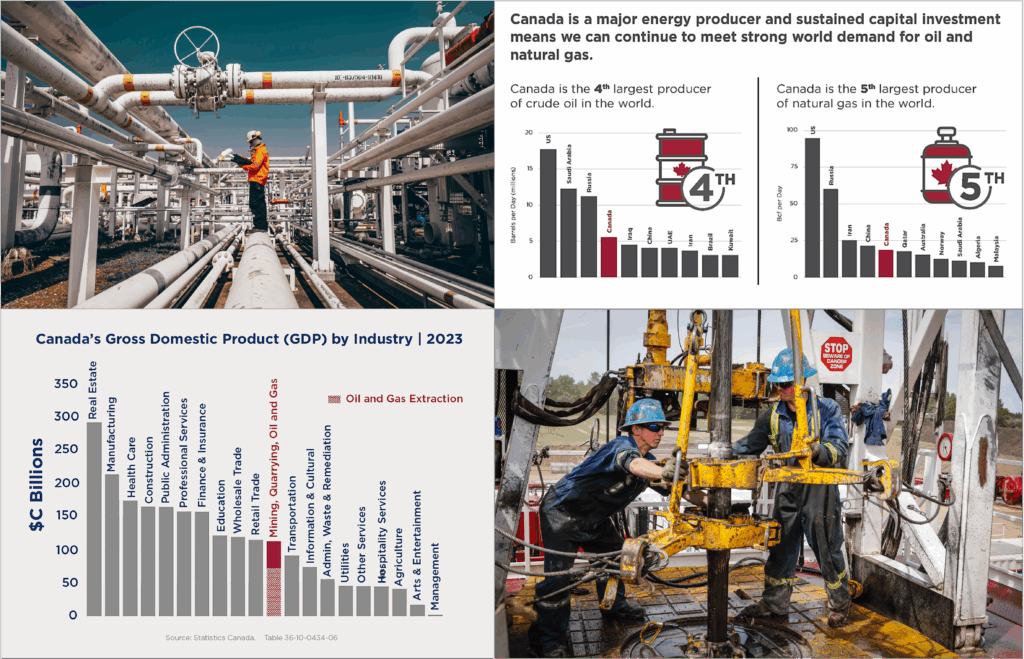
Against all odds: Becoming the world’s 4th largest crude oil producer and 5th largest natural gas producer meant Canada was well on its way to energy superpower. Even after a decade of Trudeau’s “phase-out” agenda, Canadian oil and gas contributes $70 billion to annual GDP, supporting 900,000 jobs nationwide.
xAgainst all odds: Becoming the world’s 4th-largest crude oil producer and 5th-largest natural gas producer meant Canada was well on its way to energy superpower. Even after a decade of Trudeau’s “phase-out” agenda, Canadian oil and gas contributes $70 billion to annual GDP, supporting 900,000 jobs nationwide. (Sources: (top left photo) Shutterstock; (bottom right photo) The Canadian Press Images/Jeff McIntosh; (graphics) CAPP)

The revenues and profits generated by our oil and natural gas industry have become the bedrock of the Canadian economy, providing the foundation for everything from provincial equalization grants to foreign exchange revenues crucial to the Canadian dollar exchange rate. Figures provided by the Canadian Association of Petroleum Producers show that just the oil and natural gas industry’s “extraction” activities contribute over $70 billion annually to Canada’s GDP. Directly related value-added activities such as petro-chemicals, which yield the plastics ubiquitous in our modern economy and are classified as manufacturing, add tens of billions more. The industry generates $35 billion in government royalties per year, plus billions more in corporate income taxes levied on energy-producing, processing and manufacturing companies.

At nearly $140 billion annually, crude oil and natural gas are our largest export, making up about 20 percent of Canada’s balance of trade. The industry employs engineers, scientists, safety technicians, environmental technologists, field operators, construction workers and financial experts. When direct, indirect and induced jobs are included, the industry employs 900,000 people across the country. Capital investment is expected to be close to $40 billion this year, by far the highest of any industry.

And this is despite the Trudeau government’s concerted efforts to hold back (or “phase out” as Trudeau once put it) the industry through deliberately damaging policies now familiar to virtually every reader. These range from Bill C-69 the “no more pipelines” bill to the ban on oil tankers on northwest B.C.’s coast, which killed the Northern Gateway pipeline, to endless foot-dragging on LNG export projects. As Alberta Premier Danielle Smith stated in her remarkable televised address to Albertans two weeks ago, the Trudeau government’s anti-energy policies prevented projects with an estimated capital value of $500 billion – an incredible half-trillion dollars, or nearly 20 percent of Canada’s annual GDP.
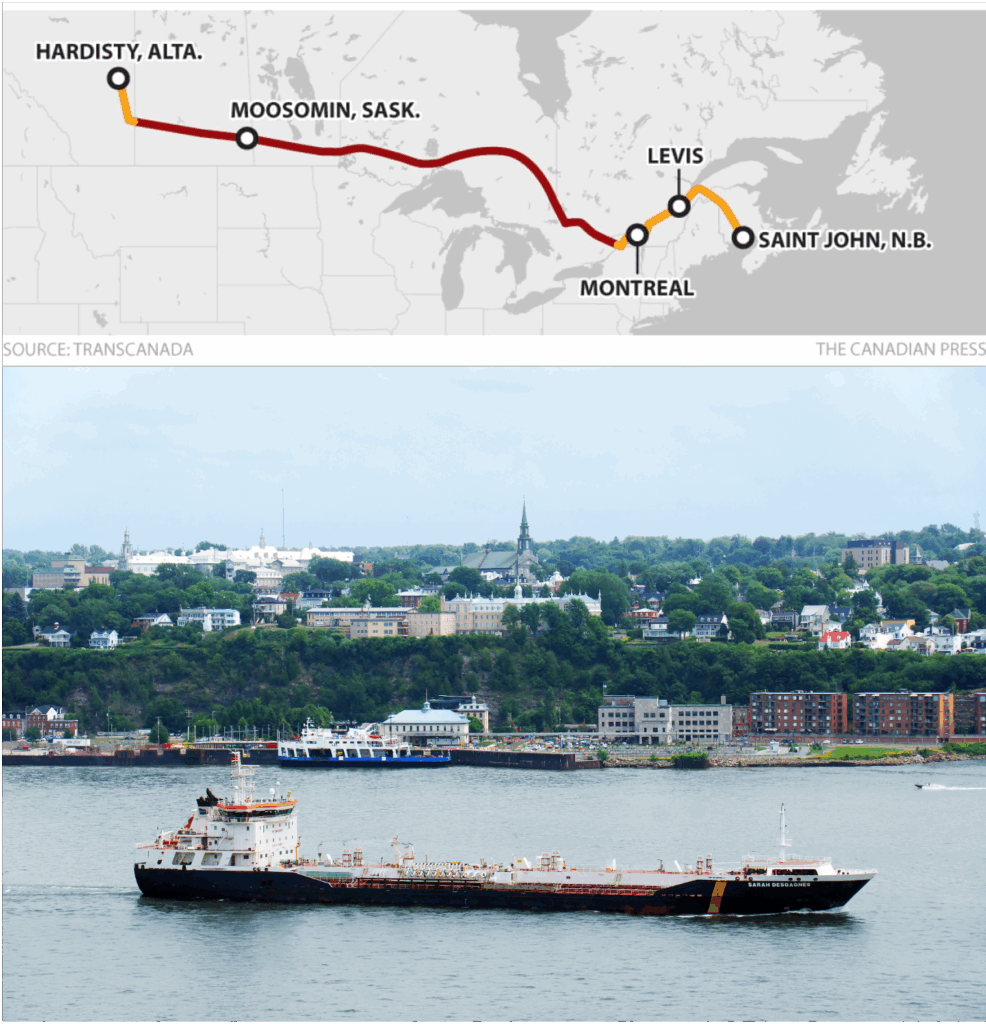
Bring back the Energy East project: An energy policy allowing construction of a new cross-country crude oil pipeline would replace Quebec and Atlantic Canada’s foreign oil imports with domestic supplies, while enabling exports of Canadian oil to Europe. At bottom, foreign-flagged oil tanker in the St. Lawrence River at Quebec City.
xBring back the Energy East project: An energy policy allowing construction of a new cross-country crude oil pipeline would replace Quebec and Atlantic Canada’s foreign oil imports with domestic supplies, while enabling exports of Canadian oil to Europe. At bottom, foreign-flagged oil tanker in the St. Lawrence River at Quebec City. (Sources: (map) CBC; (photo) Sylvie Bouchard/Shutterstock)

Removing such investment shackles and signalling to global investors that Canada was once again open for business might restart Canada’s progress towards being an energy superpower – and would be a key move towards restoring Canada’s economy. Carney now says he wants to make Canada a top global conventional energy producer. But energy superpowers don’t import foreign crude oil, and much of Quebec’s oil comes from Saudi Arabia, Algeria and Nigeria, delivered by foreign-flagged tankers travelling up the St. Lawrence River. Eliminating that travesty would be relatively easy: build just one new crude oil pipeline from Alberta to Quebec (and preferably onward to New Brunswick, from where some of the pipeline’s throughput could be exported to Europe). In other words, revive the Energy East project.

When he’s in a certain mood and is working the right room, Carney will say that he supports doing this. It would require expedited regulatory processes as well as lifting the Trudeau government-imposed oil and natural gas “emissions cap” to accommodate the increased production needed to fill that pipeline. Carney says he wants to see that pipeline built soon. But he’s a master of ambiguity and such a project directly conflicts with his green passions. Plus, Quebec’s elites have been fiercely opposed to any such pipeline (though that might be softening slightly). “So the [emissions] cap is there [for a reason],” Carney said back in March, speaking with reporters after meeting virtually with Premier Smith. “I’m focused on, as the government is, on getting emissions down from the production to the transportation of conventional oil and gas.” So I would advise pipeline CEOs not to start ordering steel pipe or lining up construction crews just yet.
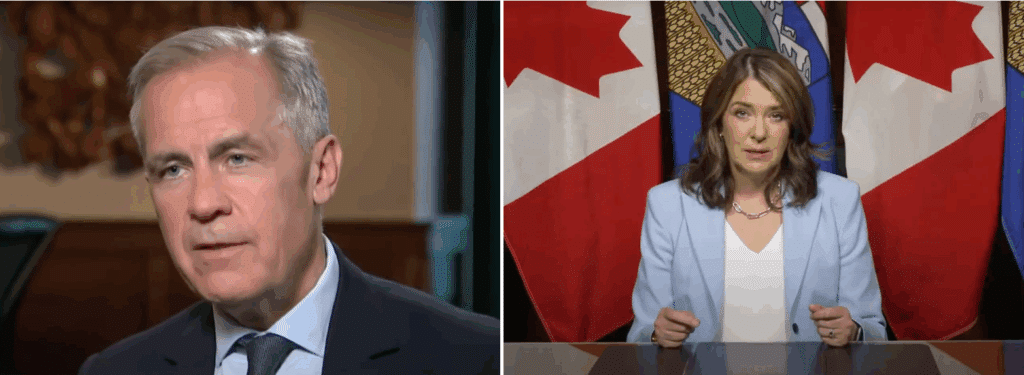
Working the right room: Carney’s (left) recent remarks that he might support new oil or natural gas pipelines were welcomed by Alberta Premier Danielle Smith (right) – but Carney has also declared he will keep the Trudeau government’s oil and natural gas “emissions cap”, which will effectively cap production – making new pipelines pointless.
xWorking the right room: Carney’s (left) recent remarks that he might support new oil or natural gas pipelines were welcomed by Alberta Premier Danielle Smith (right) – but Carney has also declared he will keep the Trudeau government’s oil and natural gas “emissions cap”, which will effectively cap production – making new pipelines pointless. (Sources of screenshots: (left) YouTube/CTV News; (right) YouTube/Danielle Smith)

I spent 16 years as an oil and natural gas company CEO trying to keep Pierre, the first Prime Minister Trudeau, from destroying our industry. Then came Justin with the same mission. Carney’s words sound like, as John Fogarty’s hit song goes, “Déjà Vu All Over Again”. Although there are those who hold out hope that Carney is at his core an opportunist who will do whatever it takes to succeed personally and look good doing it – and that looking good in his current job requires unleashing Canada’s economy by suppressing at least some of Trudeau’s green policies – I don’t share that optimism. I simply don’t see an economic restoration happening as long as he’s prime minister.

What about Carney’s plan to make Canada a “clean energy superpower”? Like other green zealots, he intends to achieve this by forcibly decarbonizing our energy usage and generating ever-more electricity from costly and unreliable wind turbines and solar panels backed up by massive battery arrays. But by any rational standard, Canada already is a clean energy superpower. As the Canadian Centre for Energy Information’s website states, “In 2022, 82% of electricity in Canada came from non-[greenhouse gas] emitting sources. Hydro made up 62%, nuclear was 13%, and other renewables were the remaining 8%.” This makes Canada a world leader in zero-emission electricity generation. Carney should be ecstatic about that, and taxpayers should be relieved. But to the zealots, nuclear and even hydro are the “wrong kind” of non-emitting power.

Liberal Prime Minister Mark Carney’s history in co-founding and co-chairing GFANZ (the Glasgow Financial Alliance for Net Zero) and his role as a UN climate envoy show a deep commitment to eliminating fossil fuels. Despite his claims during the March-April 2025 federal election campaign to support conventional energy projects such as a new crude oil pipeline from Alberta through Quebec to the Atlantic Coast in New Brunswick, his oil and gas emissions cap policy and past advocacy suggest the opposite. Meanwhile, Canadian oil and gas contribute $70 billion to Canada’s annual GDP through extraction alone and support 900,000 jobs. Undermining this sector jeopardizes the Canadian economy’s backbone.

That brings us back to the hard reality that the former GFANZ co-chair and UN Special Envoy for Climate Action and Finance ultimately wants to see the elimination of fossil fuels. Carney’s predecessor inflicted huge economic damage with his net-zero policies. For that, Canadians have endured a decade of economic and personal sacrifice. Trudeau leaves the country with a doubled national debt and a GDP per capita that has collapsed to 55 percent of the current U.S. level – meaning the average Canadian now produces and earns barely half that of the average American. Yet it’s all-but certain that Carney harbours the same net-zero fanaticism as Trudeau.
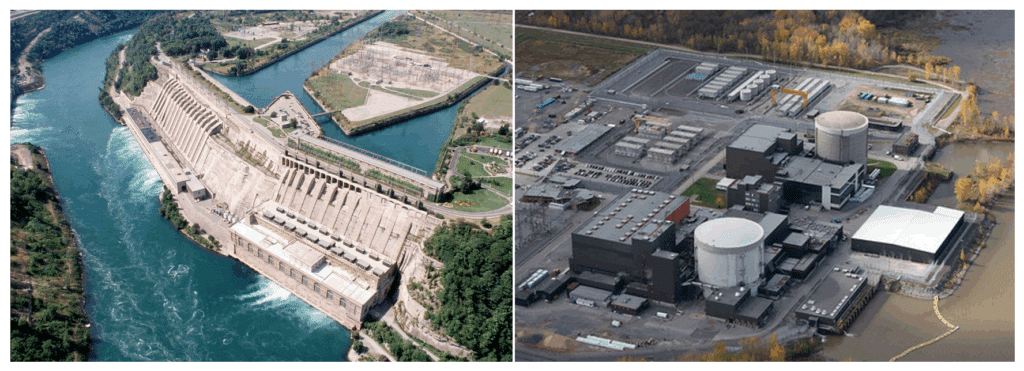
“Wrong kind” of clean power: With 82 percent of Canada’s electricity coming from non-greenhouse-gas-emitting sources – primarily hydro and nuclear – Canada is an unquestionable global leader in clean electricity generation. This fails to satisfy the net-zero zealots who insist on wind and solar power. At left, Sir Adam Beck Generating Complex in Niagara Falls, Ontario; at right, Gentilly-2 Nuclear Generating Station in Bécancour, Quebec.
x“Wrong kind” of clean power: With 82 percent of Canada’s electricity coming from non-greenhouse-gas-emitting sources – primarily hydro and nuclear – Canada is an unquestionable global leader in clean electricity generation. This fails to satisfy the net-zero zealots who insist on wind and solar power. At left, Sir Adam Beck Generating Complex in Niagara Falls, Ontario; at right, Gentilly-2 Nuclear Generating Station in Bécancour, Quebec. (Sources of photos: (left) Ontario Power Generation, licensed under CC BY 2.0; (right) -AX-, licensed under CC BY-NC 2.0)

The crucial question is: will Carney continue Trudeau’s nation-debilitating emissions reduction policies, or back off on the throttle at least slightly? The former policies would crush the nation economically and send our economic indicators below those of any member of the OECD, the world’s 38 most developed countries. The latter policies would ease or perhaps even halt the decline. Either way, the path to economic restoration will require much more. Pierre Poilievre promised to scrap carbon taxes and expedite construction of new pipelines and LNG plants. Unfortunately, too many Canadian voters seem to have had other plans. It is going to be a very difficult four years. How tragic and avoidable for a country endowed with such vast natural and human resources.

Canada already is a global leader in clean energy. With 82 percent of its electricity coming from non-greenhouse-gas-emitting sources – 62 percent from hydro-electric facilities, 13 percent from nuclear power plants, and 8 percent from all other renewables, like wind and solar, combined – the country has little to prove. Demands for even more drastic measures, such as replacing reliable systems entirely with wind and solar farms backed up by massive battery arrays, are not based on necessity. They reflect an ideological outlook, not an energy shortfall.

Gwyn Morgan is a retired business leader who was a director of five global corporations.

Source of main image (modified): Shutterstock.

Love C2C Journal? Here's how you can help us grow.

More for you

What’s Yours is Ours: Why Canada’s Charter Ignores Property Rights and What That Means for Everything You Own

“The whole meaning of life,” famed comedian George Carlin once observed, “is trying to find a place for all your stuff. That’s what your house is, it’s a place for your stuff with a cover on it.” If so, then Canadians should be very concerned about their stuff. Unlike nearly every other modern nation, Canada lacks constitutional affirmation of the right to own property and as protection against its unjust seizure. With a recent B.C. Supreme Court ruling putting the very notion of home ownership at risk, Peter Shawn Taylor seeks out legal opinions on Canada’s surprisingly lax attitude towards property rights, how it differs from other countries and what that means for everyone’s possessions. If Canadians really want to protect their homes, belongings and personal finances, Taylor concludes, now’s the time to get loud.

The Righteous Response: What Canada Can Learn from America’s Fight Against Antisemitism

Canadians frequently criticize U.S. President Donald Trump’s projection of American power. But in the fight against anti-Semitism, Canada could learn a thing or two from our neighbour to the south. In Part One of this series, Lynne Cohen revealed how Canada’s political and civic leaders have chosen to ignore or even abet the hate crimes and abuse Jews have suffered since October 7, 2023. In this second installment, she shows how the U.S. – from the President on down to local officials and law enforcement – has fought back. Where Canada has been cowering and cowardly, the U.S. has resolved to fight anti-Semitism, protect its Jewish citizens and defend Israel’s right to live freely as a Jewish state.

One Free Miracle: Towards a Theory of Everything

A new year has dawned and, as the light strengthens across the Northern Hemisphere, David Solway reminds us that how we choose to experience our world is at least as important as understanding how it came to be. In the first instalment of this two-part series, the writer illuminated the irreducible paradox at the heart of all theories concerning the universe’s creation, then scrutinized the seemingly unbridgeable gap between quantum physics and the physical world we live in. In Part II he considers an even tougher and, so far, unsolved scientific challenge: gravity. Some of the finest minds in science think it actually is insoluble without some kind of creative intelligence to oversee it. In other words, a miracle. To Solway, the true miracle is the fact of a marvellous world and our freedom to experience and wonder at it.

More from this author

The Price of Foolish Pride: What Germany’s Social and Economic Decline Can Teach Canada

Germany was postwar Europe’s most successful nation – until it was seized by an arrogant leftist ideology that led it down a ruinous path. Its government abandoned safe, zero-emission nuclear power for inefficient wind and solar plus natural gas from Vladmir Putin. It threw open its borders to millions of asylum-seekers with barely a thought to the enormous costs or the difficulties of social integration. Today, at the 11th hour, Germany is at last struggling to turn around its decade of economic decline and social disintegration. In this cautionary tale, Gwyn Morgan sees a profound warning for Canada.

Socialist Shakedown: It’s Finally Time to End Supply Management in Agriculture

U.S. President Donald Trump’s trade policy may be chaotic and punitive, but he’s right about one thing: Canada’s agricultural supply management system has to go. Not because it’s unfair to America, though it is, but because it punishes Canadians. The price-fixing scheme limits consumer choice, requires a huge bureaucracy and prevents farmers from producing more in the face of shortages, forcing them instead to dump excess production. Worst of all, writes Gwyn Morgan, it drives up prices for milk, cheese, chicken, eggs and other essential foods — all for the benefit of a few thousand farmers, largely in Quebec. For Canada’s trade negotiators, argues Morgan, ending this mad racket should be job one.

Climate Climbdown: Sacrificing the Canadian Economy for Net Zero Goals Others Are Abandoning

Climate-obsessed politicians – Justin Trudeau in the vanguard – nearly destroyed the Canadian economy chasing emissions targets that are both unrealistic and pointless. Ottawa and the four biggest provinces have squandered $158 billion to create just 68,000 “clean” jobs. Meanwhile, fossil fuels are supplying a bigger share of Canada’s energy needs than ever. And now, leading U.S. officials and even eco-zealots like Bill Gates are re-evaluating their net-zero ideology. But that hasn’t gotten through to Prime Minister Mark Carney who, warns Gwyn Morgan, intends to inflict further punishment on an ailing country in pursuit of a delusional cause.