 The Dark Knight Rises is the most politically important movie of a generation. But few critics understood it. They seem to have attempted to decipher the film meaning in isolation from the rest of the trilogy. However, The Dark Knight Rises is the Dark Knight’s antithesis. The trilogy is less about political institutions, and more about the civic virtues required in a liberal democracy.
The Batman was born from the notion that a man could do more as a symbol than as a mere mortal. The myth would outlive the man, and would inspire goodness. Amidst the gang-fueled chaos of Gotham, the city needed something to believe in. Thomas Wayne stepped in, using his fortune to help the city’s neediest. However, he and his wife were murdered and his son Bruce left Gotham at 18 seeking justice. He joined Ras al Ghul, leader of the League of Shadows, a mercenary group.
Upon completing his training, Wayne was informed that the League planned to destroy the greatest symbol of corruption: Gotham. Wayne escaped to defend the city, and defeated the League by becoming the Batman. But the victory was fleeting. When the League was defeated, another threat emerged: The Joker.
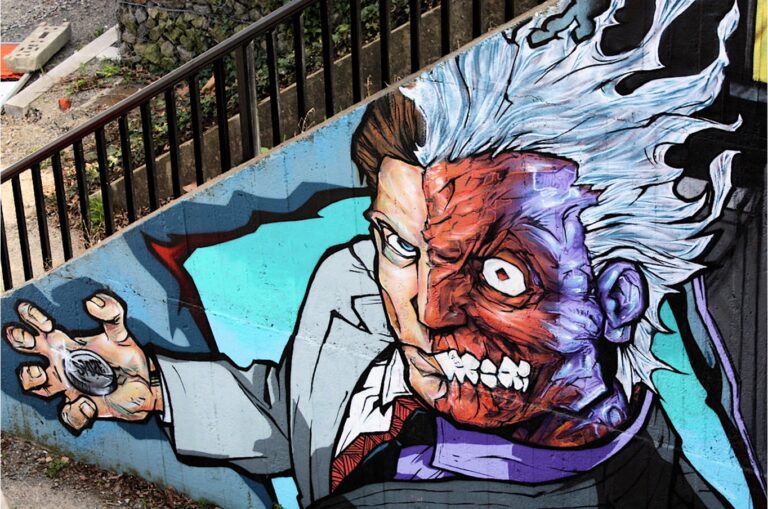
Whereas the League of Shadows held values that posed an existential threat to Gotham, the Joker had no values. He preyed on Gotham’s hypocrisy. Corruption was rampant in the police force, and many Gothamites attempted to kill their fellow citizens to meet the Joker’s demands. Wayne saw District Attorney Harvey Dent as the man who could restore justice. Once Gotham had a hero without a mask, Wayne could live a normal life with his childhood sweetheart Rachel Dawes. However, she was killed by the Joker and Dent exacted revenge upon corrupt police officers, and was killed by Batman. After thwarting the Joker, Batman took the blame for Dent’s crimes (with Commissioner Gordon’s help), and went into hiding.
The Dark Knight Rises begins with telling words from Commissioner Gordon: “I believed in Harvey Dent.” The story then shifts to the CIA using ruthless tactics to capture a nuclear physicist. They are thwarted by Bane, who kidnaps the physicist as part of his plan to destroy Gotham.
The lies in The Dark Knight unravel as Bane recovers a confession from Gordon, detailing Dent’s crimes and as a result, the Dent Act, used to imprison suspected criminals without due process, lost its moral authority.
Meanwhile, Wayne had lost his belief. He saw death as respite until his Butler Alfred revealed that he had burned a letter from Dawes, in which she revealed that she would never be with Wayne as promised. This required him to come to terms not with what he was willing to die for, but what he was willing to live for. He realized the truth behind the Batman myth. It wasn’t about one man. It was about a conspiracy of selflessness. The Batman could not have functioned without Alfred, nor without Lucious Fox, or Commissioner Gordon. Wayne realized that there were still people worth protecting. So he once again put on the mask to protect his friends, and fellow citizens.
Many interpreted the Dark Knight Rises as a conservative revolt against Occupy Wall Street. This interpretation has survived despite director Christopher Nolan pointing to the French Revolution as his influence for the film’s revolutionary scenes, and the references (Blackgate prison as the Bastille; Jocobinesque tribunals; a eulogy from A Tale of Two Cities).
Furthermore, the new protagonists, John Blake and Selina Kyle, were both critics of the establishment. Ms.Kyle described her failure to escape the criminal underworld: “Once you’ve done what you had to, you can’t do what you want to.” She only sided with the establishment after the revolution. Examining a newly socialized mansion, she lamented that it “used to be someone’s home.” Blake was cynical because the boys home that he grew up in lost the funding from the Wayne Foundation it required to keep troubled youth off the street.
The politics of the Batman trilogy has evolved. Rachel Dawes set the tone for the first film, paraphrasing Tory Edmund Burke: “What chance does Gotham have when the good people do nothing?” Harvey Dent defined the second: “When their enemies were at the gates, the Romans would suspend democracy and appoint one man to protect the city. It wasn’t considered an honor, it was considered a public service.”
Dent’s words suggest an elitist view of society. However, in his last words as Batman, Wayne gives us the real message: “A hero can be anyone. Even a man doing something as simple and reassuring as putting a coat around a little boy’s shoulders to let him know that the world hadn’t ended.” When the Batman dies, Wayne’s Estate is left to Blake’s boys home, and Blake is inspired to take Wayne’s place as Robin. The conspiracy continues.
There are few overtly political statements in the film. The most obvious is that extreme poverty cannot coexist with decadence. Absent other opportunities, kids turn to crime. This fuels the vicious cycle of funnelling impoverished youth through the justice system. Breaking that cycle requires a commitment to fighting the root causes of poverty. Given the film’s ambivalence to institutions, this suggests a need to strengthen civil society. We need symbols that give us hope. But they are empty if they do not inspire action. For our institutions to be effective, we must continue the conspiracy of selflessness that has allowed Western civilization to thrive.
———————-
Steve LaFleur is a political consultant and public policy analyst based in Calgary, Alberta. He recently graduated with an MA in Political Science from Wilfrid Laurier University, and was a research associate at the Cascade Policy Institute in Portland, Oregon during the summer of 2009 as a part of the Koch Fellowship Program.