Charles Raymond, a native of Windsor Ontario, was the first Canadian combat death of the First World War. A Corporal in the (British) King’s Royal Rifle Corps, he was killed southeast of Paris on September 14, 1914. He left a widow, Ella Isabel Raymond, of Church Street, Aldershot, England. His death would be followed by that of approximately 61,000 fellow Canadians who perished in the Great War.
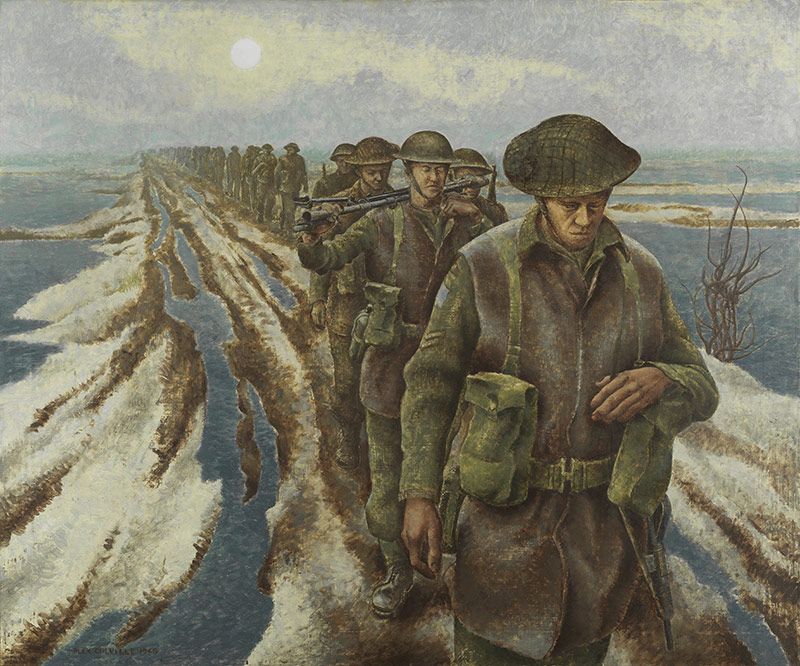
Raymond’s unit was part of the British Expeditionary Force (B.E.F.). It landed in France on August 13 and ran headlong into the nine divisions of the German First Army near Mons, Belgium. The B.E.F.’s five divisions were well-trained but were overwhelmed at Mons by the skilled and more numerous Germans. Raymond and his comrades then marched more than 250 kilometres south in the “Great Retreat” as the Germans pushed to the gates of Paris. At his death he would not have known that the Battle of the Marne River where he fell was a pivotal early moment in the war, forestalling as it did a quick German victory. Nor would he have known that he was part of a body count that was mounting at a pace previously unknown in human conflict.
One-and-a half-million men were engaged in battle at the Marne alone, with millions more elsewhere in France and on the eastern front. The French alone suffered over 300,000 dead just from August to December 1914. From the beginning it was clear this was a new kind of war, introducing the “industrialization” of human slaughter.
The sheer magnitude of death and suffering is almost unimaginable today. When the carnage finally ended four years later, it had claimed some 40 million lives, including an estimated 10 million military combatants. In at least seven countries, more than 10 percent of military-aged men were killed. Tens of millions more were wounded, maimed or disfigured. In addition, more than 2.2 million civilians were killed globally as a direct result of military action, and an estimated 5-7 million civilians died from disease and malnutrition. Revolution and regional wars unleashed by the great conflict killed millions more in the years following the Armistice. And finally, the end of the war spawned the Spanish Influenza epidemic, which killed another estimated 50-100 million. In a phrase derived from the title of a book by H.G. Wells, it became known as “the war to end all wars”. In fact, it was but the opening act to the monstrous global bloodletting of the 20th century.
The details and enormity of this tragedy have inevitably faded from public consciousness, even though the war has been continuously studied to the present day. Its origins, strategies and tactics, social and economic impact, the effect of the imposed peace; all are still under serious debate. And its after-effects linger, particularly in Eastern Europe and the Middle East.
As the conflict wore on and the cost in lives, money, material damage and suffering mounted, the warring parties fought on past the point of sanity, seeking to achieve gains commensurate with the great cost. Propaganda rose to an unprecedented, fever pitch, with vilification of the enemy unseen since the era of religious wars.
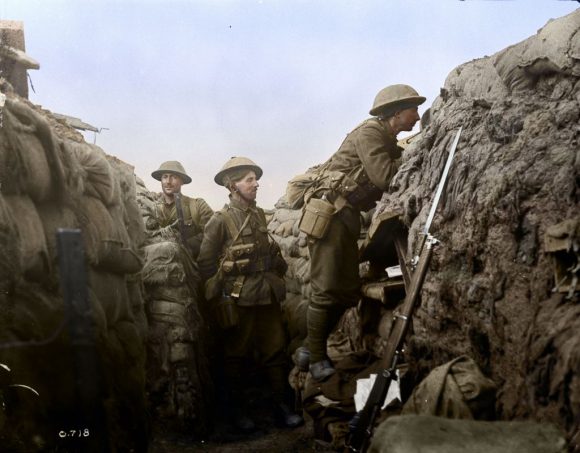
The fighting literally stretched around the globe. What Canadians know of the war is generally seen through the lens of Flanders’ Fields and the Western Front. There was of course also fighting in southern Europe, on the Balkan and Italian Fronts, along a 1,000-plus km front in Russia, another in the Caucasus, as well as epic campaigns in the Middle East and East Africa. Naval combat spanned the seven seas; German U-boats alone sank about 5,000 merchant ships.
Canadian soldiers experienced most of the new military technologies and tactics inspired by the war. The use of sophisticated chemical weapons, notably mustard gas, is perhaps the best-known and most horrifying innovation. But even before its introduction, advanced machine guns and rapid-firing rifles, and more accurate and lethal artillery and mortars, had outpaced 19th century military tactics, leading to the adoption of defensive trench warfare. The rival armies spent most of the war dug in along the Western Front – with Canadians in Flanders and the adjacent lowlands – that extended from the English Channel to the Swiss border.
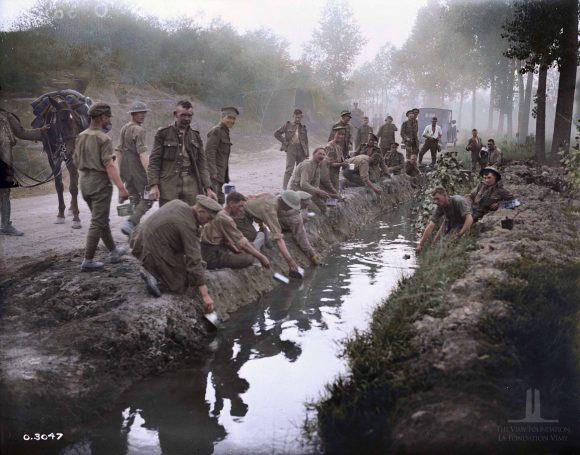
Both sides tried to break the stalemate with mass infantry attacks supported by ever-increasing artillery bombardment (aerial combat, though highly romanticized on both sides, was immaterial to the war’s course). The enormous casualties led to an in-retrospect sickening doctrine of attrition, with the objective of “bleeding the enemy white” and achieving a positive “body count” over the span of months. At Verdun, the Germans specifically planned such a protracted battle of annihilation, while at the Somme and elsewhere, Allied commanders consciously bled out the ranks trying to breach the trench barrier.
The Somme was fought from July to September 1916 and is often cited as the war’s benchmark for death and futility. The British suffered almost 60,000 casualties on the first day of the battle – including over 19,000 killed – with entire units mown down. One of these was the Newfoundland Regiment, consisting of volunteers from towns, villages and outports across the island. During an assault on the Belgian village of Beaumont Hamel, the regiment lost a total of 324 dead and 386 wounded in a matter of hours. Only 68 men answered roll call the next morning.

One survivor, Private James McGrath, crawled about 2 km before reaching safety. His recollections bring the nightmare to life: “The Germans actually mowed us down like sheep. I managed to get to their barbed wire, where I got the first shot; then went to jump into their trench when I got the second in the leg. I lay in No Man’s Land for fifteen hours….They fired on me again, this time fetching me in the left leg, and so I waited for another hour and moved again, only having the use of my left arm now. As I was doing splendidly, nearing our own trench they again fetched me, this time around the hip as I crawled on…I was then rescued by Captain Windeler who took me on his back to the dressing station a distance of two miles.” From the other side, a German machine-gunner reported: “They went down in their hundreds. You didn’t have to aim, we just fired into them.”
Short-lived breakthroughs were achieved in exceptional cases, like the famously well-executed Canadian victory at Vimy Ridge. But by and large soldiers were condemned to live in sodden, filthy trenches, plagued by lice and disease, often surrounded by the half-buried corpses of friend and foe alike. The farm fields of France and Belgium were churned into mud. The worst perhaps was Passchendaele, where in July 1917 the British launched another offensive, which the autumn rains ultimately stalled. Trenches filled with water, access to the rear was on improvised “duckboard” paths – which were relentlessly shelled – and anyone who strayed off the paths was liable to drown in the mire. The Canadian Corps arrived there in October, only to lose almost 16,000 men in the morass, while total British casualties were over 275,000.

Artillery bombardments were equally hellish. At the Somme, the British fired over 1.5 million shells in seven days. At Verdun, the Germans fired 1 million rounds in the first 10 hours, while they and the French expended over 10 million in the 10-month battle. Soldiers hunkered down in dugouts endured hours, often days of continuous shelling, wondering if the next round would strike them. One Frenchman described it as, “a torture the soldier can’t see the end of…he’s afraid of being buried alive…[he] stays put in his hole, helplessly waiting for, hoping for, a miracle”.
Shellshock, a debilitating reaction to this unrelenting horror and stress, wounded more than 10,000 Canadians soldiers. What we would now call PTSD was then a new phenomenon, often ascribed to cowardice, with improvised treatment, if any. Back home, survivors had to deal with it as best they could: often with a few stiff drinks, or many.

The centenary of the war has revived a number of contentious questions, not least whether the war and its slaughter was actually worth it. The Canadian historian Margaret McMillan maintains that our soldiers fought “for hearth and home” and to “maintain a way of life” – which sounds like a contemporary way of saying “for King and country”. Her Scottish colleague, Niall Ferguson, is less sanguine. He questions the inscription on his grandfather’s Great War medal – “the war for civilization” – and doubts the war was worth the cost. Ferguson’s research shows that soldiers often fought out of loyalty to their comrades, to avenge their deaths, and, for some, the sheer pleasure of killing “beautifully”. Almost incomprehensibly, many veterans recalled it as the best time of their lives.
It’s worth remembering how different the world of 1914 was from our own. Fewer than half of Canadians lived in cities. Most were used to hard physical labour for limited reward. Normal life expectancy was 52 for men, 57 for women. Inured to the hardships of life, most people were about as far removed from the relative comforts of modern life as one can imagine. Many had seen siblings die of childhood diseases, or mothers or wives in childbirth. They were buoyed by a strength of community and faith little known today.
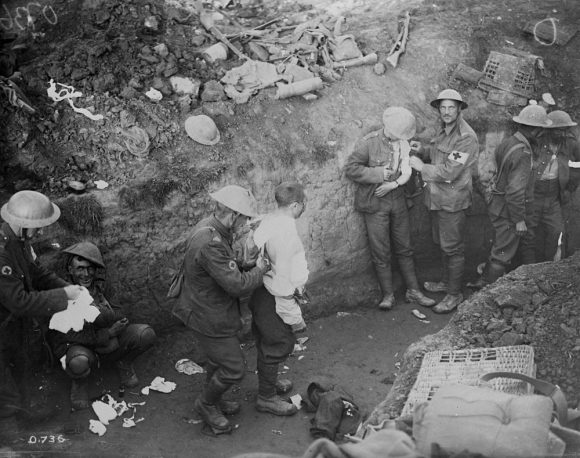
For long, deadly months and then years, it seemed as if the Great War might never end. But then the end came fairly suddenly, and the great empires of the Central Powers disintegrated. Casting aside the political calculus and the retrospective rating of dead political leaders, it is perhaps best to remember the strength and perseverance of that generation in the face of tremendous hardship. The war caused social change and unrest even in Canada. Still, the loyalty to their fellows of so many of that generation, their willingness to sacrifice when called upon, and their simple returning to society without complaint is remarkable, memorable, and an example to this day.
Special ceremonies will be held this month to honour George Lawrence Price of Falmouth, Nova Scotia. He was felled by a sniper’s bullet at 10:58 am on November 11, 1918 – two minutes before the Armistice – near Mons, Belgium, where Charles Raymond first saw combat.
There is a poignant symmetry to the experiences of these two young Canadians, at the very beginning and very end of the war. One hundred years on, perhaps Raymond and Price can represent for us the tens of thousands of Canadians – and millions of others – who perished. Lest we forget.
~~~~~~~~~~~~~~~~~~~~~~~~~~~~
Hanging on the old barbed wire
The First World War inspired an extraordinary amount of music, including many songs which will be heard at Remembrance Day family and social gatherings in Canada. One of the most poignant is Hanging on the Old Barbed Wire, a soldier’s sardonic criticisms of his officers. Although the original author is unknown, the lyrics below are one of several variations passed down over the last century, including a powerful acapella version recorded in 1988 by the British pop band Chumbawamba.
If you want to find the Sergeant,
I know where he is, I know where he is, I know where he is.
If you want to find the Sergeant, I know where he is,
He’s lying on the canteen floor.
I’ve seen him, I’ve seen him, lying on the canteen floor,
I’ve seen him, I’ve seen him, lying on the canteen floor.
If you want to find the Quarter-bloke
I know where he is, I know where he is, I know where he is.
If you want to find the Quarter-bloke, I know where he is,
He’s miles and miles behind the line.
I’ve seen him, I’ve seen him, miles and miles and miles behind the line.
I’ve seen him, I’ve seen him, miles and miles and miles behind the line.
If you want the Sergeant-major,
I know where he is, I know where he is, I know where he is.
If you want the Sergeant-major, I know where he is.
He’s tossing off the privates’ rum.
I’ve seen him, I’ve seen him, tossing off the privates’ rum.
I’ve seen him, I’ve seen him, tossing off the privates’ rum.
If you want the C.O.,
I know where he is, I know where he is, I know where he is.
If you want the C.O., I know where he is
He is down in a deep dug-out,
I’ve seen him, I’ve seen him, down in a deep dug-out,
I’ve seen him, I’ve seen him, down in a deep dug-out.
If you want to find the old battalion,
I know where they are, I know where they are, I know where they are
If you want to find the old battalion, I know where they are,
They’re hanging on the old barbed wire,
I’ve seen ’em, I’ve seen ’em, hanging on the old barbed wire.
I’ve seen ’em, I’ve seen ’em, hanging on the old barbed wire.