Watching the United States government’s bloody and disastrous native policy unfold during the 18th and 19th centuries provided Canada with plenty of salutary lessons when the time came to make its own treaties.
Avoiding the Indian Wars that accompanied the settlement of the American West was top of mind for Canadian government officials during the numbered treaty negotiations on the Prairies, which began in 1871. Notably, Canada did not create large native reserves capable of supporting entire tribes, such as the Americans did with the Great Sioux Nation that occupied large parts of what is today South Dakota and Nebraska, as well as the once-autonomous Oklahoma Indian Territory. These enormous tracts were prone to constant depredation by white settlers – as occurred when gold was discovered in the Black Hills of South Dakota – and also facilitated the rapid mobilization of native warriors in response to such incursions.
Instead, Canada’s numbered treaties were marked by the creation of many small reserves scattered throughout the Prairies and Northern Ontario. Such a policy was opposed by several native leaders of the time, most prominently Plains Cree chief Big Bear, who refused to select a specific plot of land within Treaty Six as part of a sophisticated political strategy meant to encourage other band leaders to select land contiguous with each other and thus cobble together a large self-supporting Cree homeland. Big Bear’s stratagem failed; and that is partly why Canada today is home to 618 mostly small and widely-dispersed First Nations.
The implications of this policy still linger. While the settlement of the Prairies occurred relatively peacefully, today many of the small, isolated reserves are disconnected from the larger aboriginal community and identity, and lack an economic centre of gravity. On the other hand, Canada’s diverse collection of reserves offers a wealth of varying experiences and data points that may be put to greater use in the quest to raise indigenous living standards and economic opportunities to levels enjoyed by the rest of Canadian society.
A better way forward
Tom Flanagan’s important new book The Wealth of First Nations, recently published by the Fraser Institute, makes ample use of the evidence provided by the varied outcomes of Canada’s numerous native reserves. And the lessons he distills from these experiences present powerful lessons for how Canadians of Indigenous and non-Indigenous descent can move forward together in the future. Significantly, his work offers a solid empirical basis for changes that are already beginning to reverberate throughout the country’s Indigenous business community.
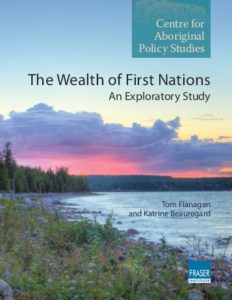
The title is an obvious tip of the hat to Adam Smith’s seminal 1776 text The Wealth of Nations. For his investigation into the economic health of Canada’s native communities, Flanagan’s main diagnostic tool is Canada’s Community Well-Being (CWB) index, based on Statistics Canada census data. The CWB index captures life on Canada’s native reserves across four metrics: per capita income, education, housing and employment, which can then be compared with the performance of 4,000 other Canadian locales reporting similar data. As such, it offers valuable insights into the nature of life on native reserves over time, as well as the relative performance of Indigenous communities compared to the rest of Canada. Given the large number of reserves in question and a wide variety of strategies and political philosophies in play, it is thus possible to discern what works and what doesn’t among the efforts to make life better for Canadians of aboriginal descent.
The CWB can be calculated for 452 participating native reserves, and it ranges from 37 to 90, with an average score of 59. Discouragingly, that is 20 points less than the 79 recorded for non-native Canadian communities, and the gap is the same as it was when the index was developed in 1981. With this data in hand, Flanagan sets out to determine what reserves at the top end of the leader board are doing right, and what those at the bottom are doing wrong.
The Makers
The retired University of Calgary political scientist divides his book in two halves. The first, called “Making,” considers the range of on-reserve policies aimed at creating wealth through resource development and the creation of own-source revenues. This includes such things as the structure of community governance, band council salaries, the composition of budgets and overall fiscal management. “The evidence is overwhelming that prudent financial management is a robust predictor of CWB,” Flanagan writes. Bands that operate with obvious prudence generally provide better outcomes for their citizens. Reserves that pay their leaders salaries comparable to similar positions elsewhere in Canada tend to have better CWB scores. The same comparability holds for property rights. While land on reserves is held in common without traditional fee simple ownership, certain work-arounds are possible, including certificates of possession that offer holders permanent title to their land with some restrictions. Flanagan finds a strong connection between the use of certificates of possession and a reserve’s CWB score. Reserves that levy property tax, another proxy for sound financial management and acceptance of Canadian economic norms, also reveal better CWB performance.
Perhaps Flanagan’s most significant finding arises from reserves’ differing experiences with own-source revenues. This is money generated through the business activities of band-owned entities. It includes revenues from resource extraction leases on reserve lands and impact benefit agreements with extraction companies, as well as stand-alone businesses operated by bands. The data shows a clear connection between bands that aggressively seek out own-source revenues and high scores on the CWB. Among the most successful strategies, Flanagan identifies “the use of land as an economic asset.” In other words, reserves that can turn land − their biggest resource − into a revenue stream through mining, forestry or oil and gas production, as well as such things as residential developments, retail malls, casinos, golf courses and environmental tourism, consistently display higher living standards than those that can’t, or won’t.
“To be successful, First Nations have to sell things that other Canadians want – their labour, resources, the advantages of their location,” Flanagan writes. Such economic connections with the world outside reserve boundaries improves the overall health of the community. “When band members are earning income, not just receiving rents or government transfers, there are positive effects on education and housing.”
Fort McKay First Nation, in the heart of Alberta’s oil sands region, is a case study in this regard. While the reserve does not produce any oil of its own, it provides a wide range of services to companies that do, ranging from transportation, vehicle repair, equipment rentals and accommodations. This business success, which depends on the overall success of the oil patch, has funded substantial improvements to education, health care and housing, as well as offering plenty of jobs for local residents. The band’s business ventures earn approximately $500 million a year and sustain 2,000 jobs. Between 1996 and 2011 Fort McKay’s CWB score rose from 57 to 76, putting it 17 points ahead of the First Nations average, and just 3 points below the non-Indigenous Canadian mean. It is an important lesson, given what comes next.
The Takers
The second half of the book, called “Taking,” looks at the impact various non-earned forms of revenue can have on a reserve’s CWB. This includes government payments, compensation claims and other forms of income outside standard buyer/seller business relationships. Flanagan finds no significant connection between Canada’s seemingly endless federal specific claim settlement process and CWB standings. The generous allocation of cash or land to address past grievances appears to have no appreciable impact on community well-being.
One aspect of land claims that does elicit optimism is urban reserves, according to Flanagan’s voluminous data set. The option to purchase and add non-contiguous urban land to a First Nation’s reserve, which can then be used as a means to generate own-source income via native-owned property development and businesses, can offer a significant boost to well-being. In Saskatchewan, where the idea was pioneered, First Nations that make intensive use of urban reserves have a current CWB of 58, compared to 51 for First Nations that do not.
However, there is no evidence in Flanagan’s calculations that the vast ramping up of federal spending on native programs and transfers has done anything to close the gap between First Nations and the rest of Canada in terms of community well-being. Recall that the gap between First Nation and non-native communities remains an embarrassing 20 points, the same as it was in 1981. “If the well-being of First Nations has increased no more rapidly than that of Canadians in general, what is the value of all the additional spending on First Nations?” Flanagan asks. He puts the planned increase in federal spending on native issues announced as of last year’s budget by the Trudeau Liberals at $16.5 billion over seven years. Will any of this result in improvements in actual well-being on reserves? Given past experience, the likely answer is no.

Multi-billion dollar cash payouts meant to address historical injustices, such as residential schools or the “Sixties Scoop,” are outside the scope of Flanagan’s investigation, since these involve payments to individual members rather than First Nations governments. But similar lessons can be intuited: the CWB gap between reserves and the rest of the country is unlikely to be reduced by handouts to individuals, but rather by their active participation in the market economy.
Taken as a whole, Flanagan’s scrutiny of the Making and Taking aspects of native policy offers a blueprint for an entirely new approach to improving on-reserve living standards. Reserves that focus on generating own-source revenues, practice prudent financial management and actively seek out economic linkages with the rest of the country tend to deliver better results for their constituents. Those that demand ever-larger handouts from government, nurse a culture of grievance and entitlement, and generally act in ways that frustrate efforts at resource development, tend to fare poorer.
Flanagan is a long-time critic of Canadian aboriginal policy, as is the Fraser Institute, but they are not alone in arriving at these conclusions. Numerous current flashpoints in Canadian politics point to a growing rift within the Indigenous population between Makers and Takers. An increasing number of native leaders focused on improving the living standards of their people in the ways Flanagan outlines are beginning to push back against the failed status quo.
Consider the significant aboriginal opposition to the federal government’s Bill C-69, which promises to make future assessment process for major resource development projects far more onerous. In addition to familiar criteria regarding jobs and direct environmental impacts, this new legislation proposes to add gender and sexual identity reviews, upstream climate change claims and a host of other burdensome processes that will allow development opponents to frustrate such projects into perpetuity.
In response to this threat to future development, groups such as the Region One Aboriginal Business Association and the Indian Resource Council are expressing strong opposition to the bill. “The Indian Resource Council (IRC) is urging all Senators to take a stand and oppose Bill C-69,” IRC president and CEO Stephen Buffalo, a member of Alberta’s Samson Cree Nation, recently told the Financial Post. “Bill C-69 would wreak havoc on Indigenous economic development in many parts of Canada.” Such a message is sharply at odds with the conventional view of perpetual Indigenous opposition to natural resource projects.
The nasty internal politics of the Wet’suwet’en nation in coastal British Columbia regarding the Coastal GasLink project further reveals the split between pro- and anti-development native leaders and factions. While all five elected band councils have reached agreements with the proponents of the $6.2 billion national gas pipeline, a group of hereditary chiefs doggedly opposes it. When three women representatives of the Wet’suwet’en Matrilineal Coalition voiced their support as well, they were summarily stripped of their honorifics by male hereditary chiefs.

Last year a handful of First Nations and allied environmental groups successfully used the vagueness of duty to consult obligations as a de facto legal veto in their effort to kill the Trans Mountain pipeline proposal. That forced Ottawa to buy the asset for $4.5 billion simply to keep the project alive. This despite the fact 43 aboriginal groups and First Nations had already signed mutual benefit agreements with Kinder Morgan Canada, the former private sector owner of the pipeline. Obstructionism of this sort has allowed a small number of bands in British Columbia to frustrate the efforts of many more First Nations across B.C. and Alberta seeking to improve their own economic opportunities and living standards through economic activity and own-source revenues.
Just last week, however, a new consortium fronted by Indigenous corporate leaders announced it is assembling a bid to purchase the Trans Mountain pipeline. Interestingly, the group calls itself Project Reconciliation, implying that the effort to come to terms with the history of the colonial era in Canada can be pursued through our common economic interests and destiny.
The status quo that equates Indigenous best interests with strident, anti-development environmentalism has denied economic opportunities to generations of Canadians of Indigenous descent in all parts of the country. Relying on government transfers and other unearned benefits as the means to improve living standards on reserves has been an abject failure, as evidenced by Flanagan’s CWB data. Conversely, First Nations such as Fort McKay have been able to effect real, positive change in the lives of their people by fully engaging with the outside economy. As such, every obstructed pipeline, mine or coastal terminal represents a lost opportunity for other native communities to improve their living standards. This is why forward-thinking native leaders are now speaking out about the dangers of obstructionism and the importance of own-source revenues. Engagement with the broader economy is far more rewarding that attempting to hold it at bay.
Simply taking is insufficient. It’s time to start making a difference in Indigenous outcomes.
Peter Shawn Taylor is a freelance writer based in Waterloo, Ontario.