
Generational Economics

Quick Read

Future Tense: Why Gen Z is Right to Feel Betrayed

Gwyn Morgan
March 9, 2026
Older generations often roll their eyes when young people seek to blame them for their woes. But if Canada’s Gen Zers feel betrayed by the Boomers, they are right to do so, argues Gwyn Morgan. Years of irresponsible fiscal and regulatory policies have hamstrung the Canadian economy and left younger generations facing a bleak future of stagnant wages, rising taxes and shrinking opportunities. A former business leader who created more than his share of jobs and prosperity during his long corporate career, Morgan casts a worried eye over the next generation – and offers sympathy for the situation they’re inheriting.
Generational Economics

Quick Read

Future Tense: Why Gen Z is Right to Feel Betrayed

Gwyn Morgan
March 9, 2026
Older generations often roll their eyes when young people seek to blame them for their woes. But if Canada’s Gen Zers feel betrayed by the Boomers, they are right to do so, argues Gwyn Morgan. Years of irresponsible fiscal and regulatory policies have hamstrung the Canadian economy and left younger generations facing a bleak future of stagnant wages, rising taxes and shrinking opportunities. A former business leader who created more than his share of jobs and prosperity during his long corporate career, Morgan casts a worried eye over the next generation – and offers sympathy for the situation they’re inheriting.
Share on Facebook
Share on Twitter

It’s unsettling and confusing the first few times you come up against it. It’s the “Gen Z Stare”: a flat, inscrutable and seemingly unfeeling gaze, delivered in silence or with just a slight murmur, used by today’s twentysomethings and teens for interactions that the rest of us think should come with friendly words and vivid facial expressions. Theories abound over why Gen Z has turned their emotional meter down towards absolute zero. Some say it’s an ironic comment on Millennials’ fondness for maniacal selfie grins and performative positivity. Others see an attempt to reassert authenticity in a sea of fakery. Perhaps it’s a kind of defensive crouch in a confusing and dangerous world. Or a way for the millions of kids damaged by Covid lockdowns and closed schools to mask their poor verbal skills.

That Gen Z Stare: The flat, inscrutable gaze adopted by many teens and twentysomethings may, the author speculates, signal their resignation to the economic and social wreckage they are about to inherit.
xThat Gen Z Stare: The flat, inscrutable gaze adopted by many teens and twentysomethings may, the author speculates, signal their resignation to the economic and social wreckage they are about to inherit. (Sources of photos: (top left) @CBCNews/YouTube; (top right) @snarkymarky/tiktok; (bottom) Shutterstock)

Lately though I’ve been wondering whether the non-verbal message conveyed by that Gen Z stare might be deeper than any of that. Whether Gen Z could be quietly signalling something like, “Hey, it was all you guys – Millennials, Gen Xers and Boomers – who spent the first quarter of the 21st century dragging down our country. Now you’re leaving us the wreckage, without even the courtesy of decent jobs to dig our way out.” While I have no way to know if that’s true, there’s a painful amount of evidence that wreckage is indeed what three generations of Canadians are leaving behind for Gen Zers and the following Generation Alpha.

Most of us baby boomers (and I go back to the very beginning of that demographic) followed the education-job-marriage-buy a home pathway of life. For many Gen Zers – those born between 1997 and 2012 and therefore 13-29 years old today – that formerly clear path has become a thicket of thorns. True, many Gen Zers still study for university degrees or trade certifications, while taking entry-level jobs to gain experience. Just as we did. And technically at least, Gen Z is better-credentialled than Boomers were at the same age, with higher rates of high school graduation and post-secondary attendance.

But for many Gen Zers, a combination of stagnant or even declining wages and salaries, rising taxes and relentless inflation afflicting everything from basic groceries to big-ticket items like automobiles to, of course, housing itself, has made a central step on that pathway – owning a home – seem like an impossible dream. According to this Statistics Canada report, “Sustained food inflation, elevated housing prices, and increasingly high rental costs are casting a shadow over the homeownership dream for many households – and, in particular, for young families.” While Canada’s housing affordability crisis affects people of all ages, Gen Z is the hardest-hit.
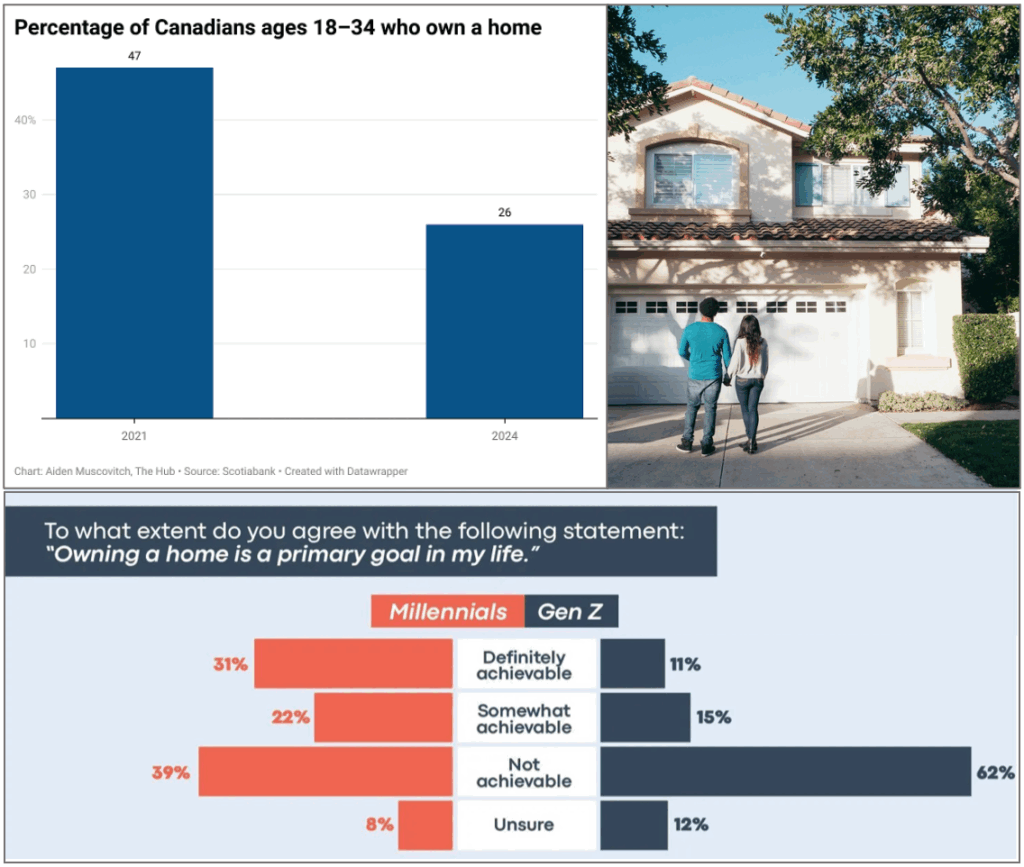
Homeownership denied: Just 26 percent of Canadians aged 18 to 34 currently own a home, down from 47 percent only three years ago. That may explain why survey data reveals the clear majority of Gen Z considers homeownership an unachievable dream.
xHomeownership denied: Just 26 percent of Canadians aged 18 to 34 currently own a home, down from 47 percent only three years ago. That may explain why survey data reveals the clear majority of Gen Z considers homeownership an unachievable dream. (Sources: (top graphic) The Hub; (photo) Pexels; (bottom graphic) Easy)

No wonder only 26 percent of Canada’s 18-34-year-olds (a span not precisely matching Gen Z, but close) owned a home in 2024. That is down from 47 percent just three years earlier. I had to triple-check those figures, because a 21 percent plunge in such a short time seemed unbelievable, but it’s straight from Scotiabank’s 2024 Housing Poll. And for most of the lucky 26 percent, homeownership only came about thanks to financial help from parents. For three out of every four Gen Zers, it’s an increasing struggle even to save enough for a down payment. Indeed, as the Scotiabank report noted, “Around 29 percent of people in that age group are now living with parents or family, up from around one-fifth of those surveyed three years ago.”

So it’s no surprise other surveys suggest nearly nine in every ten of Canada’s approximately 7 million Gen Zers are unsure whether they’ll ever own a home. Only 11 percent were certain they would, while 62 percent believe “owning a home is not achievable at all.” An article in Forbes, meanwhile, cited a survey in which 21 percent of American Gen Zers consider it more likely World War Three will break out than that they’ll buy a home in the next five years.

Between 2021 and 2024 the rate of homeownership for Canadians aged 18 to 34 plummeted from 47 percent to 26 percent. The decline was driven by elevated housing prices and high rental costs. Canada’s ongoing housing affordability crisis has left 62 percent of Generation Z (those aged 13-29 as of early 2026) believing that owning a home is an unachievable goal. The financial pressures upon Gen Zers are compounded by a national household-debt-to-disposable-income ratio of 185 percent – the highest among G-7 nations. 

The prospect of being lifelong renters isn’t the only life-altering financial challenge facing young Canadians. The above-mentioned Statcan report goes on to say, “Today, Canada has the highest household debt to disposable income ratio in the G-7, at 185 percent compared with an average of 125 percent for all G-7 countries.” And that’s for those who can get a job. According to the most recently available figures, the rate of unemployment for Canada’s youth is more than 14 percent. For Gen Z as a whole, unemployment is estimated to be a punishing 9.2-9.8 percent.
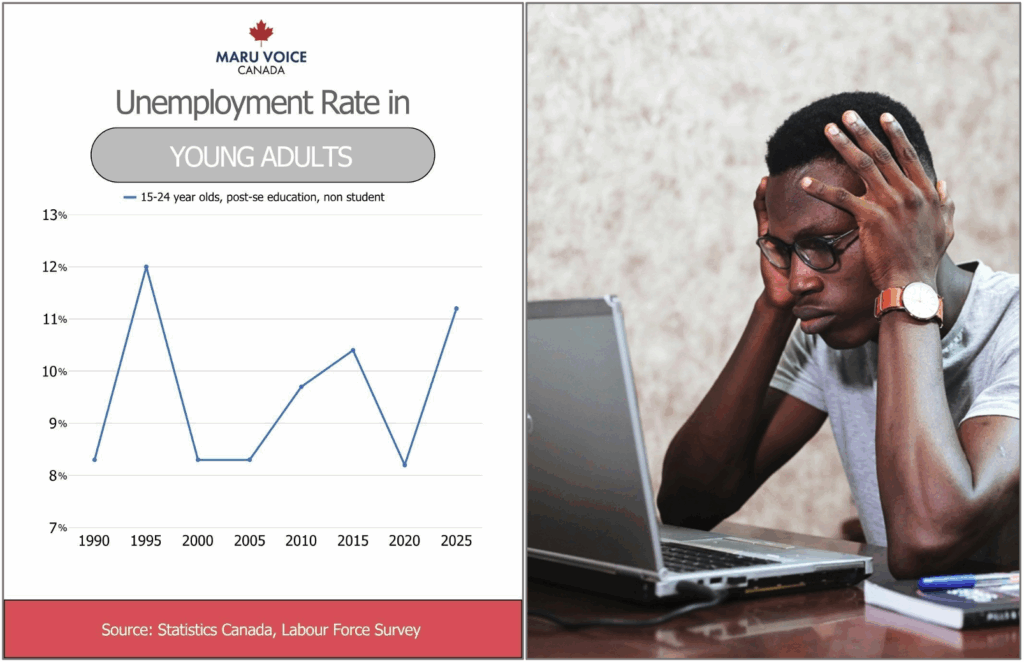
“Youth-cession”: Given steep increases in the cost of living and persistently high unemployment among young adults, no wonder nearly half of Canadians aged 18 to 34 report experiencing constant anxiety over money.
x“Youth-cession”: Given steep increases in the cost of living and persistently high unemployment among young adults, no wonder nearly half of Canadians aged 18 to 34 report experiencing constant anxiety over money. (Source of photo: Pexels)

No wonder surveys find young Canadians are “less hopeful about the future.” As a July 2025 Global News report noted, “Nearly half of Canadians 18 to 34 say they feel constant anxiety over money…putting off milestones their parents once took for granted.” In another Global News piece, columnist Ariel Rabinovitch termed this phenomenon a “youth-cession”. As Rabinovitch went on to explain, “The basics of life are getting more expensive at a time when wage growth is slowing. Young people are really getting hit on the head with the trends that are taking place right now.”

There are multiple reasons for Canada’s affordability crisis – especially as it pertains to housing – as well as for wage stagnation and high unemployment. But there’s a common thread to all: runaway government spending. When the Justin Trudeau Liberals came into office in 2015, the outgoing Conservative government of Stephen Harper left them a federal budget that was actually in surplus, a national debt (as measured by total liabilities) that had been held to approximately $1 trillion, plus economic growth that was steadily pushing down Canada’s debt-to-GDP ratio.

Since 2015 Canada’s Liberal government has been incurring budget deficits at rates that have doubled the national debt, which stood at $2.2 trillion at March 31, 2025 (the most recent fiscal year-end). The increased debt burden – plus continuing deficits incurred by Prime Minister Mark Carney – entails a significant financial obligation for future generations. A Canadian aged 16 in 2025 will be required to pay an estimated $30,000 more in personal income taxes over their lifetime just to service the interest on the added debt burden.

Trudeau then embarked on a spending frenzy that by the 2025 fiscal year-end more than doubled our national debt to $2.2 trillion. Canada’s federal debt to GDP ratio has soared by nearly one-third and is expected to reach 42.4 percent at the end of fiscal 2026. Interest costs alone to service this mountain of debt will reach $55.6 billion this year. And Trudeau’s successor, Mark Carney, has accelerated spending further.

These numbers are so mind-boggling, it’s hard to put them into perspective. When governments run deficits today, workers in future generations must eventually repay them in the form of higher taxes. For example, if you’re a 16-year-old Canadian, you’ll pay about $30,000 more in personal income taxes over your lifetime to service this mountain of debt. That’s on top of any tax-rate increases future governments deem necessary for program spending.
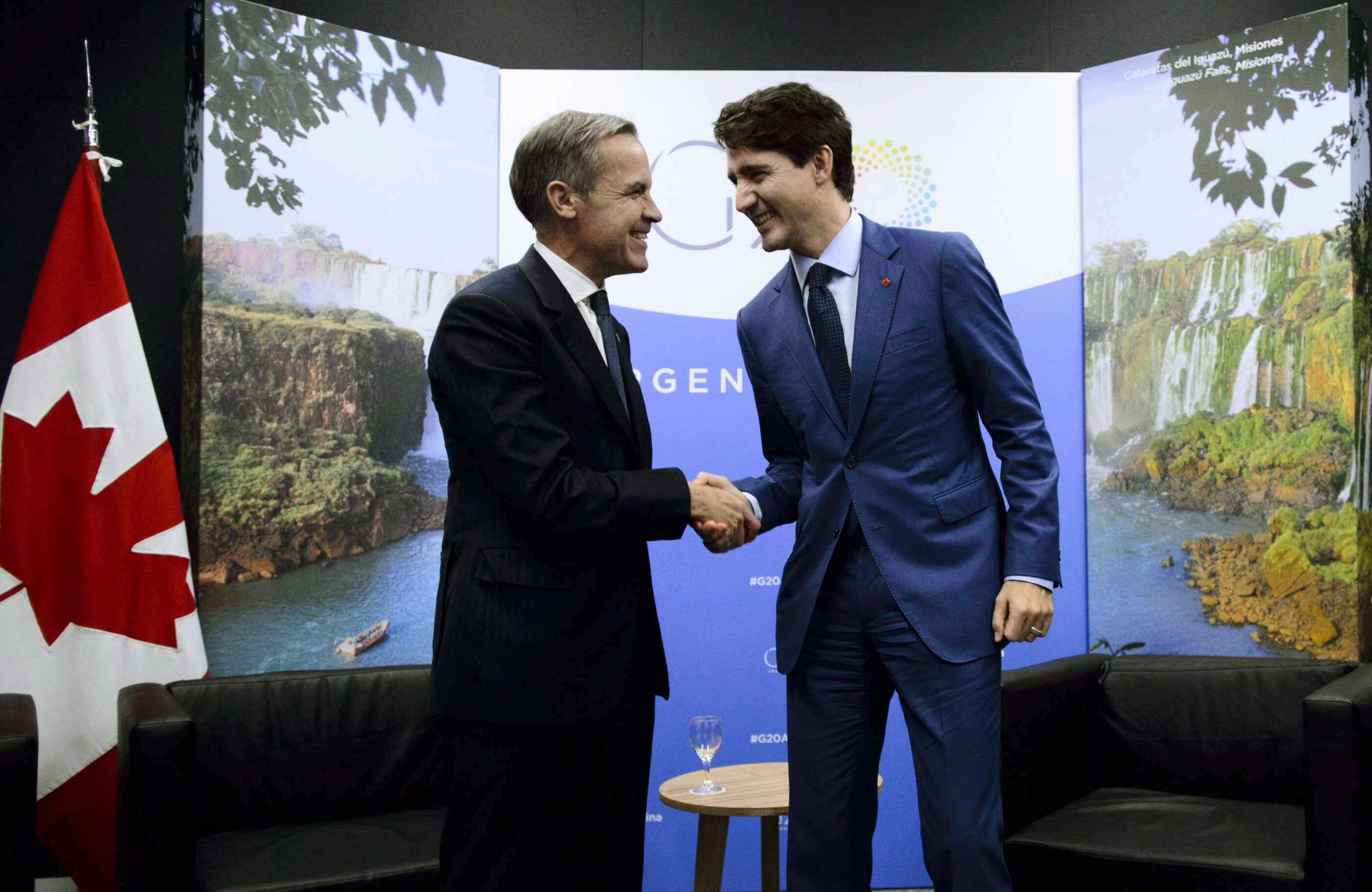
Keep piling up that debt, Mark: Prime Minister Justin Trudeau doubled Canada’s federal debt to a stunning $2.2 trillion, while successor Mark Carney has continued the federal spending spree.
xKeep piling up that debt, Mark: Prime Minister Justin Trudeau doubled Canada’s federal debt to a stunning $2.2 trillion, while successor Mark Carney has continued the federal spending spree. (Source of photo: The Canadian Press/Sean Kilpatrick)

But it gets worse still. Recurring government deficits increase the overall, economy-wide demand for borrowing. In response, interest rates rise, worsening the government’s deficit-debt-interest spiral. Private-sector borrowers must also pay these higher interest rates, at once making everything from credit-card purchases to car loans to home mortgages more expensive for consumers, and reducing the private-sector capital investment that creates new good-paying jobs.

The Canadian economy is currently struggling with a youth unemployment rate of over 14 percent; the unemployment rate for the broader Gen Z demographic (those born between 1997 and 2012) is estimated at 9.2-9.8 percent. The economic environment of high unemployment and stagnant if not declining wages has contributed to a pessimistic outlook. According to one report, 21 percent of young North Americans believe World War Three breaking out is more likely than them buying a house in the next five years. Gen Z’s malaise is compounded by Canada’s economy shrinking at an annualized rate of 0.6 percent during the fourth quarter of 2025 (following a smaller decline in Q2 and marginal growth in Q3). 

As I’ve written before, business investment has fallen substantially since the Liberal government started running massive deficits. Business investment per worker fell from $18,363 the year before the Liberal government was elected to $14,687 per worker by 2021. The interest-rate trap compounds every problem this article began with: housing is even less affordable, things cost more, new jobs are scarcer and employee compensation is held down.

These factors set up perfect-storm conditions for a recession, possibly this year. Just-released figures show that Canada’s economy “unexpectedly” shrank at an annualized rate of 0.6 percent in the fourth quarter of 2025, after also shrinking in Q2. As this Fraser Institute report notes, recessions cause employment insurance and other government payments to automatically increase, driving the nation further into debt and ravaging the value of the Canadian dollar, eroding the foundation for job creation and prosperity. Not a happy scenario, but a reminder of a famous adage from U.S. Founding Father and third president, Thomas Jefferson: “The government you elect is the government you deserve.”
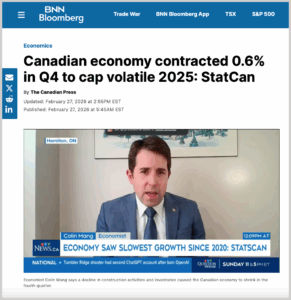
Recession on the horizon? Policy mistakes by previous generations, including poor fiscal management, increasing debt and a declining Canadian dollar, have Gen Zers bracing for an economic slowdown that’s not their fault. Shown, news coverage of Statistics Canada’s latest GDP data, released on February 27.
xRecession on the horizon? Policy mistakes by previous generations, including poor fiscal management, increasing debt and a declining Canadian dollar, have Gen Zers bracing for an economic slowdown that’s not their fault. Shown, news coverage of Statistics Canada’s latest GDP data, released on February 27.

From now on when I walk into a store, restaurant or hotel with a smile and get that unsettling flat stare in response, I’ll need to accept that the person behind the gaze might be thinking, There’s part of the problem. Because that’s what the Gen Z employee sees. She or he has no way of knowing that I spent my whole business career creating good and often downright great jobs for thousands of young Canadians, along with earning money for myself and generating returns for my investors. And, setting aside modesty for a moment, I succeeded at all three. In addition to supporting myself and my own family, I wanted Canada to become even better than it already was, and I wanted our country’s next generations to have even better opportunities than I did when I was starting out. So it pains me greatly to see that wreckage is indeed what Canada’s Boomers, Gen Xers and Millennials are leaving behind.

Gwyn Morgan is a retired business leader who was a director of five global corporations.

Source of main image: physiognomist, licensed under CC BY 2.0.

Love C2C Journal? Here's how you can help us grow.

More for you

We Have Ways of Making You Talk: The Tyranny of Land Acknowledgements and Other Compelled Speech

Indigenous land acknowledgements have become so common that many Canadians no longer give them a second thought – simply accepting a kind of tuneless new national anthem before events of all sorts. And that’s why they’re so dangerous. The enforced conformity and compelled speech they depend on are not just threats to individual freedom, writes George Ramsay, they also create a divisive moral hierarchy based on race. In this originally reported story, Ramsay delves into the dangers posed by Canada’s broader shift to enforced verbal compliance, reveals the inspiring stories of a few brave souls who have dared to challenge this social tyranny and offers practical tips on how the rest of us can fight back too.

Take This Algorithm and Shove It: Gen Z Wrestles with Digital Privacy

Generation Z should know better than anyone the risk that technology poses to personal privacy. They are after all the first generation to grow up entirely in the digital age. Jessica Nwaefidoh knows from personal experience how vulnerable your most intimate information can be. With companies anxious to profit from everyone’s personal data, politicians happy to play along for their own selfish reasons and most people willing to sacrifice their own privacy for convenience, amusement or just to get by, Nwaefidoh argues that it’s time to fight back. The right to be left alone, she finds, requires constant vigilance – and she offers some practical tactics to reclaim that right.

Unfriendly Skies: Why Canada Needs Real Airline Competition

Ireland’s Ryanair will fly you from London to Geneva for $49. Flying from Calgary to Vancouver – a shorter trip – likely will set you back four times as much. Canadians suffer some of the highest-priced, least-convenient and most unpleasant airline service in the world, and mainly for one reason: forestalled competition. In fact, creating barriers to prevent any meaningful competition has been the main goal of Canadian airline policy since the formation of Trans-Canada Air Lines in 1937. Simon Michell explains how this sorry situation came to be and reveals how opening up our skies – as so many other countries have already done – would make things much better for us all.

More from this author

The Price of Foolish Pride: What Germany’s Social and Economic Decline Can Teach Canada

Germany was postwar Europe’s most successful nation – until it was seized by an arrogant leftist ideology that led it down a ruinous path. Its government abandoned safe, zero-emission nuclear power for inefficient wind and solar plus natural gas from Vladmir Putin. It threw open its borders to millions of asylum-seekers with barely a thought to the enormous costs or the difficulties of social integration. Today, at the 11th hour, Germany is at last struggling to turn around its decade of economic decline and social disintegration. In this cautionary tale, Gwyn Morgan sees a profound warning for Canada.

Socialist Shakedown: It’s Finally Time to End Supply Management in Agriculture

U.S. President Donald Trump’s trade policy may be chaotic and punitive, but he’s right about one thing: Canada’s agricultural supply management system has to go. Not because it’s unfair to America, though it is, but because it punishes Canadians. The price-fixing scheme limits consumer choice, requires a huge bureaucracy and prevents farmers from producing more in the face of shortages, forcing them instead to dump excess production. Worst of all, writes Gwyn Morgan, it drives up prices for milk, cheese, chicken, eggs and other essential foods — all for the benefit of a few thousand farmers, largely in Quebec. For Canada’s trade negotiators, argues Morgan, ending this mad racket should be job one.

Climate Climbdown: Sacrificing the Canadian Economy for Net Zero Goals Others Are Abandoning

Climate-obsessed politicians – Justin Trudeau in the vanguard – nearly destroyed the Canadian economy chasing emissions targets that are both unrealistic and pointless. Ottawa and the four biggest provinces have squandered $158 billion to create just 68,000 “clean” jobs. Meanwhile, fossil fuels are supplying a bigger share of Canada’s energy needs than ever. And now, leading U.S. officials and even eco-zealots like Bill Gates are re-evaluating their net-zero ideology. But that hasn’t gotten through to Prime Minister Mark Carney who, warns Gwyn Morgan, intends to inflict further punishment on an ailing country in pursuit of a delusional cause.