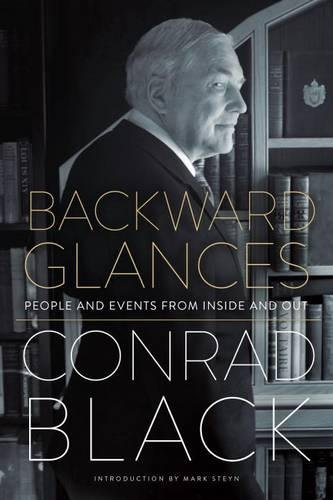
Backward Glances: People and Events from Inside and Out
By Conrad Black
741 pp: Signal, 2016
Reviewed by Patrick Keeney
This seven-hundred page collection of previously published pieces by the prodigious writer Conrad Black is pretty much what one expects: polemical, argumentative, disputatious, contrarian, acerbic, and opinionated.
It is also wonderfully well written and never less than entertaining. Lord Bolingbroke wrote that “History is philosophy teaching with examples.” By that metric, Lord Black is a wonderful tutor. One is impressed by the erudition and sheer catholicity of learning on display.
The essays range over 50 years and numerous publications including the National Post, National Review, Foreign Affairs, The New Criterion, and The American Spectator. Black’s writing spans a vast landscape of subjects including Canadian, American and International politics, celebrities, the environment, justice, punishment and retribution, historiography, religion (Black, who says his family was “divided between atheism and agnosticism”, is a convert to Catholicism) and, of course, the struggles of newspaper publishing in the age of the internet. There are book reviews, and in the last section, the author writes candidly about personal matters, including a touching encomium to his late brother, Monte.
The book suffers from the usual complaints about any such collection. Predictably, some subjects have slipped from public view or are now well past their sell-by date. And history moves on, calling into question the judgement of even the most prescient of commentators.
Nothing new in news fakery
Yet these are modest cavils. What most impresses is the overall readability of these essays. Even if their subject matter is no longer front-page news, they continue to resonate with contemporary issues and concerns. For example, in our age of “fake news”, Black’s 2015 analysis of the fall from grace of NBC anchor Brian Williams is apposite. Williams was fired by the network for falsely claiming he came under fire as a war correspondent in Iraq. Black found it “implausible, and even bizarre, for the higher-ups at NBC News to become so unctuous about Williams when the whole industry is infested with myth-makers and tendentious partisans who, in their daily reporting, can often be assumed to be taking liberties with the truth whenever you see their lips move.” The problem in part is that “there lingers in public memory a benign nostalgia that previous newsreaders and anchors were people of immense integrity and insight.” Alas, as Black points out at various places throughout this collection, this was never the case. Even the sainted Walter Cronkite, “just made it up.”
Black is a marvellous prose stylist of the kind that used to be called “muscular.” His opinions are rendered with a cogency and pithiness that makes for a lively discourse between author and reader. I frequently found myself setting the book down, either to reflect on something I’d read, to argue a point, or simply to appreciate the verve and wit of the prose. In an essay on cats and dogs he writes, “Even tomcats, unkempt and with tangles in their fur, have a certain inseparable dignity, like a feline John Malkovich.” As an admirer of both cats and Malkovich, this strikes me as precisely right.
The book abounds with such analogies, along with bon mots, word play, clever turns of phrase, and concise summations of complex ideas. And if the proper role for historians is to challenge national myths, then Black excels at forcing Canadians to re-examine some cherished national shibboleths, such as that tedious progressive talking point that defines our foreign policy as “soft power”:
“It is a concept that has any validity only when there is a hard-power option, which Canada did not possess. As practiced by this country, soft power was a fraud, just more softness.”
Or again, here is Black’s summation of what he terms the “defective moralizing” concerning the residential schools program:
“Assimilation was an extension of the Canadian and American practice of integrating newly arrived people in the majority cultures. However mistakingly and patronizingly conceived and at times barbarously executed, the authors of the residential schools program, starting with John A. MacDonald, imagined they would be benignly solving the problems of the native people.”
One might disagree with his views, but there is never any doubt as to what his views are.
Evisceration and compassion
When writing of literary celebrities, Black can dip his pen in acid. On Gore Vidal: “He was the apogee and caricature of a number of notorious types, fused in one ambulatory, humanoid sociopath. … He set out with an indomitable will to be obnoxious, and at this he was an overachiever.” As a Catholic, Black found Christopher Hitchens’ arguments for atheism “so unmitigatedly fatuous, he always seemed to me rather silly, more a pest than even a gadfly, much less a sage or wit.”
Such florid expressions of disdain are often derided by the left as evidence of Black’s pomposity and arrogance. Yet there is another quality in his prose, one which came as something of a surprise. In 2007, he was convicted in a Chicago court of embezzling funds from his holding company, Hollinger International, and sentenced to six-and-a-half years in federal prison. Ultimately, after a series of appeals, only a single conviction for obstruction of justice was upheld, along with civil penalties from the Securities and Exchange Commission. He spent 37 months in a U.S. federal prison in Florida, all the while (and to this day) tenaciously maintaining his innocence before what he calls “the rogue American proscecutocracy.”
Yet when he writes abut his time in prison Black’s tone is confessional, humble and authentic. Given his fall from the heights of the corporate world, and his insistence on his innocence, Black might be forgiven for an occasional lapse of self-pity. Instead, he meets his fate with equanimity, and displays great empathy and compassion for his fellow inmates, the social and economic disadvantages that plagued their lives, and the suffering they endured at the hands of the American judicial system. Black is particularly scathing about the abuses inherent in the plea-bargain system. He claims that American prosecutors win over 97 percent of their cases without trial.
Reading about his work in prison as a tutor to his fellow inmates, one is moved by Black’s basic human decency, and his genuine affection for his students. He writes, “It has been my good fortune to be well-received in some learned and distinguished places, and I am always grateful for considered applause, but never more so than when complimented by my students on receipt of my advanced tutor’s certificate…”
In his introduction, Mark Steyn tells of a conversation with Mrs. Black, Barbara Amiel, who speaks of the oddity of marrying a corporate titan who became a freelance writer. Yet fortunes shift for all of us, even for corporate titans, and it is a tribute to Conrad Black that he has emerged from his sojourn a wiser, and more compassionate man. As the author writes, “It pains me to verge on platitudes, but life’s rewards do sometimes come in strange ways and unexpected places.”