Energy Politics

Hard Facts Puncture Inflated Anti-Fossil-Fuel Fantasies

Gwyn Morgan
June 7, 2022
Perhaps the Liberal Party of Canada’s new tagline could become a play on an old song, something like “Up, up and awaaaaay, in our magical, our magical balloon.” As they waft ever-higher, the rest of us will be left behind to deal with the remains. The Liberals’ magical thinking, notes Gwyn Morgan, largely revolves around the fantasy that Canada’s transition to “net zero” can simply be declared, demanded and decreed while Canada’s oil and natural gas sector is regulated out of existence. This is worse than naïve, Morgan argues, it is colossally irresponsible, already doing real damage by indirectly enriching Russia’s war machine. And if not reversed soon it portends even worse for Canadians and others around the world. Morgan offers a bracing list of facts to puncture the Liberal airship.
Energy Politics

Hard Facts Puncture Inflated Anti-Fossil-Fuel Fantasies

Gwyn Morgan
June 7, 2022
Perhaps the Liberal Party of Canada’s new tagline could become a play on an old song, something like “Up, up and awaaaaay, in our magical, our magical balloon.” As they waft ever-higher, the rest of us will be left behind to deal with the remains. The Liberals’ magical thinking, notes Gwyn Morgan, largely revolves around the fantasy that Canada’s transition to “net zero” can simply be declared, demanded and decreed while Canada’s oil and natural gas sector is regulated out of existence. This is worse than naïve, Morgan argues, it is colossally irresponsible, already doing real damage by indirectly enriching Russia’s war machine. And if not reversed soon it portends even worse for Canadians and others around the world. Morgan offers a bracing list of facts to puncture the Liberal airship.
Share on Facebook
Share on Twitter

The marvellous Christmas movie Polar Express, starring the inimitable Tom Hanks, ends with the words “Anything is possible, if you only believe.” It’s a fine sentiment, except that as adults understand, many things aren’t possible, no matter how hard some people do believe them. An obvious example is the fantasy that the 84 percent of global energy supplied by fossil fuels can be replaced by so-called “green energy.”

Since the United Nations’ first Conference of the Parties (COP) meeting on global warming in 1995, world crude oil demand has increased from 64 million to 100 million barrels per day, while overall global energy consumption has increased by about 60 percent. As this was occurring, the “environmental, social and governance” (ESG) movement badgered and pressured investors to unload their oil industry holdings. Faced with share valuations reflecting their perceived status as a “sunset industry,” oil company leaders concluded the rational course was to use much of their cash flows to pay out large dividends and to buy back shares rather than reinvest in production growth. Global energy demand continued to grow but crude oil supply therefore stagnated and so the world’s “supply margin” of energy gradually shrank.
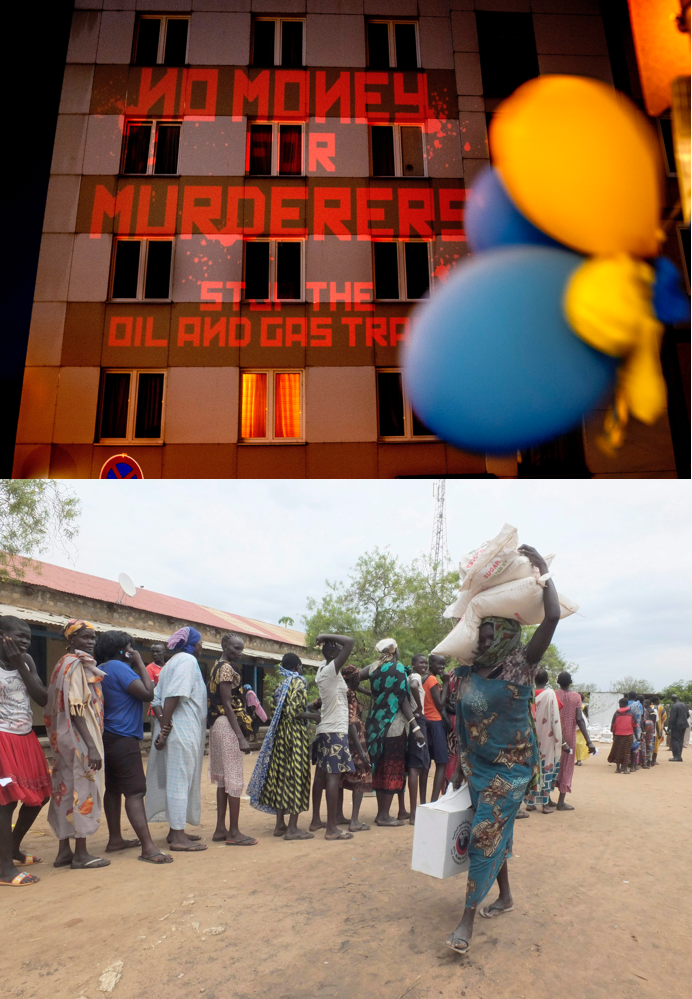
xA tragedy wrought in part by the environmental movement – with possibly worse to come: Russia’s invasion of Ukraine is largely funded by sky-high oil and natural gas prices, caused largely by decades of global underinvestment (shown at top is a protest slogan projected by activists onto the Russian consulate in Frankfurt, Germany in April 2022). If world energy prices are not brought down soon, food shortages could be next (shown at bottom, famine-afflicted South Sudanese line up for food relief in 2017). (Sources of photos: (top) The Associated Press/ Michael Probst, file; (bottom) The Associated/Samir Bol)

The Ukraine crisis revealed just how narrow the supply margin has become. Regrettably, much of that margin is in the hands of Russian dictator Vladimir Putin, leaving European countries that depend on Russian oil and natural gas no choice but to continue to provide the funds with which he ravages the Ukrainian people. This is the tragedy that the sanctimonious ESG zealots have wrought. It is their worst one so far, but I fear that if sanity is not soon restored to national energy policies – including in Canada – Ukraine will not be their last. An energy shortage that endures for any length of time will have cascading effects throughout economies all over the world – up to and including shortages of basic foodstuffs afflicting hundreds of millions of people.

Meanwhile, back in the world capital of “if you only believe” fantasies, the prime minister of a country endowed with one of the world’s largest reserves of crude oil has presided over an eight-year long anti-oil industry scourge, including thwarting multiple proposed export pipelines that could now be supplying those needy countries that are instead the captive market of Russia.
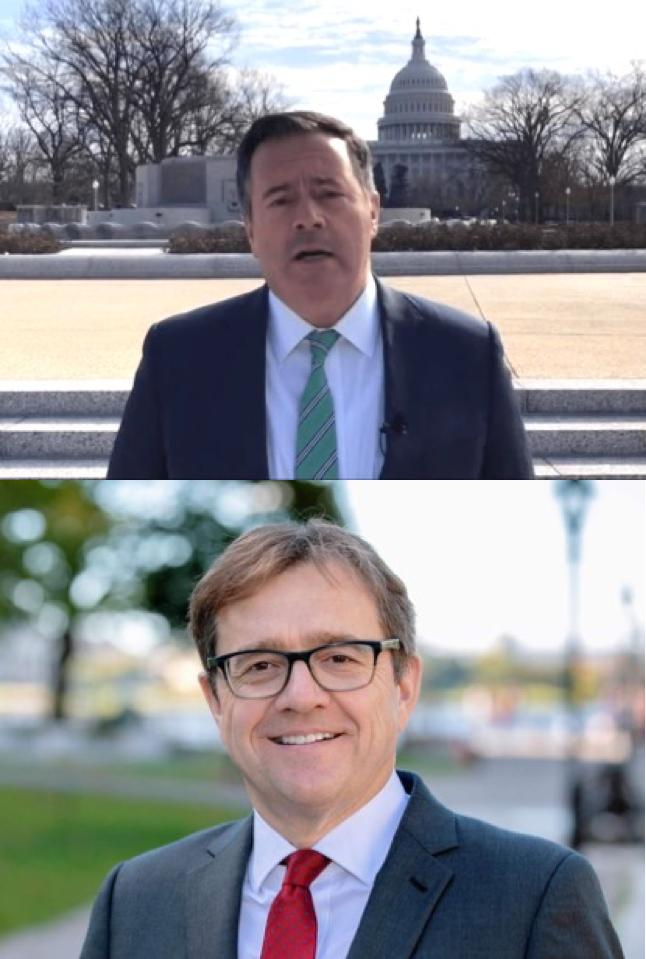
xHelp defund Putin’s war? Not on my watch! After Alberta Premier Jason Kenney (top) suggested practical steps to increase Canadian oil exports and thereby alleviate Europe’s dependence on Russian energy, Liberal Natural Resources Minister Jonathan Wilkinson (bottom) quickly rebuked Kenney and offered the claim that wind and hydrogen will “provide true energy and national security.”

Sharing his anti-oil zealotry seems to be a necessary qualification for Trudeau’s cabinet. Alberta Premier Jason Kenney recently went to Washington, D.C. to present the Senate Energy Committee with plans to increase Canadian oil exports, thereby freeing-up more U.S. oil to help Europe reduce Russian oil purchases. The idea received a warm reception. Unfortunately, Kenney’s message was promptly contradicted by federal Natural Resources Minister Jonathan Wilkinson, who told the same committee that shifting to renewable energy and hydrogen “will provide true energy and national security to Europe.” Since none of this energy exists yet and, even if it did, could not be shipped across the Atlantic Ocean, Wilkinson’s message amounted to: don’t count on Canada to help de-fund Putin’s murderous war unless it lasts five or ten more years.

It’s incomprehensible that during a global oil and natural gas shortage brought on by the wanton destruction of a civilized democracy, our prime minister thinks all will be well if only Canada rids itself of fossil-fuelled vehicles. Deep in delusion, Justin Trudeau instead considers this a perfect time to announce a plan to have 60 percent of new cars and light-duty trucks be “zero emission” (i.e., electric) by 2030.

When you live in a perennial state of fantasy, facts don’t matter. But here are facts that do matter to Canadians forced to face the real-world impact.

Fact 1: High Cost – The federal budget promises a rebate of $5,000 per electric vehicle (E). Currently there are approximately 24 million gasoline and diesel-powered vehicles in Canada. Subsidizing the replacement of just 1 million of these would cost $5 billion (while consumers would need to spend approximately $55 billion). The budget also contains $900 million for new EV charging stations. That’s helpful in urban centres but providing the charging station network necessary to allow EVs to travel interurban highways would cost tens of billions more, as this C2C article discusses in detail.

xExpensive and impractical even if subsidized forever: At the Liberals’ promised $5,000-per-electric-vehicle subsidy, adding even 1 million EVs (out of Canada’s current fleet of 24 million cars and light trucks) will cost taxpayers $5 billion and consumers another $55 billion. Then multiply by 24. And that’s before the cost of charging stations and massive needed additions to Canada’s electrical grid. (Source of both photos: Shuttertock)

Fact 2: Revenue Needs – The Trudeau government’s longer-term plan is to get rid of all fossil-fuelled vehicles. Federal and provincial fuel taxes now total a stunning $22 billion each and every year. These revenues fund the cost of building and maintaining urban streets and highways. As the number of such vehicles drops under the Trudeau-forced transition plan, so will government fuel tax revenues. How long can it be before governments are forced to regain those revenues through EV charging levies or other EV-related taxes?

Fact 3: Grid Stress – The average Canadian motorist drives 15,000 km per year and the average passenger EV uses approximately 20 kilowatt-hours (kWh) per 100 km travelled. That works out to 2,850 kWh per year, or more than 25 percent of current Canadian household consumption. Many of the country’s electrical generation and distribution grids are already near capacity. EV advocates say the problem will be mitigated by mandating low-amperage (i.e., slow) charging during off-peak, late-night hours. But most highway drivers travel during the day when the grid is often near capacity. And they will need high-amperage DC quick-chargers during these already supply-tight hours.

Fact 4: Land Demand – Refuelling with gasoline or diesel takes around five minutes. But even rapid chargers need 30 minutes. That ultimately translates to using six times more land occupied by charging stations. How much of that land will be taken from agricultural production?

Fact 5: Higher Emissions, Not Lower – Canada’s 24 million fossil-fuelled cars and pickup trucks emit 14 percent of the country’s 1.5 percent share of global emissions. If all 24 million were converted to battery power, global emissions would be reduced by just two-tenths of one percent. Emissions growth from China’s coal-fired power plants would offset that in just a few days. And that two-tenths of a percent doesn’t count emissions produced from mining and transporting the materials that go into all those batteries. Nor does it consider that 20 percent of Canada’s electricity is generated with fossil fuels.

These factors clearly wipe out any benefit, unless we include the benefit that living a fantasy allows people, our prime minister included, not to have to think about all those Ukrainians we could have saved by helping Europe say “no” to Russia’s oil – if only our oil industry hadn’t been hamstrung.

Gwyn Morgan is a retired business leader who has been a director of five global corporations.

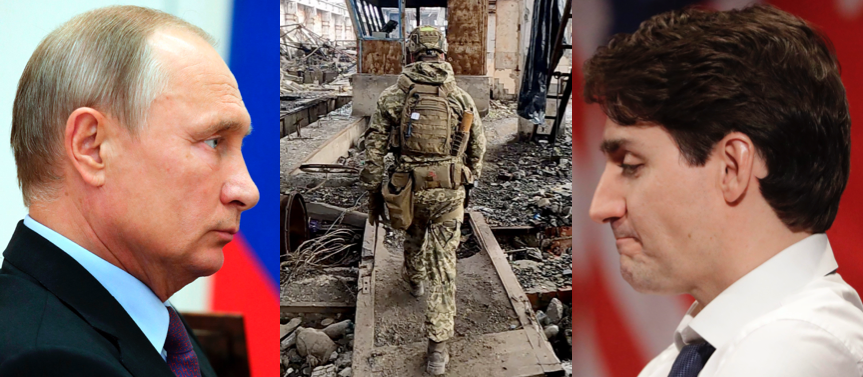
Sources of photos in main image (left to right): Mikhail Klimentyev/ Sputnik/ Kremlin Pool Photo via the Associated Press; Goktay Koraltan/ Depo Photos/ abacapress.com; The Associated Press/ Charles Rex Arbogast.


Love C2C Journal? Here's how you can help us grow.

More for you

Freedom Fighters: The Pushback Against Universities’ Woke Agenda

That a liar and fraud such as the late Jason Arday has become a martyr to “progressive” academics is evidence enough of how thoroughly universities have been captured by wokism. But all is not lost. Jonathan Barazzutti recently travelled to England for the annual conference of the Centre for Heterodox Social Science and spoke to those fighting back. Their weapons? Courses and workshops encouraging open inquiry, a push for policies enshrining political neutrality in institutions of higher learning and the creation of brand-new centres or entire universities dedicated to academic freedom. Much more needs to be done if universities are to rediscover the one form of diversity that really matters in higher education – diversity of thought.

Canada’s Economic Web of Woe

In these “Elbows Up” times, when so many Canadians act so eager to tout Canada’s resilience and potential, veteran business leader Gwyn Morgan points to a troubling list of economic woes that tell a different story. Canada is indeed among the world leaders – in food costs, taxation, government debt, the regulatory burden on business and the crippling shortage of affordable housing. Meanwhile, the private sector is neglected and trade talks prioritize political goals. All that, and a government that lacks the ability or courage to take effective action. It is a veritable web of woe – one in which each strand worsens the other.

A girl sits alone against a brick wall, bullied – an image of how the HWDSB treated one parent who challenged compelled speech.

School Board Bullies: One Parent’s Fight Against Compelled Speech and a Woke Education System

Catherine Kronas joined the school council at her son’s Hamilton, Ontario high school for the same reason most parents do – to have a say in their children’s education. Having read the relevant provincial legislation, Kronas thought she knew how the council was supposed to work. But rather than giving parents a voice in the school system, it turned out to be one more way for Canada’s education bureaucracy to impose its woke worldview on kids, staff and parents, including via compelled speech. In a soul-baring first-person account, Kronas reveals the many deceptive, manipulative and punitive ways in which school administrators tried to shut down her efforts to hold them to account.

More from this author

Canada’s Economic Web of Woe

In these “Elbows Up” times, when so many Canadians act so eager to tout Canada’s resilience and potential, veteran business leader Gwyn Morgan points to a troubling list of economic woes that tell a different story. Canada is indeed among the world leaders – in food costs, taxation, government debt, the regulatory burden on business and the crippling shortage of affordable housing. Meanwhile, the private sector is neglected and trade talks prioritize political goals. All that, and a government that lacks the ability or courage to take effective action. It is a veritable web of woe – one in which each strand worsens the other.

The Hands-On Future: Skilled Trades, Data Centres and Canada’s Big AI Opportunity

Whether Canadians fear or favour artificial intelligence, they can’t stop it. AI’s transformative power in making so many things faster and easier will doubtless cause pain, says veteran Canadian business leader Gwyn Morgan, but it will also provide generational opportunities Canada must seize. The Prairie region, especially, has the abundant land and energy needed to build the massive AI data centres that will power the future. Some workers are at risk, Morgan concedes, but AI will create opportunities as well, particularly in the skilled trades. AI might just transform our labour force into one where more workers do real things for real people.

From the Strait of Hormuz to Cuba, Net Zero is Dying – Mark Carney Needs to Let Go

After decades spent pursuing net-zero dreams at great cost to their economies and social fabric, most of the world’s industrialized nations are waking back up. War with Iran and the threat of tanker blockades have everyone worried about oil and natural gas supplies and clamouring for energy security. Or nearly everyone. Not Mark Carney, though. Canada’s prime minister keeps pushing industrial carbon taxes higher and insists on wasting taxpayers’ money on windmills that make no difference. Gwyn Morgan recalls his own observation of the global warming movement’s original rise, its morphing into the radical “net zero” cult – and its spectacular global disintegration. It is high time, Morgan writes, that Canadians demand Carney also drop his delusions.

Three images, left, Vladimir Putin side profile. Middle, a soldier walking through ruble in Ukraine. Right, Justine Trudeau side profile.