Policy Imitating Art

Giorgio de Chirico and Our Modern-Day Curators of Disaster

David Solway
August 11, 2021
Fascinated by the metaphysics of the city, 20th century Italian artist Giorgio de Chirico produced jarring urban scenes bereft of people and normal human bustle. He meant to trigger contemplation; he didn’t actually hate people. The tiny minds who run our governments, control our public health agencies and staff our hospital system seem to have taken de Chirico’s metaphorical presentations as an operating blueprint, for in David Solway’s view they have delivered a globe-girdling art installation using the world’s cities as their canvas. From soaring commercial vacancy rates and boarded-up businesses in hundreds of the world’s second-tier cities to the moonscape that Manhattan has largely become, Solway denounces the incalculable damage wrought not by SARS-CoV-2 itself – but the government response to it.
Policy Imitating Art

Giorgio de Chirico and Our Modern-Day Curators of Disaster

David Solway
August 11, 2021
Fascinated by the metaphysics of the city, 20th century Italian artist Giorgio de Chirico produced jarring urban scenes bereft of people and normal human bustle. He meant to trigger contemplation; he didn’t actually hate people. The tiny minds who run our governments, control our public health agencies and staff our hospital system seem to have taken de Chirico’s metaphorical presentations as an operating blueprint, for in David Solway’s view they have delivered a globe-girdling art installation using the world’s cities as their canvas. From soaring commercial vacancy rates and boarded-up businesses in hundreds of the world’s second-tier cities to the moonscape that Manhattan has largely become, Solway denounces the incalculable damage wrought not by SARS-CoV-2 itself – but the government response to it.
Share on Facebook
Share on Twitter

The city, for all its anonymity, traffic congestion and claustrophobic density, is the centre of the economic and cultural life of a people. What happens to the city happens to the nation and ultimately to the character of its citizens. British philosopher John Gray in his aphoristic tract on humanistic folly Straw Dogs speaks of the grand delusion of stability represented by great cities, especially in the modern era, observing that, “In cities, persons are shadows of places…The settled life they once contained is fading from memory.” Images of our cities today in the wake of draconian Covid-19 regulations and decrees emphasize the point.

Giorgio de Chirico (1888-1978) is considered by many as one of the signature painters of cities in the tradition of Western art, as, for example, Canalleto was famous for his views of Venice and its canals. But the Greece-born Italian’s paintings were not merely representational; in the words of French poet Guillaume Apollinaire, they were best described as a kind of “Metaphysical Painting,” relying on a technique of disorientation to develop a perspective on reality hidden by our habitual preoccupations and assumptions about the world. They intended to enact in paint a revelation of the guileful and enigmatic nature of consensual experience that glazes over the primal strangeness of the world and the natal loneliness of being.

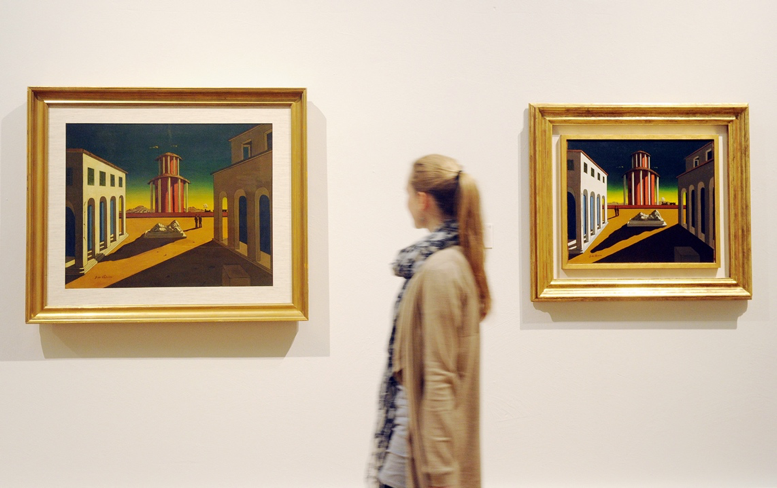
xAlthough he painted himself numerous times, as in the 1925 self-portrait at centre, Giorgio de Chirico’s Pittura Metafisica or “Metaphysical Painting” moved him to produce unsettling cityscapes empty of people and their items of daily life. De Chirico intended to encourage self-reflection – not be taken literally. At right, “The Enigma of an Autumn Afternoon” (1924).

De Chirico’s canvasses “read” like a synthesis of riddle and parable. “One must imagine everything in the world to be a riddle,” he wrote in Memoirs. His imaginary cityscapes, empty plazas, long arcades, brooding figures and sculptural fragments are ways of making us confront what he liked to call, in work after work, the “enigma” underlying everything we see and do, all that normal perception and belief tend to suppress or overlay with facsimiles of “the real.” His intention was to expose the distortions and distractions that consciousness provides for our solace and comfort in a world that neither loves nor needs us.

Horror author and cult figure Thomas Ligotti might well have had de Chirico in mind when he wrote in The Conspiracy against the Human Race that we are invested in immunizing awareness “from any thoughts that are startling and dreadful” in order to perpetuate a “falsifying and specious view of ourselves.” A de Chirico painting repays contemplation for its bizarre motifs and eerie insights into and beneath the surface of the world we take for granted.

But the world of de Chirico’s “phosphorescent” imagination – his word – brings to mind a twisted aspect of presentational immediacy. His spectral cityscapes now suggest the agenda of our political leaders who have led us into a caricature of de Chirico’s art, a travesty which is also worth contemplating, but only as a function of disembrained planning. They are not visionaries but curators of disaster, embodied shadows cast by the totalitarian architecture of deceit and stupidity.

xFrom the city that never sleeps to government-mandated coma: New York City in 2017 (above) and in February 2021 (below) is emblematic of the damage governments have wrought around the world. As a de Chirico curator put it of her own city: “When we walk in Turin today, it is as if we are walking inside a de Chirico. What is a city without people, what is the point of an empty piazza?” (Source of images: Shutterstock)

The destabilization of practical life caused by the official (and generally useless if not counter-productive) response of masks, quarantines, lockdowns, experimental vaccines and endlessly evolving mandates to the Covid-19 panic and variant obsession has turned our cities into ghost conurbations and deep-sixed the economy of nations into the bargain. Some scholars believe it may take a decade to return to the former status quo, others say a generation, Klaus Schwab of the World Economic Forum says “never” (and, we should note, he wants it that way). Schwab may be right.

Certainly, our cities, featuring shuttered shops, half-vacant office towers, phantom skyscrapers, half-deserted lanes and by-ways, and sparsely populated parks, might never quite be the same again – an aura of desolation fortuitously captured in de Chirico’s The Enigma of Skyscrapers. And for those who think I exaggerate, consider just a couple of data points. In the second quarter of this year the city of Calgary’s downtown office vacancy rate hit an all-time record of 29.2 percent and is still climbing, while a large percentage of “occupied” offices are of course barely used. In New York City, for a century the world’s most intensively used downtown, an astonishing 78 percent of office space is still empty of workers. You read that right.

In Metaphysics of Silence: Giorgio De Chirico, Lucio Giuliodori’s summation of the impression left by certain paintings casts a premonitory light on the current practices of our political gauleiters, mired “in the throes of a kind of dehumanizing effect…in a world ruled by madness rather than rationality.” Of course, the Pictor Optimus (as he is known to his admirers) wasn’t thinking of political contingencies, plagues or natural disasters, but of the metaphysical quality of deep perception, of the reality of sadness, menace, dislocation and emptiness beneath the laminate of ordinary life and the consoling illusion of common expectation.

Yet, as art critic Maximiliano Durón has pointed out, our cities under lockdown are weird, serendipitous projections of de Chirico’s strange and unsettling vision. He quotes a colleague, the director of a great art museum in Turin, who writes: “When we walk in Turin today, it is as if we are walking inside a de Chirico. What is a city without people, what is the point of an empty piazza?” The phrase was picked up in a recent video essay by Evan Puschak (aka The Nerdwriter) and could apply to hundreds of cities around the world.

De Chirico’s art is plainly “metaphysical” in Apollonaire’s sense – “meta” is the Greek prefix for “after” or “beyond” – thus beyond the physical. Giuliodori puts it somewhat differently, though to the same effect: “He didn’t set metaphysics beyond physics but rather in physics, deep into the hidden core of it.” The “art” of our political leaders and their medical cronies, however, is anything but metaphysical or even intelligent; it is, frankly, not only misguided but punitive and spiteful, a mutilation of the physical. They succeeded in turning de Chirico’s mysterious mises-en-scène and avowedly melancholic deconstructions of the customary into grim empirical realities, embarking on a program that has not only failed but caused unparalleled devastation.

xA synthesis of riddle and parable: De Chirico’s “phosphorescent” imagination might have taught our pandemic managers more about the damage they were about to unleash than swallowing the bogus pandemic projections of Neil Ferguson’s Imperial College Model. Left-to-right: “The Enigma of a Day” (early 1914), “The Skyscraper’s Enigma” (1960), “The Enigma of the Hour” (1911).

The havoc they have released in following the prescriptions of a self-interested medical profession is unprecedented in peacetime, dividing citizens into competing groups of indignation and contempt, wrecking the economic life of entire countries and emptying our city streets and buildings of activity, commerce and pleasure. A visit by our ostensible superiors to the Tate or MoMA or Palazzo Strozzi, where de Chirico’s oeuvre has been on exhibit, would have been far more beneficial than consulting Anthony Fauci or Neil Ferguson, who got almost everything wrong, or relying on their own timorous and mediocre judgment. They have created not a work of imagination but a palpable monstrosity.

One recalls Joseph Conrad’s famous statement of purpose: “My task is…before all, to make you see.” The visions of great artists and writers will often have predictive value, but not always as strict reproductions of the everyday world. They will occasionally assume ironic and unexpected manifestations, semantic fictions or visual exaggerations that become uncannily prescient and part of the sediment of actual existence, like Kafka’s deformed and irrational judicial system in The Trial. In such cases, irrealism tends to become fact and implausibility, truth. Today, making allowance for the distinction between acumen and stupefaction, the painter and the politician, we are indeed walking in a de Chirico.

David Solway’s most recent volume of poetry, The Herb Garden, appeared in 2018 with Guernica Editions. His manifesto, Reflections on Music, Poetry & Politics, was released by Shomron Press in 2016. He has produced two CDs of original songs: Blood Guitar and Other Tales (2014) and Partial to Cain (2019) on which he is accompanied by his pianist wife Janice Fiamengo. His latest book is Notes from a Derelict Culture, Black House Publishing, 2019, London.
Love C2C Journal? Here's how you can help us grow.

More for you

A Mess and Minefield: Ottawa’s Clarity Act on Provincial Separation is Anything but Clear

Proponents of independence for Alberta seem to believe the federal Clarity Act provides a sure pathway to secession should they win a referendum vote. But as Jim Mason and George Koch explain, the Act is less pathway than political minefield. It demands a clear question with a clear majority vote – but offers no criteria for either. It provides no instructions on how separation negotiations should proceed, but it does allow other provinces, Indigenous groups and others to intervene. And it assigns virtually all decision-making to Ottawa. It is, Mason and Koch find in the first of this two-part series, a formula not for resolution but deadlock, virtually certain to frustrate any constitutional effort to secede. Almost like it was designed that way.

Bubble-Wrapped World: How Safety Culture Has Destroyed Our Sense of Adventure

Why were our forebears more adventurous than we are today? Was it just that they had more empty space to explore, no GPS or instant communications to keep them safe, no social welfare state to protect them? It’s all that and more, writes Murray Lytle. The derring-do of days past, he argues, sprang from a value system that admired courage and saw risk-taking as a social virtue – even a duty – that could expand knowledge and build a better world as well as protect the nation. Lytle urges our society to shake off its smothering safety culture and rediscover a sense of adventure.

Ego Over Everything: How the Progressive Fixation on Identity Perverts the Arts

Artists once understood they were serving something greater than themselves – truth, beauty, memory – things universal and transcendent. No longer. In a culture where imagination is cast as “cultural appropriation” and exploitation, what matters is not art but the artist. Ego, self-regard and “lived experience” are paramount. In this searing critique, T. G. Kelemen uses recent examples of cancellation in the arts to explain how “progressive” pieties have inverted the very foundation of the arts, fuelling not just a culture war, but a war on culture.

More from this author

Culture Beyond Politics and State Control: The Life of the Apolitical Man

You may not be much interested in politics, but politics – to borrow from the famous dictum on war by Leon Trotsky – is most definitely interested in you. With land acknowledgements to stand up for, rainbow-coloured sidewalks to stride over, garbage to sort and slogans like “Elbows up!” to recite, politics in today’s world is virtually inescapable. But is there any point in even trying? David Solway argues that the answer is an emphatic “Yes”. In a transcendent essay that ranges from idyllic Aegean islands to crumbling 19th-century communes, Solway paints a vivid portrait of the nature and meaning of apolitical life in its full sense, charting its evolution and blind alleys in literature, art and real-world attempts – and issuing a rallying cry for its centrality in building and, he still hopes, saving the greatest civilization the world has ever known.

One Free Miracle: Towards a Theory of Everything

A new year has dawned and, as the light strengthens across the Northern Hemisphere, David Solway reminds us that how we choose to experience our world is at least as important as understanding how it came to be. In the first instalment of this two-part series, the writer illuminated the irreducible paradox at the heart of all theories concerning the universe’s creation, then scrutinized the seemingly unbridgeable gap between quantum physics and the physical world we live in. In Part II he considers an even tougher and, so far, unsolved scientific challenge: gravity. Some of the finest minds in science think it actually is insoluble without some kind of creative intelligence to oversee it. In other words, a miracle. To Solway, the true miracle is the fact of a marvellous world and our freedom to experience and wonder at it.

The Impossible Equation: Seeking a Unified Theory for a Miraculous Universe

We’ve long been told that science and religion occupy two incompatible poles – one of reason and fact, the other of faith, superstition and even irrationality. But what if it isn’t so? In this two-part series, David Solway proposes a new Grand Unified Theory of cosmology aimed at bringing science and religion back together. In the opening instalment, Solway illuminates the irreducible paradoxes at the heart of all theories concerning the universe’s creation, then scrutinizes the seemingly unbridgeable gap between quantum physics and the physical world we live in – a gap that nevertheless is bridged into an integrated and orderly reality. What, then, might this say about the apparently irreconcilable differences between 21st century science and theology? Perhaps, Solway ventures, they’re more like two peas in a pod – and should consider forging a new entente to support humanity’s eternal search for Truth.